CODE meets Emeka and Ifeyinwa Frederick, founders of Chuku's
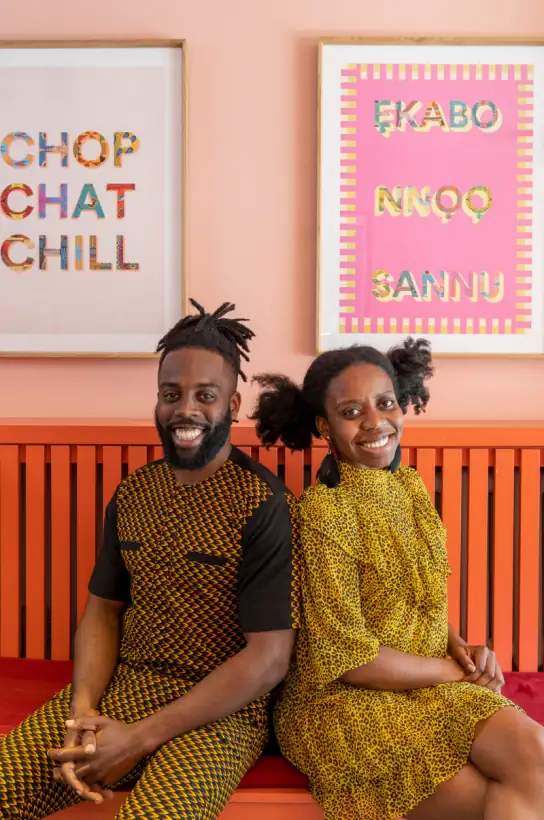
Emeka and Ifeyinwa Frederick are the founders of Tottenham’s Nigerian tapas restaurant Chuku’s.
Can you tell me about the beginnings of Chuku’s? How did the idea come about? Have you always been food lovers?
Emeka: We’ve always loved good food. I think for us it’s always been about loving and appreciating our heritage and our culture. We grew up on the borders of East London and Essex, not in a big Nigerian community, but a Nigerian household. Our mum and grandma would tell us stories about our heritage, culture, and motherland. We grew up with this burning understanding of beauty and richness and love for our heritage, although we didn’t actually grow up in Nigeria. This was a big factor in us wanting to put something out there, that reflected the way that we saw our culture and our heritage, from the beauty, the vibrancy, and the love. We want people to fall in love with Nigerian culture and cuisine in the same way. We remember eating Nigerian food at home and our grandmother’s home. We noticed that there weren’t any restaurants where you could enjoy the food that we grew up eating.
Where did the idea for ‘Nigerian tapas’ come from?
Ifeyinwa: This style of dining came from us wanting to show off different Nigerian food so people didn’t have to just choose just one dish, and could experience lots of new flavours. So, if they did have our egusi and they didn’t like that, they’re not necessarily going to write off Nigerian cuisine, because they may have enjoyed the jollof quinoa or the ojojo, for example. The idea is that you can come and experience a portfolio of Nigerian flavours. Tapas has a whole culture associated with it. It’s the whole sociable atmosphere, people coming with family and friends. This culture and style in many ways resonated with Nigerian culture. Nigerians gather around and love to share food and are very hospitable.
Do you think there’s a lack of knowledge about Nigerian food in the UK?
Emeka: I don’t think Nigerian food has had the opportunity to be enjoyed by many. One of the myths that we like to debunk is that Nigerian food is all about spice. The spices used are often for fragrance, the spice shouldn’t overpower the dish. Certain dishes need to be hot to be authentic, but there are lots of other ones where you can add hot sauce or more scotch bonnet to your taste.
Ifeyinwa: I think the other myth is that Nigerian cuisine is centred around meat. We’ve got a lot of vegetarian, vegan, and ‘free from’ options. We haven’t done this to follow a trend. For example, wheat isn’t a crop that’s really used in Nigeria, and I have been on a gluten-free diet for quite some time and have never missed out on anything Nigerian because we don’t really use it. I think it’s fair to say that a lot of Nigerians do love their meat, but meat usually isn’t the main focus of the dish. There’s a lot of leafy vegetables and pulses in Nigerian cooking. Often meat will be added to the core dish as and when people want to eat it.
What’s a Nigerian dish that everyone needs to try?
Emeka: For me, stews are one of the key pillars in Nigerian cooking and a dish I think everyone needs to try is Egusi. Traditionally it’s eaten with starch which is made into a dumpling. The stew is made from melon seeds native to Nigeria. It’s then ground up into a more-ish nutty stew, which is orange. You break off bits of dumpling and dip it in. The opportunity to use your hands as well enhances the dish. In the restaurant, we have our own version that we call an egusi bowl.
Ifeyinwa: Mine is a bit tricky because it’s Suya, but the one they serve on the roadside in Nigeria! It’s classic Nigerian street food. Suya isn’t just the name of the dish, it’s the name of the spices that marinate the meat too. It’s a blend of peanuts, cloves, garlic, chillies, and more native herbs too. You receive the dish open in foil with more suya seasoning sprinkled on top of it with chopped red onions and tomatoes. It conjures up memories and nostalgia of going to Nigeria on holidays as a kid. That is a dish to talk about. You eat it with your hands or with a cocktail stick.
How is it working together as a brother and sister duo? Would you recommend others go into business with their siblings?
Ifeyinwa: I would recommend people go into business with someone that they can really trust and who shares the same values and work ethic as them. I’m fortunate enough that that person is Emeka, who happens to also be my brother. Emeka is someone who I can trust wholeheartedly. We know each other very well. We also have mutual respect as Emeka and I have slightly different remits within the business. So ultimately Emeka gets the final say on the food menu and I have more of a say at the front of house and marketing. Irrespective of that, we both want Chuku’s to be a success so are both passionate about making this happen. Something really important with all the recent obstacles and the pandemic is having a business partner that is fun and someone you can confide in. Working with Emeka is a lot of fun, we crack jokes constantly. And I think when you’re working as hard as we do, you need to find ways to inject fun into it but also have someone to talk to and confide in at any time.
Emeka: I’m not sure if I would recommend running a business with your sibling. If you’re asking yourself whether it will work, it probably won’t. It was a very natural move for us. The idea was something we’d been talking about for a while. I think if people have an idea and then try and crowbar a co-founder into it, whether it be their best friend or a member of their family, I think it’s always going to be a struggle. I think if the partnership feels like it’s one of love, one of trust, and one of respect, then that’s a great place to be.
What advice would you have for someone who was thinking about opening their own restaurant? Are there any attributes that you think people need to have to be successful in running a restaurant?
Ifeyinwa: Firstly, don’t open before a global pandemic! It feels weird to give advice because Emeka and I still haven’t reached all the goals we’ve set. I think you need tenacity, and a lot of it. I also don’t think it’s by chance that both Emeka and I are really into fitness. Because I think when you train your body physically and regularly, it develops a mental fortitude. I think you need to be someone who likes people. Emeka and I had to go and learn about gross profit margin and about the operations of running a restaurant, but we didn’t need to learn about being hospitable as this comes really naturally to us. I think that really great restaurants don’t just serve good food and have an instagrammable design, but they provide a heart-warming experience with a team that makes their guests smile and laugh.
Emeka: I agree with all of Ifeyinwa’s points. Patience and persistence are two attributes I think are important. Also staying humble, as there’s a lot of dirty work you have to do too, taking out bins, unclogging drains and so on. It’s also finding a way to enjoy these more unglamorous parts of the work because the reality is that this takes up a big chunk of your days and nights when guests have left, for example. I get a buzz from the small things like straightening menus and dusting window sills before the guests arrive. You need to be able to enjoy both backstage and the main show.
Are you optimistic about the future of hospitality?
Ifeyinwa: I think we have to be optimistic. I think what we’ve experienced over the last few months for hospitality has been nothing short of devastating. When you think that big corporations like McDonald’s and Nandos are running out of supplies, you can only imagine the effect there is on the small independents. And when you’re seeing big restaurants in Soho closing lunch service as they don’t have enough team members. It’s affecting everyone. I think we have to be optimistic because if we don’t, we admit to the collapse of the hospitality industry. I don’t think it’s necessarily going to be easy the next few months and the start of next year. We’re all in survival mode at the moment, navigating the ever-changing conditions. I am optimistic that the industry can return to being fully functioning at some point.
Emeka: On an optimistic note, I think these uncertain times for hospitality have shown how adaptable the industry is, not just from the pandemic, but challenges it’s faced over centuries and centuries. I think one concern I have is our relationship with Europe and the increasing prices of energy and raw materials. I think all stakeholders in hospitality, including diners, can do their bit to help the industry, from their attitudes to no-shows and service charge.
Do you both have favourite places to eat in London?
Emeka: There are two restaurants I can think of, and I’ve worked at both! Morito Tapas restaurant in Hackney and Honest Burgers. I’ve always loved Morito and the Mediterranean food with a North African spin that they serve there. I also love the Honest Burgers story, when I worked there they were five years old, and now they’ve hit the 10-year mark.
Ifeyinwa: I’ve only been there once so it might be premature to call it my favourite, but I think it’s going to be. It’s called Capricho, near me in Essex, and for me, it’s everything a restaurant should be. The food and drink were fantastic, and there was great décor and music. The service made the difference, though, with a really warm reception from the team. I’d had a difficult week and it lifted my mood.