How to make homemade pasta with or without a machine?
Making homemade pasta is simpler than it seems! With or without eggs, using a pasta machine or a rolling pin, discover the steps, tips and recipes to easily make your own fresh pasta.
Good pasta is homemade! Why not impress your family or guests with a homemade pasta recipe? Tagliatelle, ravioli, gnocchi... anything goes! To ensure success, we're sharing all the tips and recipes you need to have on hand. How do you make pasta with or without eggs? And without a pasta machine? We'll reveal our quick and delicious Italian fresh pasta recipes! You'll see, it's also totally cost-effective!
What type of flour should I use to make pasta?
Flour is the most important ingredient for making fresh pasta. It directly impacts the texture. Here's a brief overview of the different types of flour:
- Durum wheat flour: it is traditionally used by professionals for dried pasta because it keeps better. However, it remains difficult to find in stores.
- Durum wheat semolina: With a texture similar to durum wheat flour, it is available in all supermarkets and allows for a consistent and firm dough.
- White flour, also known as "soft" flour, is the kind you usually have in your cupboard. Easy to find and use, it's also suitable for making pasta. However, it's best to choose type T55, which produces a softer, more fluid dough.
- Rice, buckwheat or chickpea flour: these are used for gluten-free pasta.
Antonio di Vita, chef of the Parma Rotta restaurant in Parma, recommends using "type 0" and "type 00" flour. Regarding the proportions: "For my recipe, it's one kilo of flour for 10 eggs," explains the Italian chef. Traditionally, it's considered that you should double the amount of flour to the weight of the eggs. So, for 100g of flour, you should use 50g of eggs, the equivalent of one egg. For pasta dishes with sauce, it's advisable to divide the flour in half: half white flour and half durum wheat semolina.
Using a pasta machine—that traditional pasta maker—is much less tiring. To get a "sheet," that is, dough that has passed through the rollers of the pasta machine, requires perseverance. To obtain a flat but fairly thick sheet of dough, we advise you to pass the same dough through the pasta machine several times. It's a bit tedious, but the result will be worth it! Be careful not to make any holes in the dough!
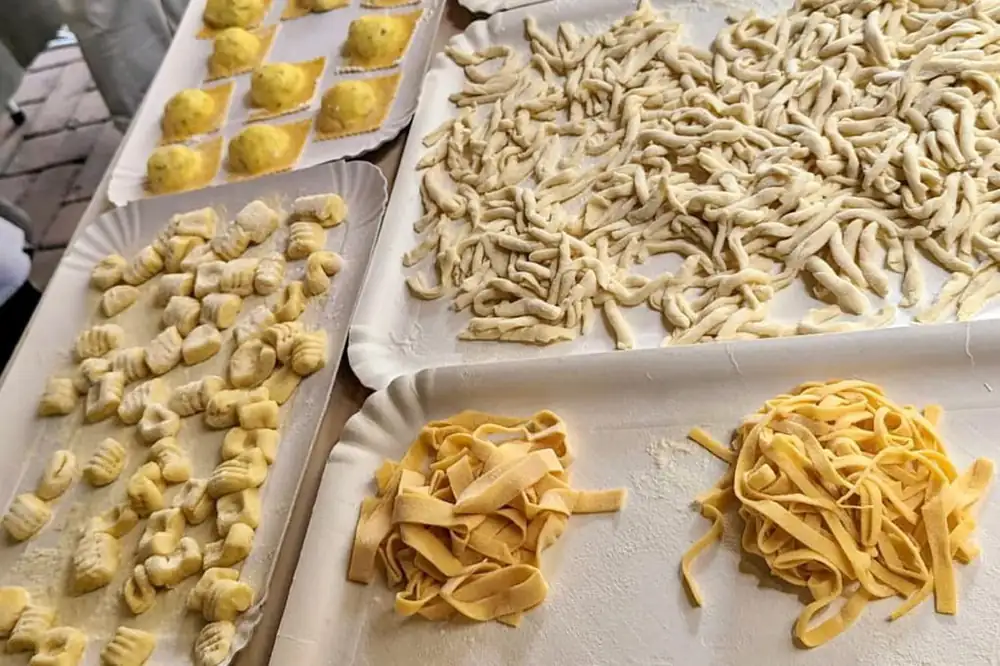
Italian chef Antonio di Vita has some truly convincing techniques for making delicious pasta without a machine and without any fuss. Forget tagliatelle, spaghetti, or ravioli, which will always be better made with a machine; the chef has other ideas that go beyond gnocchi.
- Gratified pasta: nothing could be simpler for this recipe. The chef takes the homemade ball of pasta dough and grates it against a cheese grater. The result? Small pasta "perfect for adding to broth".
- Strozzapreti pasta: again, nothing too complicated. First, you'll need to roll out the dough as thinly as possible using a rolling pin. Then, cut strips about 3 centimeters wide. Hold the top of a strip at your knuckles and roll your hands together once. The dough will then cut and twist.
Remember to keep your fresh pasta on a tray or work surface covered with a thin layer of flour.
To make colorful (and fragrant!) pasta, use natural food colorings. If you're adding moist ingredients like spinach, beets, or tomatoes, add them to the dough, but remember to add more flour to ensure a smooth dough with the right texture. "Always add the flour to the center of the dough because that's the moistest part," explains the chef of the Parma Rotta restaurant.
How should I cook homemade pasta?
Cooking time will depend on the thickness of your pasta. The thinner it is, the faster it will cook. Generally, you need 1 liter of water for every 100g of pasta, and a cooking time of 2 to 3 minutes for thin pasta. Salted pasta is always better, but don't oversalt it. Chef Antonio di Vita explains, "We add a pinch of coarse salt when the water boils, and that's it!" Between making the pasta and cooking it, "we always wait about 30 minutes for the gluten to develop; you shouldn't cook it immediately."
If covered with cling film, pasta can be kept in the refrigerator for up to 5 days. Without the film, don't keep it for more than a day. If you want to keep it longer, freeze it for up to a month. But remember, when making fresh pasta, it's always best to enjoy it as soon as possible. Buon appetito!