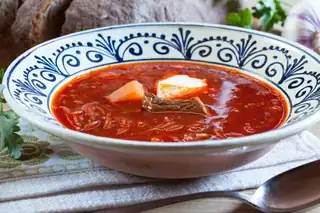
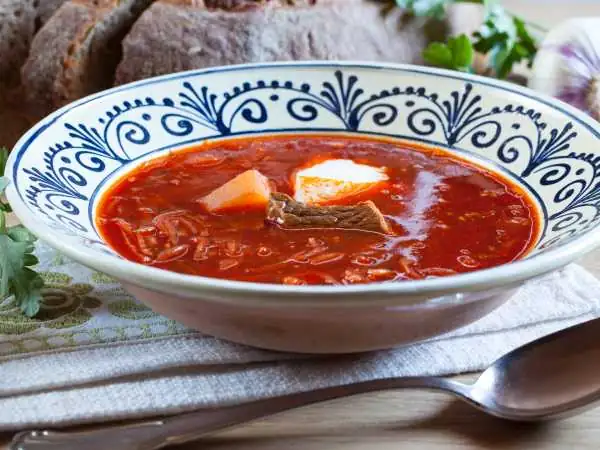
Classic borscht with meat
Let's prepare the ingredients for a classic borscht with meat. My borscht recipe calls for 500 grams of beef brisket (although you could use a thick or thin brisket, or a sirloin). By the way, if you're using both beef and pork, the pork should make up no more than half of the total amount of meat.
Cook the meat broth from unseasoned beef brisket using any method you prefer (clarity is not important later) for 2-2.5 hours.
An hour before the end of cooking time, we begin to prepare the vegetables for the borscht.
Cut the potatoes into cubes.
Cut the cabbage into thin strips (well, as you can see, I shred it).
Peel the carrots and parsley root and cut them into strips (it’s very convenient to do this on a Burner grater for Korean carrots!).
In the same way, cut the beets into strips, moistening the beets with one tablespoon of vinegar and stirring.
In a frying pan, simmer the beets with 1 tbsp of sugar and 100 ml of tomato paste in lard (1 tbsp) that has been previously melted until soft.
Meanwhile, we continue cutting vegetables.
The onion is also diced—but very finely. I think you could easily chop it on a Burner, for example; it's faster, but Pokhlebkin said diced, so it means CUBES!
William Vasilyevich insists on grinding pork fat (with a pestle) with garlic and parsley. I don't know, maybe my lard is different, but it stubbornly refused to be ground with a pestle and garlic, so I decided to chop all these ingredients with a cutting screw first (to avoid chopping the parsley with a knife).
Of course, you can then crush it with a pestle: after all, isn’t that what’s needed in the classic recipe?
I'm not sure what happened faster for you: the beets simmered until tender, or the meat simmered for 2-2.5 hours. Either way, after the broth has finished cooking, remove the meat, increase the heat, and add the potatoes, followed by the cabbage after 10 minutes.
Once the beets are cooked through, remove them from the pan and fry the carrots, onions, and parsley root in butter until golden brown (or until it's time to add them to the broth). This is 15 minutes after the potatoes start cooking and 5 minutes after the cabbage starts cooking. Add all the fried vegetables to the borscht together: the carrots, parsley root, and onions along with the beets.
Now you need to quickly cut the meat into portions, allowing it to cool enough to be easily cut. The pieces should fit in a tablespoon. Add the meat, bay leaf, and peppercorns to the borscht 20 minutes after the potatoes start boiling (or 5 minutes after adding the sautéed vegetables).
Lastly, 7 minutes after adding the meat (and 3 minutes before the end of cooking), add the ground lard, garlic, and parsley. I assume it's also salted here (I somehow didn't find this point in Pokhlebkin's recipe, and there was no salt listed, but I absolutely can't imagine unsalted borscht!).
After cooking, the borscht is left to rest for another 20 minutes under the lid before serving. It's usually served with sour cream. Honestly, when I ate my first bowl, I completely lost track of why I bothered with this incomprehensible process of grinding lard with garlic and parsley. I didn't notice any difference compared to my mother's and grandmother's borscht (in our family, we added freshly crushed garlic, as much as we wanted). Well, the meaning of this step dawned on me the next day: a classic aged borscht with meat is significantly richer in flavor than one without the garlic seasoning. Crushed garlic added during cooking doesn't impart the same spiciness as fresh garlic, but it does transform the overall flavor of the dish into something more intense and rich.