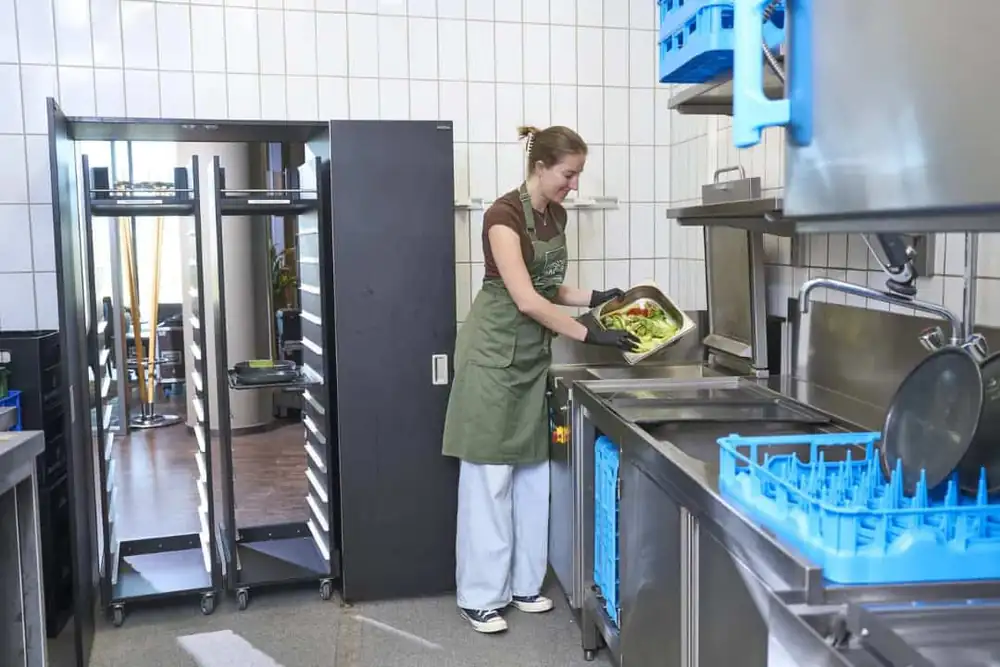
Fewer trips, more efficiency: This is how food waste management relieves the burden on the dishwashing area
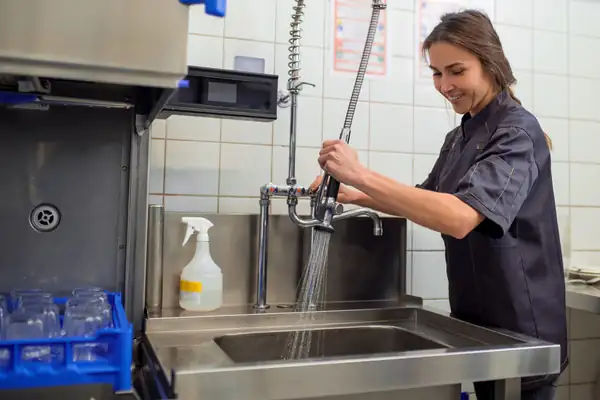
When the dishwashing area becomes congested, the entire operation quickly feels the effects. Large quantities of dishes, containers, and trays of food are crammed into a limited space, while at the same time peelings, leftover plates, and wet waste must be reliably disposed of.
For kitchen managers, this means a daily balancing act: How can the dishwashing area remain reliable and efficient when space and staff are limited, but processes must function every minute?
Leftovers are more than just waste
Food waste often becomes an invisible variable in this equation. In many businesses, it is still considered a necessary byproduct. In reality, however, its disposal significantly impacts how efficiently a dishwashing area functions.
Moving containers multiple times, blocking pathways with collection bins, or transferring food scraps waste costs personnel resources and valuable space. At the same time, hygiene and organizational requirements increase. Follow-up costs also play a role – for example, the need for refrigerated storage for waste containers.
Food scraps are therefore not just waste, but a defining factor in the dishwashing process. Integrating their disposal into the planning from the outset can simplify procedures and avoid makeshift solutions later on.
Even though structural conditions cannot be changed at will, processes can be specifically improved. The crucial factor is not so much the individual appliance, but rather the interplay between dishwashing technology, workflows, and food waste logistics.
When dishwashing technology and food waste management come together
This is precisely where MEIKO comes in. As a system provider, dishwashing technology and food waste management are not viewed separately, but as coordinated solutions.
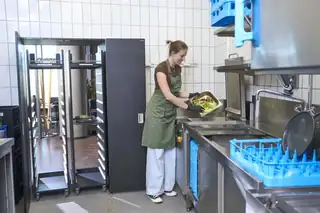
Food scraps are captured directly at the source. Input stations like the MEIKO BioMaster® Flex can be seamlessly integrated into dishwashing lines. This means that handling food scraps is not an additional step, but an integral part of the entire process – from clearing tables and pre-sorting to final cleaning.
Practice shows what a difference this can make in daily operations.
“For the team, this makes a noticeable difference in everyday life. No heavy containers, no more walking through the kitchen with organic waste bins, less smell, more hygiene,” explains Nicole Schimurek, F&B Manager at Genuss & Harmonie in the EDEKA Herzplatz Offenburg.
Besides ergonomics and hygiene, cost-effectiveness also plays a key role. Andreas Geiß, Head of Sales for Special Forms at EDEKA Südwest, sees the greatest leverage in two areas: "The greatest leverage lies in personnel deployment and disposal costs."
Another advantage lies in the use of space. If dishwashing technology and food waste management are intelligently coordinated, high throughput can be achieved even in limited spaces. For example, up to 100 place settings per hour can be handled in approximately eight square meters – including all the necessary components in the dishwashing area.
It's not just about the maximum performance of a single machine. What's crucial is an overall concept that makes efficient use of available space, reduces unnecessary travel, and supports the team in daily operations.
When many parts become a whole
Today, efficient dishwashing areas are not created solely through high-performance technology. The crucial factor is how planning, technology, and service are integrated.
MEIKO's 360° approach therefore combines sound planning with technology and coordinated chemistry, reliable service and digital solutions such as MEIKO Assist Pro. This offering is complemented by practical knowledge transfer in the MEIKO Academy.
In this way, many individual components become a cohesive overall concept.
Because an efficient dishwashing area is not created from individual devices, but where processes are considered together from the outset – for more stable processes, less strain on employees and an operation that functions reliably even under high pressure.