
Shared memories, contemporary versions of childhood flavors, community building – we talked to Bence Karácsony and Gergely Báthory about Csopaki Resti
In the recent period, several places on Lake Balaton have said goodbye for various personal, economic and other reasons. How are you experiencing these months, how are the days passing, and who makes up the winter audience?
Bence Karácsony: Lake Balaton shows a different face in every season. The more places that can stay open and the more programs there are - such as Taste Balaton - the more options guests will have, and they will feel that it is worth traveling here even in the colder months. The first step must be taken by the caterers, because if everyone closes for the season, then guests will not go to Lake Balaton. Of course, this is a very complex situation, and many circumstances influence who can accept the year-round opening hours. Many regular guests come during this period. More and more people say that they can no longer stand the hustle and bustle of Lake Balaton in the summer and prefer to enjoy the winter season, the peace and the walks. In such times, it is also very good to escape the chaos of the capital and arrive in this silence.
Gergely Báthory: Csopaki Resti is exceptional in that the staff consists of one person, so the economic operation is also sustainable. We are missing these small places that employ a few people and can survive that way. Many people still think that a restaurant with a hundred people will be profitable, but it is precisely these restaurants with a few people that will make Lake Balaton special. Bence's concept also helps business survival.
You run the restaurant as a single person - could you tell us about the benefits of this type of work and the human and professional challenges?
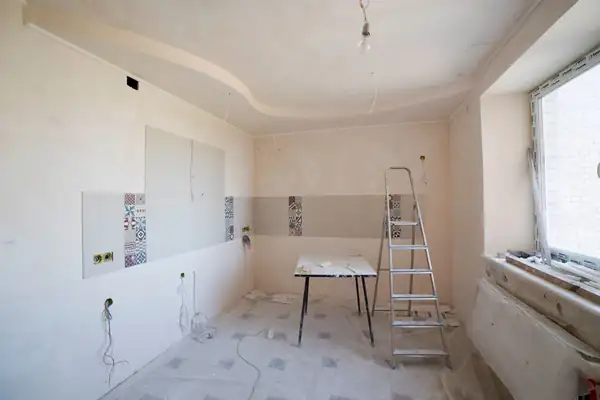
Bence Karácsony: The charm and magic of Csopaki Resti is that it has a capacity of ten people, operates in a very small space, and so I can very easily get in touch with the guests. The work is completely different this way, I can sense every little movement, I can pay attention to who needs to refill their water, who feels comfortable, who less so – and how I can help them with these. The guests see me preparing the dishes, many of them are also more interested in the processes, which there is an opportunity to delve into more. I like being in the restaurant, and of course, it would certainly add a lot if there was always someone at the beginning of the day with whom you could shake hands and discuss a few things to do. Actually, this is missing. But once the guests arrive, at lunch or dinner time, the problem disappears. The service desks are very busy, different people come every day, which makes the work not monotonous. By the way, I'm currently planning a major renovation and expansion, partly aimed at having other people around me, so I could spend the hours before guests arrive in company.
Gergely Báthory: After three years, we are also trying to pay more attention to the issue of isolation. In the long term, we would like to have a staff of three, a chef and a sommelier alongside Bence. This requires renovation and expansion to create more space. With all the positives of a restaurant-like hospitality – and I don’t just mean the business positives – it has become a very popular genre among guests in recent times. We definitely want to maintain the intimate atmosphere, and our main plan with the renovations is to help with the preparation phases, to have more space for cooking, and to expand the counter where guests sit.
What is the reason for the popularity of this genre?
Bence Karácsony: Although Csopaki Resti is not essentially an apartment restaurant, there are a lot of similarities in size and intimacy. In such a small space, it quickly becomes clear what kind of personality each guest has, whether they are more reserved or more talkative, or what kind of mood they are in. There are people who quickly open up and start talking to each other, and there are those who need a little more time or would rather be alone. I try to help with these too. For example, there is a course when we all get up and go out to the Resti together. We drink mint tea, watch the trains, and I grill the meat outside for the next course. Here everyone is more relaxed, and when we step back into the restaurant, the atmosphere is different. Since different people form a community during each service, there is something unique and unrepeatable in each occasion.
How much has the restaurant concept changed and refined since the beginning?
Bence Karácsony: Laurel's chef, Dávid Szabó, and its pastry chef, Zsuzsi Ötvös, were previously involved in creating the menu. Zsuzsi Ötvös continues to help create the dessert, and the current milk porridge and waffle recipe is also hers. The previous dishes had a slight Asian touch, but since we have been planning the menu at Resti with András Szkladányi, it has been dominated by ingredients from traditional Hungarian cuisine – tarhonya, sausage, pork cheese, milk porridge.
Could you tell us about the current menu at Csopaki Resti?
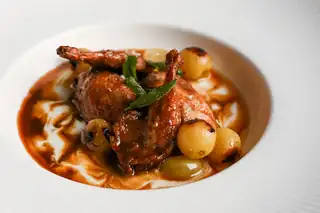
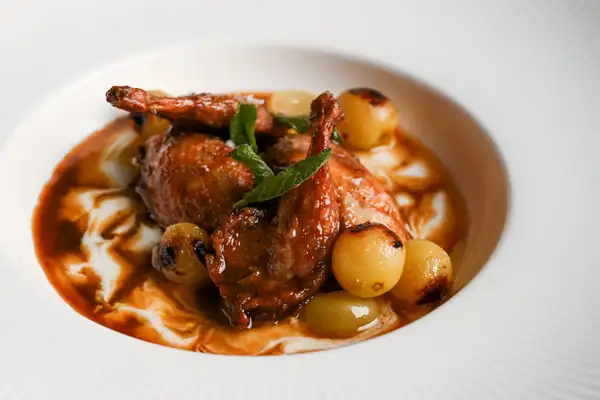
Bence Karácsony: The first course consists of three bites: blood sausage prepared in two ways (one in special winter flavors), and pork cheese, which we offer with remoulade and pie. The next course is a vegan dish, the preparation of which is always more challenging than, for example, creating a meat dish. There is a kind of clarity in meat, if you prepare it well, you won't touch anything else. In the case of vegetables, we play with flavors and textures differently to show a new and more exciting side of each ingredient.
Then comes a fish dish, a cold trout that matures in a bed of salt and sugar. It is accompanied by raw vegetables, marinated carrots, and oranges. This is a light, refreshing dish. Then comes the duck soup. The master soup technology, which is known in Asian gastronomy, is not very typical of Hungarian cuisine. The Resti master soup is becoming more intense and deeper, which I also really like to tell my guests about, there are returning visitors who have been raising their soup at home for months. Then comes the aforementioned tea and the pork cheek, which I braise and then grill outside. The closing is the previously mentioned dessert from Zsuzsi Ötvös: waffles and semolina with pear compote. Milk semolina is a very childhood dish, and everyone ate it differently, thinly, thickly, lumpily, and I have even heard that it was cut into slices and breaded. I also enjoy working with foods that are often associated with childhood memories and traumas, and I get to show them in a new way. Everything can be delicious if prepared well. This is an important message for me.
Which foods have you encountered the most preconceptions about?
Bence Karácsony: This is a very good conversation starter, I always ask guests if there is a childhood food that makes them feel safe. Egg soup is clearly the winner, and for many people, tarhonya has also caused trauma. The grains of machine-made tarhonya are so small that I actually choked on them several times as a child. I was a very picky child and I still haven't outgrown everything. Basically, I never liked meat, but I have a different feeling about offal, such as liver. Maybe it's the texture, but for some reason I don't feel like I'm eating meat.
For such a small, intimate restaurant, guest reviews are perhaps even more important. Recently, Csopaki Resti was ranked first on the Dinner Booking website, which relies solely on guest reviews. What are your experiences with guest feedback in the past?
Gergely Báthory: In addition to professional reviews, it is very important for us that our guests are satisfied. The Dinner Booking list means a lot to us, as only people who have actually visited the restaurant can rate it. We received a lot of congratulations, and these also help us mentally. The guest rates everything at this time: the food, the atmosphere, the service, the price-value ratio. The feedback that the guests like the cozy atmosphere of Csopaki Resti, which is primarily due to Bence, was important to us.
Bence Karácsony: Anyone who has met me knows that I am basically a more reserved, slightly introverted person. But these are also things that can be learned, and I knew that I had to pay attention to this during the services. When the guests arrive, I also transform, which is especially good for my personality development. I like talking to them and paying attention to their needs. I am very maximalist in my work, I can spend nights on every little mistake. I always want to perform above average.
I think that because of the proximity to the guests, I have a much easier job than those chefs who work in a restaurant with thirty people or even larger. I can connect in a different way, I have the time and space to develop more habits. For example, after the service, I take a picture with everyone, the guest also gets a copy, and the other one goes on the restaurant wall. So much is happening these days, and in addition to the food, this can also be a small shared memory.
Taste Balaton will start soon, filling Lake Balaton with guests in early spring. What programs are you preparing?
Gergely Báthory: We are planning several events, one with Zsuzsi Ötvös, which will be a five-course dinner, each course of which, both savory and sweet, will be prepared using pastry techniques. András Szkladányi will host an offal-focused dinner, which will also give a little insight into the book he is currently working on. Also, Attila Jásdi will return to Resti for a four-hand wine dinner, where Jásdi wines will complement the dishes.
The 'big brother' of Csopaki Resti, Laurel, closed last year. How do you see how much more complex the challenge is to remain in the capital? Gergely Báthory: Laurel has been through a lot over the years and we saw that we could not continue the concept in the form in which it operated then. There are economic and other factors that lead to these decisions, one has to learn to consider how far one can stretch the string, how long something can be sustainable from all aspects. The Laurel venue is currently hosting private events. In general, this sector is not having an easy time, and it is clear that everyone is struggling with very similar problems. We love hospitality and everything that comes with it, and now we are focusing all our energy on Csopaki Resti. We want to focus on the things that inspire and motivate us. This is the only way to develop.