Oli's Italian restaurant in Bratislava evokes the atmosphere of the Mediterranean streets
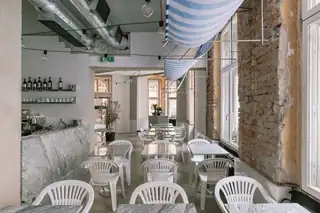
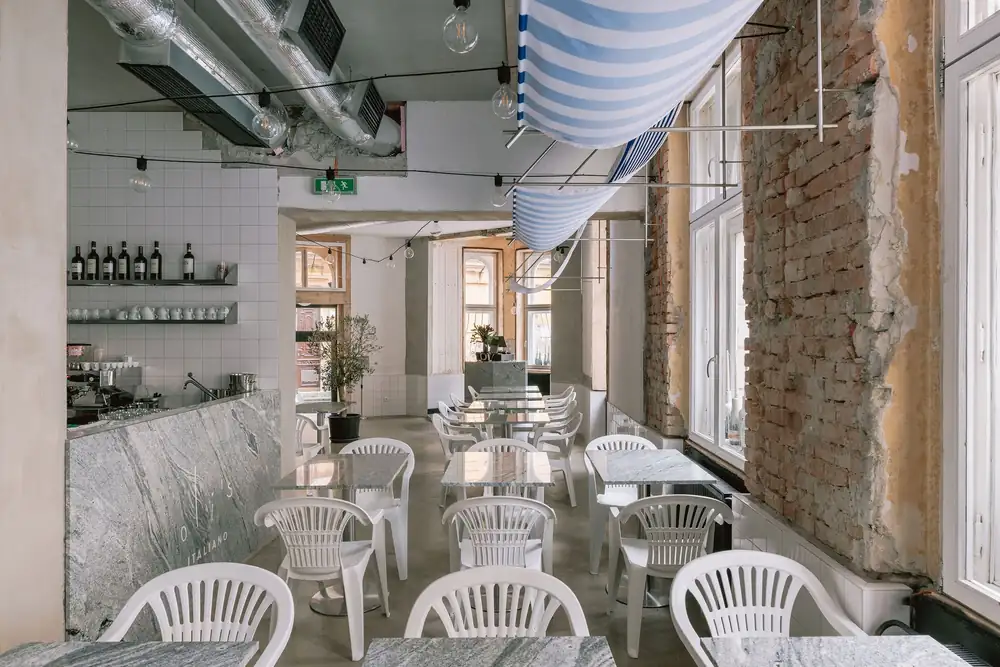
Oli's Italiano, in Bratislava, seeks to resemble a Mediterranean urban terrace, with exposed brick, blue and white striped awnings and plastic chairs.
The starting point wasn't a specific type of restaurant, but rather the everyday urban scene, where streets, cafes, balconies, and doorways connect almost imperceptibly. The goal was a space more like an urban terrace than a traditional restaurant, as if a piece of the street had been incorporated into the building.
To achieve this, the previous interior was almost completely dismantled. Layers accumulated from previous use were removed, revealing the brick walls, exposed plaster, and original proportions of the building. No decorative finishes were added: the structures were left as they were, as traces of the building's past.
The urban ambiance is created primarily by the blue and white striped awnings over the windows. These canopies, typical of Mediterranean terraces, are held up by slender stainless steel rods and appear to float in front of the openings. The light shifts throughout the day, casting striped shadows on the walls and tables. At dusk, the strings of lights hanging from the ceiling, reminiscent of winter gardens, enhance the effect.
The furniture selection is also inspired by the Italian street. The white Monobloc chair is one of the most recognizable pieces: lightweight, affordable, and stackable, it's a staple of outdoor bars, cafes, and terraces. Oli's Italiano doesn't pretend to be anything more than it is; therein lies its authenticity.
This simplicity contrasts with the marble, a fine-grained polished stone that adorns the tables and bar, lending a more sophisticated character. The combination of marble and plastic chairs encapsulates the tension of the interior: everyday materials alongside others that are meticulously crafted.
The pizza oven is the most striking culinary feature. It's a Neapolitan-style wood-fired oven covered in a cobalt blue mosaic, which stands out among the brick, concrete, and stone surfaces and functions both as a kitchen appliance and as a distinctive element of the establishment.
The blue and white stripes reappear on the pizza boxes and the cans of San Marzano tomatoes stacked around the bar. This packaging becomes an almost graphic composition, and the cans themselves become part of the interior. The restaurant thus dispenses with typical elements of Italian hospitality.
Oli's Italiano is Italian precisely because it doesn't try to boast about what it means to be Italian. There's no ostentatious atmosphere of a traditional Italian restaurant, nor an explicit Mediterranean theme: there are awnings, white plastic chairs, marble tables, garlands, pizza boxes, and tomato cans. Together, they evoke an everyday street where the boundary between the restaurant and the city almost disappears.