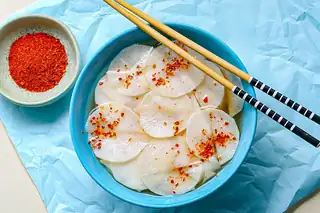
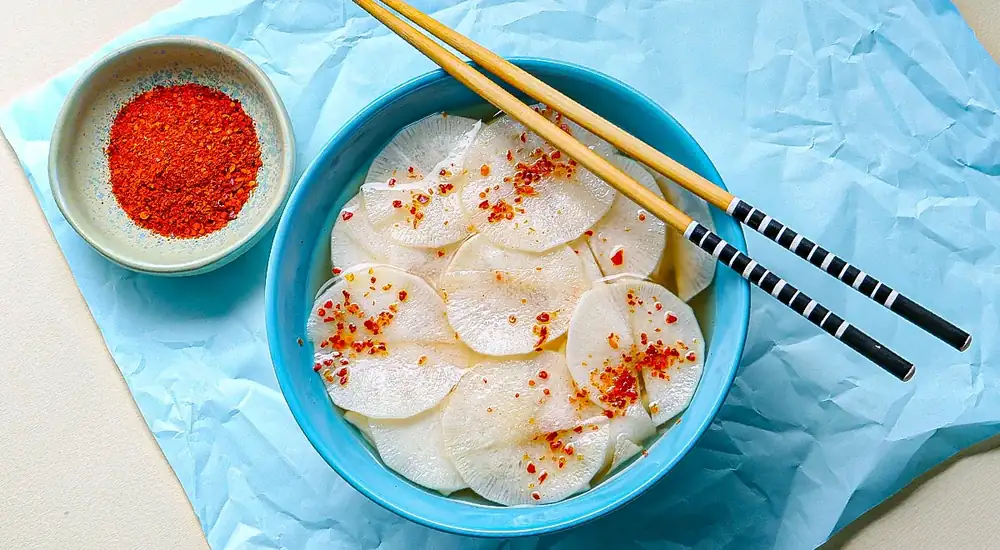
Korean-Style Pickled Daikon
- Daikon
- Garlic
- Table vinegar 9%
- Water
- Granulated sugar
- chili flakes
- Salt
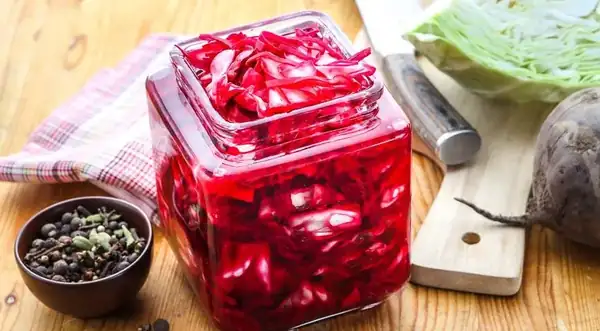
- Prepare the ingredients for Korean-style pickled daikon. Peel the daikon and cut into 1-1.5 cm cubes, then place in a jar.
- Prepare the marinade. Pour vinegar and water into a small saucepan, add sugar and salt. Bring the mixture to a boil and simmer until the sugar dissolves. Cool the marinade to room temperature, add the chili pepper, and stir.
- Place peeled garlic in a jar with the daikon, pour in the prepared marinade, close the lid and put in the refrigerator for 8 hours.
Korean-style pickled daikon is a simple yet very spicy appetizer. Daikon is in season almost until spring, storing well and retaining virtually no flavor. This white root vegetable is related to radish, but unlike radish, it lacks mustard oils and thus has a milder flavor. Therefore, daikon is often pickled in vibrant spices to retain its freshness and crunch while also enhancing its flavor. This Korean-style pickled daikon recipe is just one way to prepare this vegetable. Korean cuisine offers many variations, and it can be used as inspiration.
Korean-style daikon is a surefire, mouth-watering appetizer to accompany meat. It's irresistible and always disappears from the table. Carrots are often added to daikon radish salads—they add a natural sweetness to the spicy, salty, and sour dish. Our recipe is perfect for those who love this combination. Adjust the spiciness to your taste; there's no need to overdo it with chili peppers for the sake of convention. Keep in mind that proper Korean salads call for vinegar essence, not table vinegar: a minimum of liquid and high acidity. So be careful not to overdo it.
Tuna gimbap is one of the most popular Korean rolls. Incidentally, you might see it spelled "kimbap" online. This is due to the peculiarities of Korean phonology, and the correct spelling hasn't yet been recorded in Russian dictionaries. What does it even mean? "Kim" is the same as "nori" in Japanese, and "bap" is rice. It's that simple. The end result is a roll with rice and various fillings. How does it differ from Japanese sushi rolls? Firstly, gimbap is thicker, with a larger and more varied filling. The filling for gimbap can include six or seven ingredients, while Japanese rolls typically have three or four at most. Another important difference is that gimbap doesn't contain raw fish. But canned tuna or crab sticks are available in abundance. The third difference is that gimbap doesn't need to be eaten with ceremony—for example, with chopsticks or by dipping it in soy sauce. There's no need to dip the slices of Korean rolls. Otherwise, you won't taste anything other than the soy sauce—the filling will actively absorb it. We'll teach you how to make traditional Korean tuna gimbap, which includes the obligatory omelet and pickled daikon, as well as optional carrots, cabbage, and spinach—lightly fried or blanched. We recommend using red cabbage for a striking coloring, but regular cabbage will do just fine.
A close relative of the radish, daikon is a delicious and very healthy vegetable. Its pleasant fresh flavor and slightly piquant note make it a wonderful ingredient for salads, appetizers, and hot first and second courses. Daikon season begins in late October—the perfect time to incorporate this wonderful vegetable into your diet. We'll show you how to cook daikon deliciously and easily.
In the hot and humid climate of Asia, harmful bacteria proliferate rapidly, which is why vinegar is so popular there. In many Asian countries, vegetables are not eaten raw at all—only fried, steamed, or, like these, pickled. You can serve them as an appetizer with other vegetable dishes or as a side dish with rice or noodles.