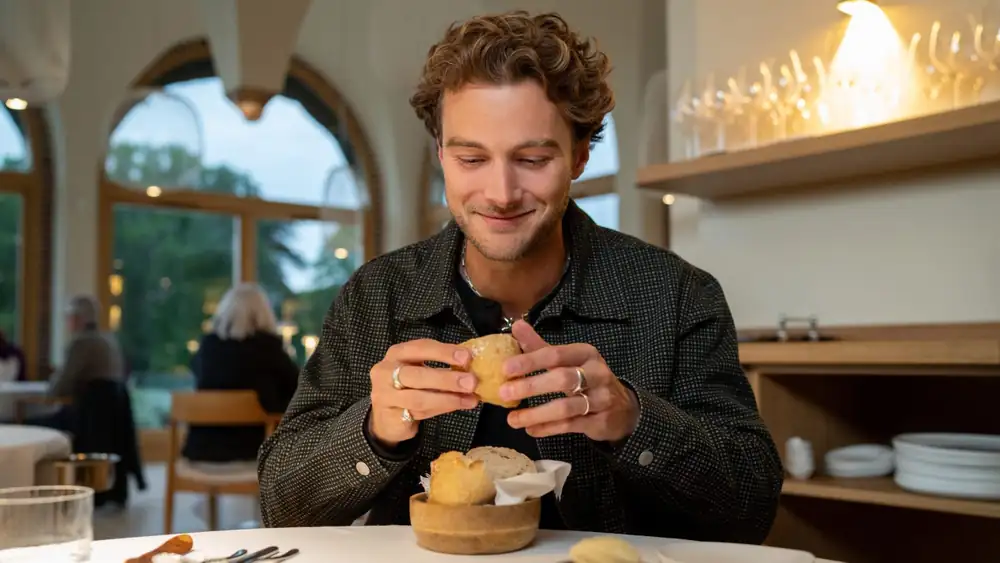
Jesse Burgess, who hosts Gordon Ramsay's Michelin-star series, says “enough with the stereotypes.”
If you've never been to the Oscars (and this writer, obviously, has never been), it's hard to imagine what it's like. What emotions the nominees must feel as they share the screen with their fellow nominees, before just one of them receives the statuette.
Well, this is exactly how I imagine Oscar Night for those chasing the most coveted award in cinema, but I don't really know what it's like. However, I do know, even if only a little, what it's like to wait for the most coveted award in another industry, the restaurant industry, and I know this because I've attended several Michelin star award ceremonies, and I perfectly and clearly felt—along with everyone else who was there with me—that whirlwind of emotions swirling in the air.
And there's no doubt that Gordon Ramsay had a stroke of genius in realizing that there, in all that turmoil of thoughts, sensations, and emotions, was good material for a story. From there, "Knife Edge – For a Michelin Star" was born, the series that closely follows the world's chefs in their pursuit of a star, in their sacrifices for that goal so coveted it seems the only thing in the world, more important than family, children, or any aspiration to personal happiness. Knife Edge shows all this, and above all, it shows the moment when, in that whirlwind of emotions mentioned above, the star arrives, or doesn't. And anyone who has stood before a stage like that understands how much there is behind that announcement, and how pivotal a moment it is. Like it or not, whether it's right or worrying, whether it's sensible or completely crazy, nothing in gastronomy has this power, and that's precisely what "Knife Edge – For a Michelin Star" is based on.
The series, in its second season (debuting September 25th on Apple TV), follows sixteen restaurants, but above all, sixteen chefs who risk everything, especially their personal serenity, to put their cuisine on the Michelin map. Leading the story is Jesse Burgess, a food and travel creator who rose to fame by co-founding TOPJAW, one of the world's most influential digital platforms dedicated to food and travel. This is his first major TV hosting gig with "Knife Edge." We interviewed him to understand his approach, as a young gastronomy connoisseur, to the world of Michelin-starred fine dining.
What did the program teach you about the Michelin world? Did you learn anything you hadn't realized before doing "Knife Edge"? "I'd say the most surprising thing was better understanding the entire process that leads inspectors to award or deny a star. It's never just one inspector who makes that decision: if a restaurant convinces one person, then another will be sent to do a re-verification, and so on. Then they'll meet before the ceremony and agree, again anonymously, that the restaurant deserves the star. Or it doesn't. And if just one person says no, then no star: that's crazy, isn't it? It means it's never just one person, or just one evening, and that's why it's absolutely true that every single service, for a restaurant, can make a difference."
What do you think are the things that people outside the industry haven't really understood about that world? "I think there are a lot of myths circulating among people. For example: if you drop a fork and no one picks it up within thirty seconds, will that cost you a star? And what about the way they welcome you? Well, that's not the case: what perhaps isn't yet truly clear is that the inspectors judge what's on the plate in front of them. Sure, service is important, but only to the extent that it influences the dish. And that's why they can award stars to a noodle shop in Singapore, a taqueria in Mexico City, or an omelet stand in Thailand. Michelin doesn't follow the stereotypes we imagine."
Are these prejudices what contribute to the distance between people and the world of fine dining? “Yes. I think there's a widespread misperception that all Michelin restaurants are inaccessible and very expensive, when in reality they cover a broad spectrum. Just think of the Bib Gourmand category, which is one of my favorites: restaurants that serve exceptional cuisine but are inexpensive.”
Let's talk about chefs: how much has it struck you that they're often willing to sacrifice everything, including family and peace of mind, to get that Michelin star? "Actually, I think it's like that in any industry, in any career you choose. I'm thinking of athletes, for example, or musicians, or dancers. But it happens in offices too, if you want to reach the highest levels, right? If you want to become the best at what you do, and in this case, be a Michelin-starred chef, you have to commit, sacrifice, put all your time and energy into your goal."
And do you think all this is healthy? “I think, as I was saying, it's a common thing in many work environments. I think many of these chefs don't want to do anything else in life. I think for them, the kitchen is home, that's all. You often hear of chefs who've tried doing something else in life, but when they feel the rhythm of the kitchen again, the noise, the team spirit, the almost militant sense of service, it sparks something in them that is unlike anything else.”