Kai doesn't pretend to be Thailand, and there's really no need to
Not by the book, but spot on.
The new Kai in Zichron Yaakov doesn't pretend to be authentic Thailand, and that's where its strength lies: with a soup that was too delicate for Bangkok but perfect for a rainy day in Israel and a dessert that could star in any restaurant but that you can't put down the spoon, it is undoubtedly one of the most interesting additions to the region's culinary scene.
When you come across the mission statement on the website of the new Kai restaurant, it's hard not to be sarcastic. "Kai, a live Thai kitchen, brings contemporary Thailand to the heart of Zichron Yaakov, with culinary precision, a theatrical experience of a live kitchen, and an accessible elegance that changes from day to night," it says. And you can't help but wonder, what is meant by live Thai kitchen? It's one of the most popular cuisines in the world, why would it die? And what is the elegance of day versus night? And why is a live kitchen theatrical, especially if when you sit in the restaurant you don't even see it?
Adding to the skepticism was the fact that the restaurant is hidden on the second floor of Mall Zichron, a shopping center with outlet stores and an air-conditioned Rami Levy Extra branch, not exactly a location where one would expect to find a promising restaurant. The communiqué sent by the public relations office only added to the sense of suspicion. It noted that two well-known chefs, Gadi Bur and Yoni Danon (who led the successful Nomi in Emek Hefer and are currently working on opening two restaurants of their own), were partners in creating the menu, but their names subsequently disappeared without explanation.
In the end, all of this contributed to the pleasure of being deceived, and during the meal itself, dish by dish, her cynicism dissolved and was replaced by surprise.
The new Kai is run by the owners of the Italian restaurant Raffaello in Ein Shemer. They've been in the business for 15 years, and only now have they decided they're seasoned enough to open a place that's all their own, and not a franchise of an Italian restaurant chain. This in itself indicates that those behind Kai are serious. They didn't come to rip off diners, they came with the experience and knowledge required to run a real restaurant and not a hobby, and they recognized the potential inherent in the cuisine that Israelis love and that is lacking in the region.
The menu features familiar and routine Thai dishes like pad kep pao, papaya salad, or tom yum soup, but also more unique dishes. Trout on mushrooms and pak bong with oyster butter, for example, or shrimp in eggplant and cream with coriander seeds and kefir lime, or mille-feuille with crème patisserie and caramelized bananas, dishes whose connection to authentic Thai cuisine is not even coincidental, it is almost non-existent, making Kai suitable for those looking for an authentic meal, or just one that corresponds with Thai cuisine but does not rigidly follow its rules. This usually raises an eyebrow, but we have already said that this place provides surprises.
The sauces make the dishes
Kai's space is carefully designed, impressive and clean, well separated from the tired commercial center. There are relatively few seats here, so the place feels intimate and not crowded. In light of demand, they opened a covered and slightly less inviting outdoor wing. The waiters explained that a chef named Kai is responsible for the food, while the menu advice and special dishes were created by the duo Bur and Danon and moved on.
After tasting the dish, we can declare that the connection between two talented chefs who are identified with local cuisine and Thai culinary art is not trivial but it definitely works. Lap Pha Ba Kai is a fish tartare in a sweet greenish coconut sauce full of basil aromas, with roasted rice, cucumber cubes, shallot rings, green onions, and Thai chili.
Thailand is only implicitly expressed here, but if you separate this dish from traditional cuisine, it is an extraordinary fish tartare dish. The fish is coarsely cut, fresh and meaty, and gets refreshing boosts from the cucumber and crunchiness from the shallot. Another spoonful and another spoonful, each time a slightly different sauce dosage, it is impossible to stop eating this excellent and aromatic appetizer. The coconut in the sauce could have taken the dish in a sweet, clichéd and terrible direction, but it added a charming exoticism and creaminess to the sauce and greatly upgraded the tartare.
A more conventional starter of stir-fried greens, broccoli, bok choy, asparagus, green beans, and shiitake mushrooms called Pad Pak Kaew (52 shekels) was also excellent, especially thanks to the right ratio of the vegetables. They maintained an excellent texture, each according to its type, and the balanced dressing created a warm salad with everything precise, with flavors that correspond subtly with Thai cuisine and do not clash with it head-on.
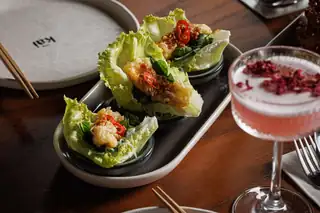
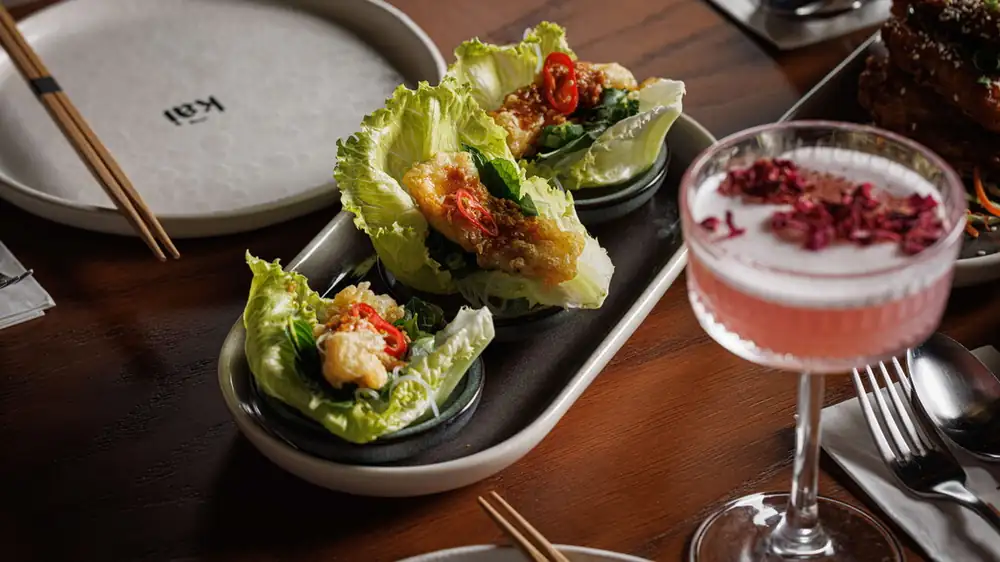
The same was true of the pese (58 shekels), lettuce boats stuffed with fried sea bass coated in a very thin and crispy mixture that was more reminiscent of fish and chips than Thai food, with thin bean noodles and a pleasant sauce of peanut butter and tamarind. This was not the pese you would get in a Thai house. It did not burn with a sharp sting, it was not sour enough and it did not have the powerful depths that Thai cuisine reaches. But it was a delicious and restrained opening of well-fried fish, in crisp lettuce, in which everything came together into a pleasant bite.
The som tam (54 shekels), a papaya salad and perhaps the most well-known dish, was less impressive. It had a slight problem of an imbalance between spiciness and sweetness and sourness, and it is not the reason to come to Kai. Why do you come here in particular? To eat the dish of phe ko (136 shekels), a grilled fish fillet (on our visit they used trout from the Dan River, a local Israeli and very un-Thai ingredient that goes great with the dish). The grilled fish - crispy skin on top and sweet and delicate pink fish below - sits on large pieces of grilled mushrooms that are bathed in an addictive sauce of oyster butter and roasted cashews. Words cannot be overstated about the correct use of sauces here, they simply make the dishes.
In the case of the grilled fish with mushrooms, it's an original sauce that intelligently and thoughtfully combines Western butteriness with Thai oyster sauce. It's both innovative and so delicious. The mushrooms enjoyed this rich, buttery sauce the most. They drank it up and became juicy and flavorful until they defeated any fish. The dish was served with steamed rice with furikake - another example of the mix made here between Japanese, Thai, Western and Asian. Don't look for rules here, just enjoy breaking them.
Another dish proved that there is a delicate hand in the kitchen - Gyo Nam Soup (74 shekels). It has chicken stock, chicken and peanut dumplings, rice noodles, bok choy, green onions, ginger, cilantro, garlic and crispy leeks. The relatively clean chicken stock was enhanced by grated ginger and roasted garlic, creating a refined soup (compared to Thai cuisine) that even those who are very wary of Thai food will enjoy sipping.
The dumplings, not exactly Thai, are filled with lightly seasoned ground chicken and crunchy peanuts that contradict the devotion of this beautiful and delicate dumpling, and go well with the clear Jewish chicken soup. If I had to judge this soup as a Thai dish, it would get a fail. I have never tasted such a calm and introverted soup in Thailand. But as a chicken soup with dumplings and noodles, this is exactly the bowl you want to return to on a rainy day.
The statement hit a nail on the head.
Courtesy of the restaurant, we received Dan Dan noodles (84 shekels), egg noodles originating in Chinese cuisine, with Sichuan pepper and peanut butter sauce, and a skewer of roasted chicken on top. The meaty noodles were good, although very spicy, but the roasted chicken was bland. It would have been better if they had been served with ground beef, which would have both absorbed the spicy, fatty peanut butter sauce and given it the meaty umami that would have added a necessary layer of flavor and made for a rich Chinese Bolognese.
We also got dessert, a variation on tres leches (56 shekels) with milk cream, milk jam, whipped cream and toasted rice crumble, a dessert that could appear on any chef's restaurant menu. In a Thai restaurant, it's mostly an excuse for a refreshing and different ending. A light last course, and the cream, cooling, sour, not too sweet, makes you feel wow. So interesting, you can't stop taking more and more spoonfuls from the half-frozen plate, to understand what exactly is happening in this combination.
After we received the bill, one of the owners said he was struggling to maintain the menu and the Thai line and not give in to the pressure from the crowd to add dishes like sushi. It's a struggle that's worth taking seriously, because Kai stands somewhere between being a Pan-Asian restaurant with a confused concept, and a Thai restaurant that also has other elements that still play on the Thai field for the most part.
It's worth keeping this delicate game and not breaking out into culinary populism and sushi rolls and boats. Because right now, Kai is an equally great addition to the area's restaurants, which are hardly ever renewed, and certainly not a magnet for people who are really looking for good food and don't just live nearby.
Almost all the dishes we had here were excellent, but Kai is not necessarily an exceptional Thai restaurant. Its strengths lie in the gray areas of chef-inspired cuisine that meets Thai flavors. If it weren't executed well it could be annoying, but because it works and works well, you can't get upset about it, but celebrate the uniqueness of it.
Because for the most part, Thai cuisine in Israel is expressed within narrow boundaries that we have learned to take for granted - curry (which is almost never on the menu here, and that's a good thing), pad Thai (which is, in fact, there is, but why dwell on it when there are much more appealing dishes?), and som tam (which I expressed my opinion on).
How fun it is to break down those walls and have a meal that may not be authentic Thai, but doesn't feel forced or strange, but creates an experience of surprising, colorful, and delicious food, alongside the familiar. If this is what is meant by contemporary Thai cuisine, then that statement hit the mark.
Kai, complex opposite Zichron, Zichron Yaakov. Sunday-Saturday, starting at 12:00. Not kosher