He cooked around the world, then he chose a village of 10 inhabitants: this is how Serpillo was born
Imagine touring the kitchens of some of the world's most important cities and suddenly finding yourself managing a restaurant in a small village of about 10 inhabitants.
Two entrepreneurs, a young chef, and a gamble for the future
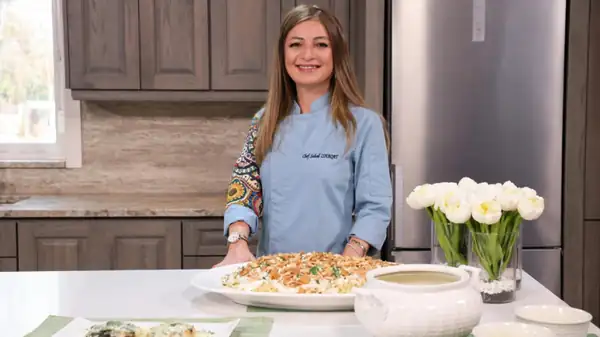
This story began about 13 years ago, when Daniele Giorgetti—now chef and one of the restaurant's partners, along with Elena Crisanti—returned from Paris: the opportunity awaited him to take over this restaurant in Torre del Colle. Francesco Colombo and Umberto Bonetti, two local entrepreneurs, offered him the role, but Giorgetti initially turned them down. At their insistence, however, "I went to see the place, and when we opened the restaurant doors, it was love at first sight." And, just like all the best love stories, Serpillo's adventure began from that moment: "At first, it was just my sister and I, me in the kitchen and her in the dining room. Then, when my sister left, my cousin, now a partner in the restaurant, came in," the chef explains. A gamble (won) and a stroke of luck, Giorgetti calls it, because "it was truly magical that these two gentlemen believed in a very young boy they didn't know and placed such a challenging situation in his hands."
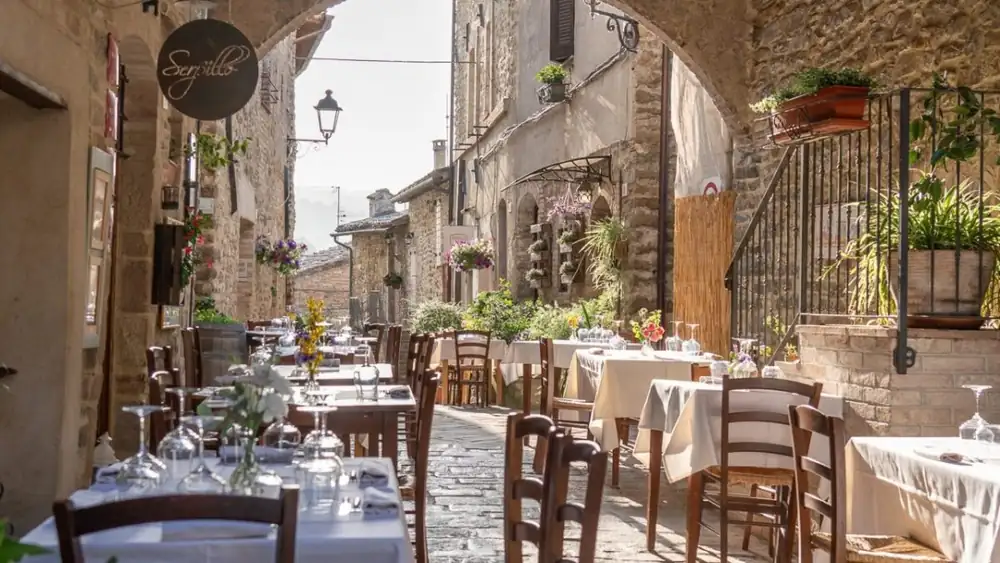
But if everything has been very romantic up until now, the beginning of the business was a little less so: "Before I took over, Giorgione worked there, but he hadn't yet been on TV and wasn't yet what we know today, so the clientele was very local," explains the chef, who took over the kitchen after the restaurant closed for a winter. And when Giorgetti arrived, it wasn't exactly easy, and anyone familiar with Italian villages can imagine why: "There were ten residents, and it wasn't very easy to integrate with them because you have to imagine a small castle surrounded by walls where the ladies come down from their homes and that alley, for them, is still home." A reality that, for those accustomed to city living, is almost difficult to understand, but which embodies all the charm of small villages that, despite everything, persist and where time seems to move at a speed we've long forgotten. And it's clear, therefore, that it was a bit like invading their home, so "we paid great attention to trying to collaborate, also because we occupied the spaces that they felt were theirs, we were a bit cumbersome" explains Daniele: "It had to be a combination that worked" and, fortunately, it worked.
The restaurant that revived the village's fortunes. Or maybe not.
It would be easy to construct a story in which the chef on duty arrives in a small ghost town and poses as the superhero who manages to save the half-abandoned village from its horrific fate. Unfortunately, or fortunately, not all stories are always so heroic: some remind us that things can be simpler, and yet no less beautiful or worthy of being told. And the story of Serpillo and Giorgetti is precisely one of these: "I don't like to portray myself as the chef who saved the village, because that's not really the case." However, it's undeniable that any business, anywhere in the world, can contribute, intentionally or otherwise, to revitalizing an area, or simply to making it known to others. In this case, Serpillo and all the people who work around it have given a huge boost to the "real estate market, because those who arrive see a vibrant town. Services have been increased – even compared to other small villages around Bevagna – it is better served, also because it is convenient, there is parking outside and it is very livable," says the chef.
All this, however, doesn't mean—fortunately, we can say it—that the village has been overrun by hordes of crazy tourists from all over the world. Serpillo's customers, in fact, are "80% local. Tourists come in the summer, of course, we have about 20% of this 'contamination' and it was important to figure out how to manage it, also with respect to the locals."
From the cuisines of the world to Umbria
London, Dubai, Paris: these are the destinations Giorgetti visited before returning to his native Umbria. Some might expect a more international cuisine, but the chef from Serpillo chose a different path: "an authentic cuisine, with a strong soul: we work with local people, we source products and raw materials from here. It's Umbrian cuisine." But a chef's cuisine, in some way, is always an expression of his experiences, and this case is no exception, even if in a slightly different way than one might expect: "Working abroad gave me the opportunity to have a 360-degree view of Italy. It's a paradox, I know, but when I worked in Paris," Giorgetti continues, "we were 17 Italians from all over the peninsula. Many of them had worked at Michelin-starred restaurants, and the standard was extremely high. It was precisely by watching them that I had the opportunity to learn a lot about our cuisine." So, no cuisine that looks to France or England: despite its world tour, Serpillo's takes inspiration instead from Sardinia, Campania, or Lombardy.
A transition in style and environment that was effortless, despite moving from one context to a completely different one, because "imagine working in Dubai, in Giorgio Locatelli's restaurant, in a hotel that had around 2,000 employees, and ending up in a village with only five residents and the catchment area being Umbria," says the chef. So everything was scaled down, but "it wasn't that difficult to go back to working with local products, with small businesses, with the farmer or the lady who raises geese. I returned to a simpler world and I feel I belong much more there than in the big cities. For me, it was a homecoming," concludes Giorgetti.
Dinner by 300 Candles: What is Serpillo in the Dark?
But there's another reason Serpillo is so well-known: two evenings a week, during the fall and winter, they dine by the light of only 300 candles. The initiative is called Serpillo al buio (Serpillo in the Dark) and was born one day when "Umberto said to me, 'There's this evening launched by Radio 2 Caterpillar called M'illumino di meno, a national evening where they're encouraging energy saving.'" A project that "I didn't really care about at first," the chef says honestly: "Then I thought about it, and since our restaurant is an old oil mill, I thought, 'You know, maybe candlelight would be wonderful.'" And so, thanks to this initiative, the restaurant began to be illuminated by the soft light of a few candles.
"We started out a little shy, with about 15-20 people showing up. Then one day a girl from Perugia came—who's now our marketing manager—made a couple of videos, and it went viral, and from there I continued to push this event forward." Today, Serpillo al buio can be experienced in the months of October and November and February and March—usually on Thursdays and Fridays—since it was actually born "as a winter event because we take advantage of the fact that it's cold and candles are incredibly warm, and also because there's a fireplace that creates an extraordinary light and atmosphere," concludes Giorgetti.