Another invisible star
The absolute surprise of this trip to Madrid is Hannah, or Sushi Bar Hannah, as it says on its website: a Japanese bar that appeared unexpectedly.
I was led by the GPS to an alley I would never have entered on my own, not because it was seedy—it's not a Ginza dive bar, like the one in Netflix's Midnight Diner; check it out if you've seen it—but because it was so unremarkable. Bland and gray, it separates the Serrano branch of El Corte Inglés from the Hotel Villamagna; a kind of demilitarized zone where Hannah's presence among the hotel complex's restaurants feels like an atypical intrusion. Two half-curtains covering the doorway, in a Japanese style, are the only identifying feature of the place, nestled among service entrances or back entrances to the Villamagna's dining rooms.
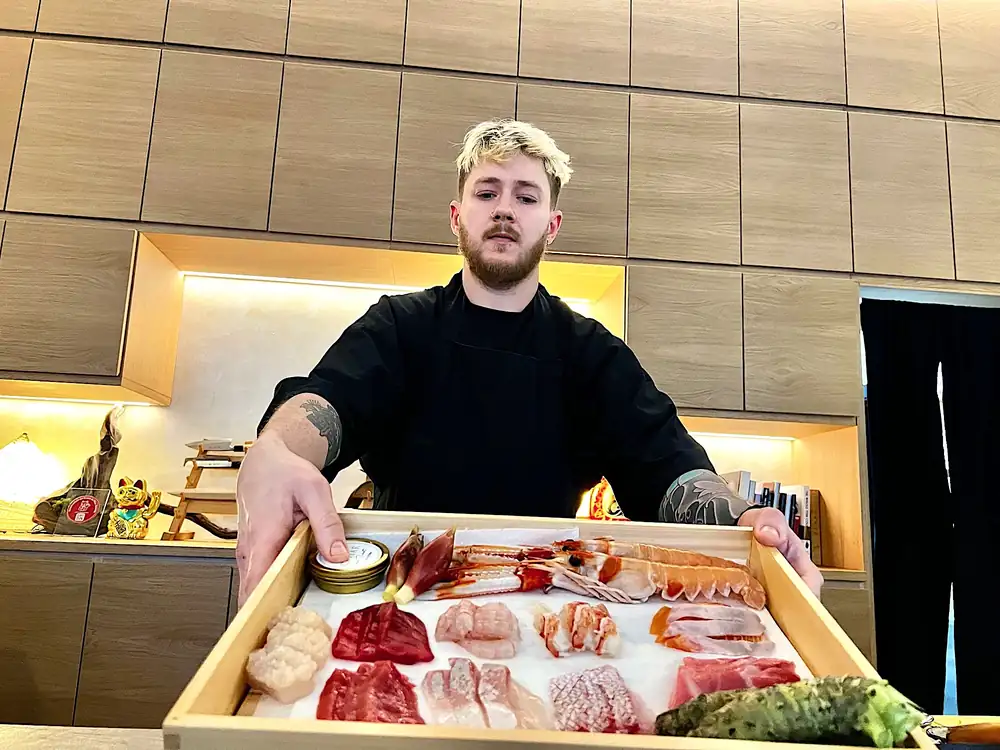
Passing through the formal barrier of the curtains, you arrive at a clean and simple space. A bar with ten seats dominates the space, behind which Janek Fleming, a British chef with Polish blood and a strong Japanese influence, works, shaping his culinary principles and, I get the feeling, his life. Five tables facing the bar complete the space. On this early February midday, there's space available for lunch, which I'm told isn't the case in the evenings. After lunch, I think the most incredible thing is that it wasn't full during the meal either. Two hours have been enough for Hannah to reveal itself to me as a revelation: it's one of the best meals I've had in years. Don't get upset, darling, yours might have been among the other select few.
I am captivated by the orthodoxy that permeates everything, the precision of movements, the choreography orchestrated by the itamae with movements that seem measured, always paused, the delicate elegance that breathes in every gesture, the meticulous staging of the service and the brief explanation of each bite… Another lesson: one can be brief, precise, explicit and eloquent; learn this, esteemed reciters of dishes at the table, boredom is an induced sensation.
Everything comes together perfectly and captivates from the very first bite, which culminates in the presentation of a kaiseki platter. Five bites that herald the difference, beginning with a piece of sea bass semen that immediately catches the eye, with a more whole and dense texture than that of bluefin tuna semen (the only one I recall having tried before, albeit canned; Gadira made me addicted). A simple yet eloquent cultivated mushroom (maitake; grifola) completes the quintet alongside thinly sliced red mullet and a cut of octopus with cucumber salad (sunomono), showcasing the flavor profiles that lead to what we now call umami. Above all, it's an example of how to approach the beginning of a menu, what we now call an appetizer: making an impact, grabbing attention, exciting the diner, and leaving them eager for whatever is to come.
They are the starting point of a meal that is a compelling enticement, demanding attention. From the dashi soup with razor clams and clams to the monkfish liver, the steamed abalone served with a cream made from the liver, the subtle and striking combination of shredded spider crab and sea urchins, the lobster… everything speaks of a flavorful, meticulous, and elegant journey through the intricacies of the flavor spectrum.
You're about to let go when some nigiri appear that hit you like a ton of bricks. Ten pieces that create a landscape that leaves me speechless. The rice is warm, just the way I've always liked it—I never understood cold rice in nigiri; it seems like a misguided disregard for one of the two main ingredients—and so are the fish and seafood that accompany it: scallop with sea urchin, trout belly, prawns, and langoustines, building towards the notable presence of tuna (loin, chu toro, otoro), before settling into the elegance of sea bream and snapper belly. Accompanying them are Japanese pickles (no soy sauce, bravo!) that speak of other things: bulbs resembling lilies, cuts of water lily relatives in others… Here there is work, research, and dedication.
When the temaki arrives—cylindrical, slightly loose, at least 10 centimeters high, filled with just rice, tuna tartare, and a sheet of flavorful, crispy nori seaweed—you're on the verge of collapse, but it's a powerful draw, and each bite demands the next. The white strawberry dessert that closes the festival is an exercise in style that speaks of good manners and seizing opportunities.
As I eat, I wonder where the chef's work, as he moves across the table, ranks in the culinary hierarchy. At this point, I still have my eyes glued to the Michelin Guide—the lists tell me more about popularity than cuisine, and the new guides, like Macarfi's, are beginning to reveal the constraints that ultimately degrade them—and here I see no plaques, no little figures built on wheels, or any other such paraphernalia. I discreetly search for the restaurant on the guide's app, using my phone, and find no trace of it; someone at Michelin did their job poorly. Hannah should be among those selected. It's another one of those restaurants that proudly displays the distinctive mark of the invisible star.
It's nothing new, but it never ceases to amaze how out of touch with reality the Spanish team of the French guide sometimes is (well, the Italian and French teams too; sometimes they hand out stars to chefs and kitchens that operate on the margins). Just one example. The guide's former director, who has always preferred to ignore certain restaurants, is now touring Madrid, tweeting praise and compliments (#thefoodisgreatinmadrid) about kitchens and restaurants she chose to ignore when she was in charge. That's how things are. Stars aren't what influences my choice of restaurant, but I understand that for most people they are a determining factor: they should be held to a high standard.
This Madrid has restaurants with cuisine as good as some of the Michelin-starred establishments I admire, and much better than others that seem like cheap imitations; bought at the local discount store. I prefer invisible stars, like Sacha's, La Buena Vida (which I consider the epitome of bourgeois culinary reality; I visit it on every trip), and now this Hannah, which has just made my trip even better.