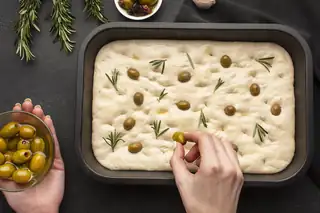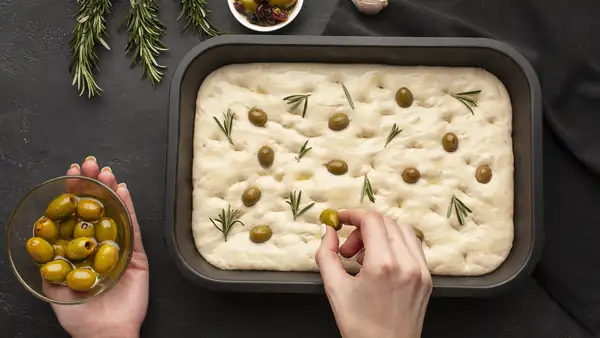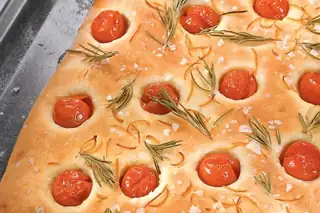
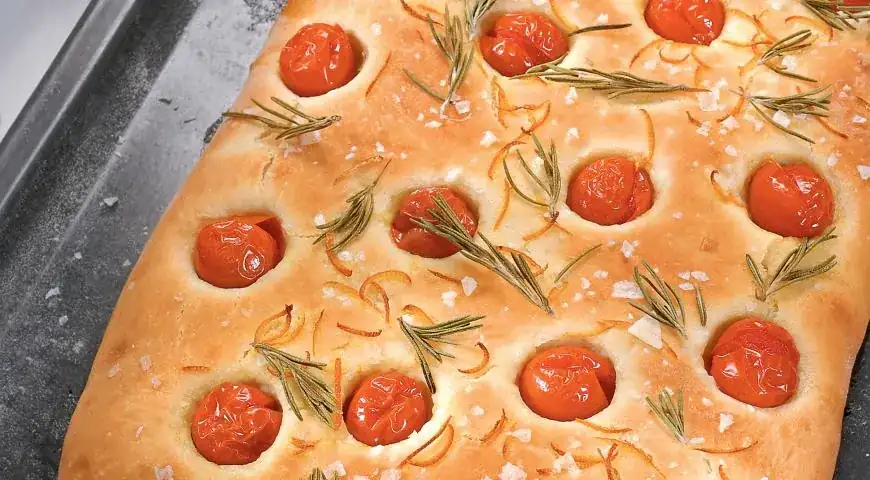
Focaccia with tomatoes and rosemary
- coarse sea salt – to taste
- olive oil for greasing
- zest of 1 orange
- flour – 600 g
- olive oil – 4 tbsp.
- sprig of rosemary – 1 pc.
- cherry tomatoes – 250 g
- dry yeast – 7 g
- In a large bowl, dissolve the yeast in 250 ml of warm boiled water. Add 2 teaspoons of salt and olive oil. Stir until the yeast is completely dissolved.
- Sift the flour into a bowl with the yeast. Knead into a soft dough. Transfer it to a floured surface. Knead for 10 minutes, or until the dough no longer sticks to your hands. Grease a clean bowl with oil and place the dough in it. Cover and let rise for 1 hour (the dough should double in size).
- Lightly knead the dough. Grease your hands with vegetable oil and place the dough on a greased baking sheet. Form the dough into a perfect rectangle.
- Wash, dry, and separate the rosemary leaves. Coarsely grate the zest from the orange. Wash, dry, and lightly press the tomatoes into the dough, spacing them evenly.
- Sprinkle the dough with rosemary leaves, zest, and coarse salt. Let it rest for another 30 minutes. Lightly spray the focaccia with oil and bake in a preheated oven at 200°C for 25 minutes.
Focaccia with tomatoes and rosemary is a traditional Italian flatbread, made using high-quality olive oil and aromatic Mediterranean herbs. Besides rosemary, the recipe also allows for the addition of sage, thyme, and oregano. In some regions of Italy, focaccia is often cooked over an open fire, which imparts a smoky flavor. The finished focaccia is seasoned with coarse sea salt and butter. These flatbreads are traditionally served as an accompaniment to any meal, either as bread or as a standalone appetizer.
Pizza Margherita was essentially born out of a whim by Margherita of Savoy, wife of the Italian King Umberto I. While touring the country, the couple stopped in Naples, and Margherita asked him to prepare her a traditional dish of the region—pizza, which was the staple of the menu for the then-not-so-wealthy Neapolitans. The subjects were perplexed (how could they treat monarchs to the food of the poor!) and invited the renowned pizzaiolo Raffaelle Esposito, hoping he would come up with something. And the master lived up to their trust! The chef prepared three pizzas, which were served at the royal table. One of them, topped with tomato sauce, basil, and mozzarella and resembling the colors of the Italian flag, was a particular favorite with the queen. She ordered the dish to be prepared again, and the grateful chef named the pizza Margherita in her honor.
Unleavened dough is typically used for large pizzas cooked on a large rectangular baking sheet, as well as for pizza rustica (rustic style pizza). In the latter case, the crust is first pan-fried and then grilled with the toppings. Of course, unleavened dough isn't as fluffy as, say, Neapolitan pizza; it's closer to a drier Roman crust. But if you knead it thoroughly, until it's elastic, the result will definitely not disappoint.
Onion pie is a popular quiche variation. Onions have long been highly prized in France, used not as a seasoning but as the main ingredient. It's best to use the white part of the onion for the filling of an onion pie...
Quiche is a French savory open tart with an egg and milk filling. The word "quiche" itself is of German origin, which is unsurprising, as this tart is typical of Lorraine,...
Pies have long been considered a staple dish among the Ossetian people, whether it was a holiday or a regular weekday. Traditionally, pie-making in Ossetia has always been reserved for women.