When rural areas become tourist destinations
For decades, Tuscany has attracted visitors from all over the world, from E.M. Forster's Englishmen yearning for a room with a view while shaking off the Edwardian conventions of the early 20th century, to the hordes of tourists we see today, phones in hand. All with their own expectations of this Italian region.
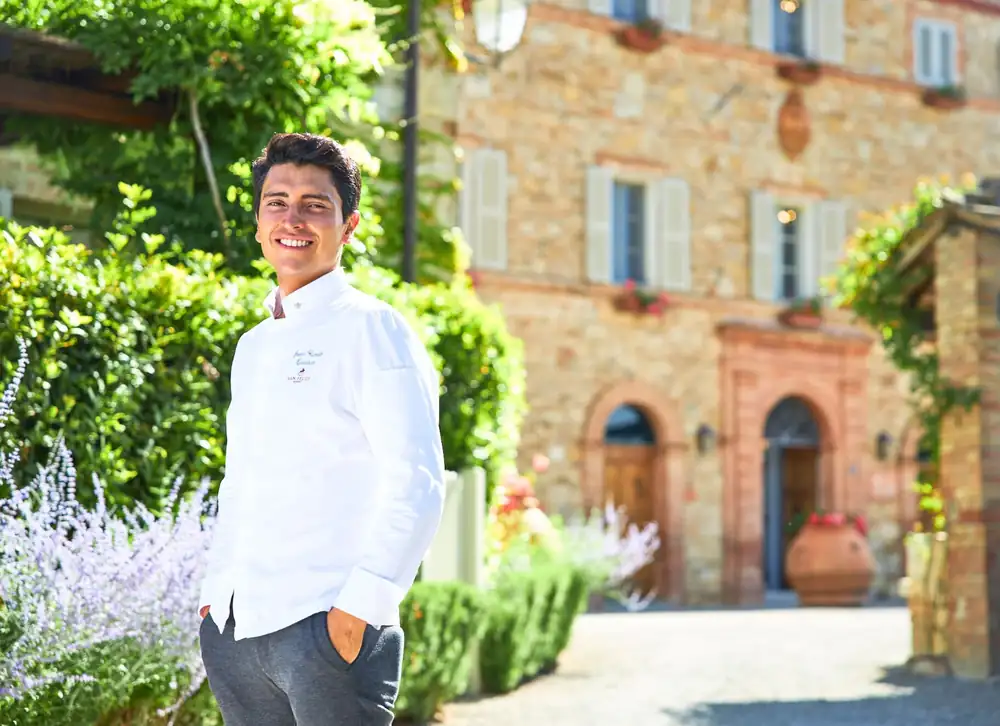
To these we must add a new type of visitor, one who, beyond art, the art of doing nothing, or Instagram photos, seeks to discover what the land of Tuscany has to offer. Let's not forget that this is an important agricultural region, with the fertile hills of Chianti as its centerpiece, but also a producer of excellent olive oils, rice, and vegetables. Juan Camilo Quintero is responsible for showcasing this still rural and agricultural Tuscany on the plate. He does so from the Il Poggio Rosso** restaurant, located in the Borgo San Felice hotel, a Relais & Châteaux property in an idyllic setting amidst the Crete Senesi landscape.
“A rural restaurant located in a tourist area is a double-edged sword,” warns Quintero, “because we’re talking about a tourist who is well-informed, environmentally conscious, and seeks quality and excellence.” It’s true that being in a tourist area makes it easier to attract customers than in other rural areas, but, as this Colombian chef, who has spent almost half his life in Italy, points out, it doesn’t come without its drawbacks. You can’t let your guard down. Juan Camilo Quintero knows this well, and that’s why he pays attention to detail and strives to offer customers “something they can’t find in the city.” “In a rural setting, luxury isn't about the restaurant's design, the service, or even the wine list. Luxury is cooking vegetables we picked from the garden an hour ago,” explains the chef, confessing that he is very particular about this, especially regarding the aromatic herbs they harvest from their own garden fifteen minutes before service, “so that the aromatic part of the plant is almost untouched. This is priceless.” This anecdote perfectly illustrates the philosophy that permeates the cuisine of this Bogota native, who, before taking charge of the kitchen at Il Poggio Rosso, worked in the kitchens of Arzak and Massimo Bottura.
Juan Camilo Quintero has a very clear vision of the cuisine he wants to create. And one of the fundamental principles is sustainability, which, for the chef, “has to stop being a trend and become an essential part of running a restaurant, alongside culinary techniques and management.” But Quintero isn't naive in his approach. While he argues that “until most restaurants stop talking about it and actually implement these changes, sustainability won't be a reality,” he also acknowledges that “there isn't a single formula or recipe that works for every restaurant. There are different realities, different locations, and diverse political situations. It's a mistake to think that what Nordic cuisine does can be applied elsewhere; each restaurant has to analyze its own identity and approach sustainability from that perspective.”
The producer as guarantor of local identity
From his own perspective, that of Tuscany, a region that is both tourist destinations and agricultural centers, Juan Camilo is forging his path toward sustainability with the principal commandment of rural cuisine: honor the product and the producer. “The customer of a rural restaurant comes relaxed, enjoys and appreciates the simple things, the connection with nature. The culinary offering must be consistent with that, without over-processing the product, allowing it to express its best qualities in its natural state. Avoid artificiality,” explains this chef, who is fully aware that, ultimately, this means that “the chef is merely the public face of this process in which, in reality, the true protagonist is the producer who obtains the best possible raw materials.”
But the recognition of the producer's role isn't solely due to the fact that they provide those essential, high-quality ingredients; it's also because, thanks to them, "a tradition is preserved, because the producer is the guarantor of the place's identity." This is no trivial statement, especially considering it comes from a Colombian chef tasked with promoting products from Tuscany, Italy, primarily for international customers. "The identity of a place isn't found in the chef's origins, nor does it matter if the customer is local or a tourist. Identity is offered by the product that one person works with and the other enjoys," he asserts. Furthermore, Quintero doesn't hesitate to affirm that "there are many similarities in cooking styles across rural areas," a further argument in favor of breaking down barriers and prejudices about who is qualified to cook in one landscape or another. The presence of grains, the value of the vegetable garden, harvesting, resourcefulness… these are all signs of unity between territories.
But despite that, and to paraphrase Ortega y Gasset, one is oneself and one's circumstances, and Quintero grew up in Colombia eating arepas. Therefore, his dream would be to apply everything he learned in Italy in his native country. And not just in terms of gastronomy.
Juan Camilo also speaks about the social impact that can stem from gastronomy. On the one hand, with a cuisine that values the product, "you contribute to the development of local production and economies"; and on the other, "you achieve a very powerful vehicle for social integration, something truly necessary in a country like Colombia with poverty and prominent minority groups in various regions," he argues. This social aspect is not new to the chef, since his restaurant's garden is managed by people with disabilities, and he knows firsthand that "there are many ways to bring about social change from a restaurant. It's something tangible, with results, that can change a person's life," he affirms.
Another avenue to explore is where rural chefs, as guardians of a cuisine that prioritizes quality ingredients and skillful preparation, can make a difference in areas where fewer and fewer people want to work the land and where agriculture and livestock farming need to be dignified. Maintaining tradition, doing so sustainably, and with social impact: could this be the new trifecta of rural cuisine?
Register for free to attend TERRAE.