The Regulars Are Back at Sam’s
Over the years, the near-century-old Sam’s was always closed in August. Louis Migliaccio, the owner, decamped to Italy for the month, depriving his regulars of pizza and parms until he returned and reopened well after Labor Day.
“We worked from a bunch of old menus and archival material going back almost to the restaurant’s opening,”
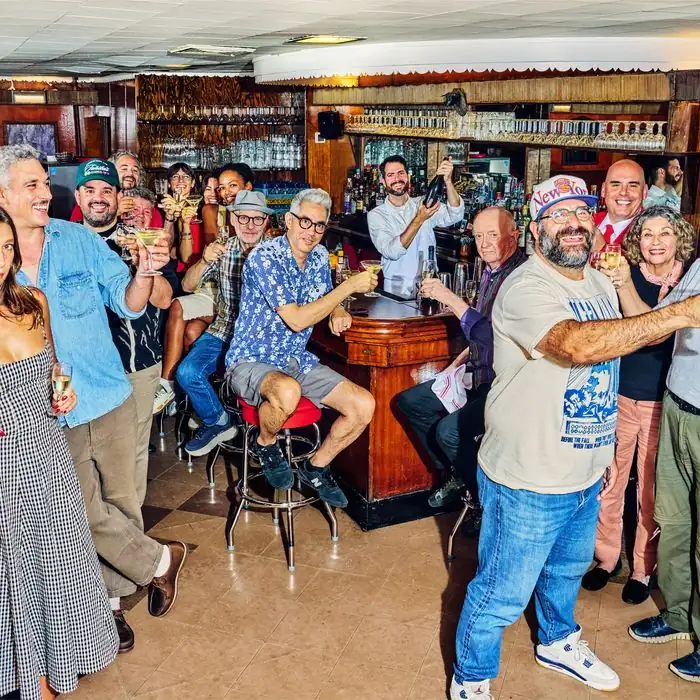
Film shoots were also a frequent occurrence at the old Sam’s, which looked a lot like the new Sam’s, the major additions to the décor being bar stools, bench seating near the entrance for waiting diners, and a partition that divides the bar from the dining area. Faithful clientele will recognize much of the menu, too. Holdovers include a celery-and-olives appetizer, baked clams, sides of spaghetti or ziti to go with the veal parms and — of course — the pizza that has anchored the menu for as long as anyone remembers. Not that re-creating the original dishes was easy: Migliaccio’s recipes, when they existed at all, were written in a sort of private shorthand. “There was no recipe book,” says Sam’s chef consultant, Andrew Halitski. Instead, “Lou showed me the special coffee cups and dishes he’d use to do the measurements.” The famous pizza oven presented its own set of concerns: It has no thermostat and operates on two gas pipes. “These ovens just need to be babied a little bit,” Halitski says.
There are some additions to the menu — orecchiette with broccoli rabe and sausage, Caesar salad, rigatoni alla vodka, and a pork chop Milanese — but it’s entirely possible nobody will recognize them as such. “We’ve finessed it so it’s pretty close to the original,” says Fulton. The actual menus were designed by May Redding, who in the past has collaborated on her sister Ann’s restaurants, including Thai Diner: “We worked from a bunch of old menus and archival material going back almost to the restaurant’s opening,” Redding says. “The goal was really to preserve the original character while updating it a bit.”
Another update: drinks. Sam’s always had a long cocktail list, but it was mostly for show. Now, it’s presented in earnest. “This is red-sauce, Italian American. It’s not an Italian restaurant,” says Rene Hidalgo, who is in charge of the bar. “We’re not trying to create something wholly new because you can’t do that with this type of cuisine. That’s the lens we’re looking through: How far away from this thing can we get where it still continues to be this thing?” Classics — a Cuba Libre, a Singapore Sling, a Rob Roy with both Cutty Sark and Laphroaig in the mix — will sit alongside modern inventions like a house spritz with rhubarb amaro and a “shakerato” riff on the suddenly very-popular Spaghett, made of shaken-up Aperol topped with Miller High Life.
The glassware for those drinks isn’t changing, though. Nor are the plates. The old-fashioned green-trimmed dishes Migliaccio had are still in use, and salads will be served in wooden bowls with metal tongs. The same goal, Fulton says, has been driven every decision: “Getting it as close as possible to the original — but better.”