Juan Luis Cañas: “Physical exertion and working in the garden relax me.”
“What relaxes me is being alone and physical exertion. I love nature, breathing fresh air and drinking water, smelling the countryside in every season, seeing the pools where wild boars have bathed, watching a pigeon take flight from a tree…
In the last years of his father Luis Cañas's life, the family patriarch always planted a vegetable garden with chard, peppers, chili peppers, and tomatoes in the village. "When we were preparing the plot, my father asked me if I would help him plant it. I liked it, and he taught me how. I plowed it with the tractor and prepared it, and he took care of watering and harvesting. I saw that I enjoyed it," says the winemaker of Luis Cañas, Amaren, and Dominio de Cair, in La Aguilera (Burgos, Ribera del Duero).
"When you start harvesting, that's when you really get the hang of gardening," he smiles. "Around eight in the evening, the women of the village stroll around here in front of the chapel. We chat, they look around, and I ask them what they'd like to take... some tomatoes, some zucchini... whatever's ripe. Giving things away is lovely, it's so heartwarming. With the rest, we make preserves for home. My wife, Begoña, has taken up the trade from Dolores, my mother-in-law, and we make preserves for the whole year. Chillies in oil, tomatoes, peppers... or jars of bonito when I go fishing with my friends Xabier Goirigolzarri and José Miguel Isasmendi, who has a boat in Lekeitio."
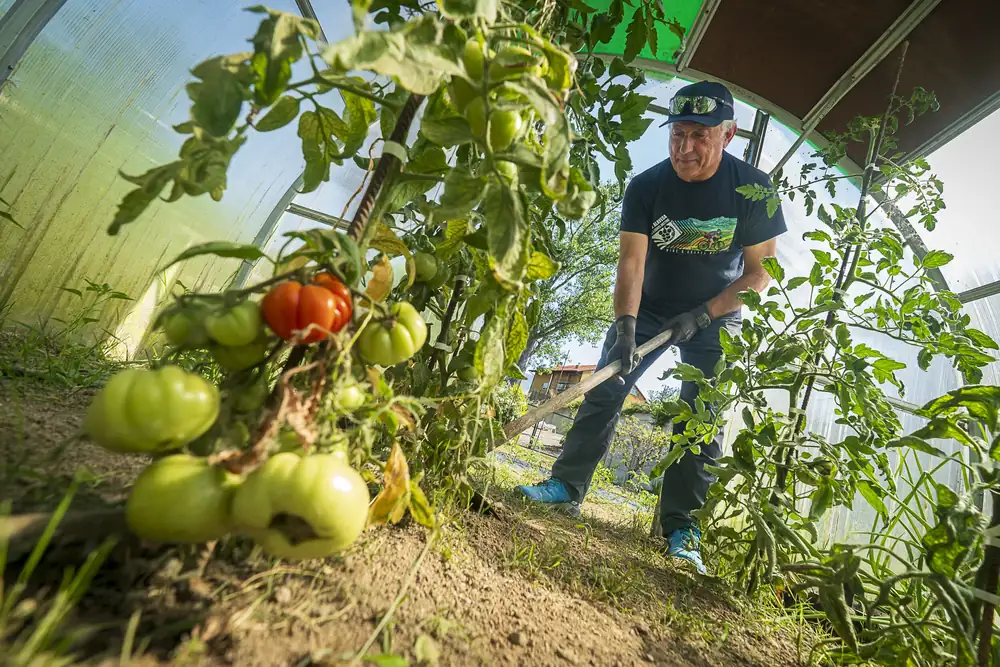
Luis Cañas gazes intently at the green playground of his school and the mountains, over which the clouds are settling today due to the foehn wind. This year, with so much rain, everything is very late. Unlike in the vineyards, where the abundance of rainfall triggered the germination of flower buds and the vines are suffering from downy mildew. The first tomatoes, the size of golf balls, are appearing. The first pepper plant shoots are beginning to climb the canes.
“I hardly use any fertilizer,” the winemaker tells me. Every year, Cañas prepares the soil in his vegetable garden with 20 sacks of 20 kilos each of organic and plant-based substrate (400 kilos of Esconsu Vital Soil, with a pH of 7.75) and waters every other night, for barely 20 minutes, using an automatic drip irrigation system he installed in the valley. “I use the water that comes down from the mountains, the same water we drink at home. The onions and tomatoes are so delicious with this soil and this water…” Cañas says with delight. Pepe Barreira, a restaurateur from Vitoria (of Ruta de Europa and Gran Lakua), recommended he become a gardener.
We strolled through the vegetable garden next to which Cañas has set up a barbecue structure for grilling lamb chops over vine shoots on a couple of metal grills. There's also a dark wood table with benches where he attends to the visitors (restaurateurs, sommeliers, salespeople) who come to Amaren. The real treat is letting guests choose the tomatoes and onions with their own eyes, which, shortly after, along with a good olive oil from an Álava mill, will accompany their lunch, washed down with wines from the family. Along the edges of the garden, Cañas has planted aromatic herbs: basil, lavender, rosemary, thyme, and lemon mint, which repel mosquitoes and add color, fragrance, and beauty to the fertile plain.
"Chaparro", jars in slaughter and arvillos
Juan Luis then shows me the tomato plants. "I have four varieties: tomato, hybrid, pink, and Raf, which I buy at Vivaria, a nursery in Varea, in addition to some well-known plants that were given to me and come from Aretxabaleta." They are his pride and joy. "And there are two types of onions, the sweet one for cooking, and another that's a bit spicy, for salads."
"In September I will plant, and it will be the second year, leeks that we will harvest for Christmas. In Leza, in the family garden that I also take care of, there are cucumbers, choricero peppers that we dry ourselves, and that we will use later for cooking, chard, which is eaten a lot here, blue and pear tomatoes, zucchini, strawberries…," the son of Ángeles Herrera and Juan Luis Cañas will explain to me in the Huerta de Dolores, next to a fragrant fig tree and a huge laurel tree next to the bed of the Mayor River where the vigorous song of the birds can be heard.
The winemaker returns with those words to the landscapes of his childhood. Days at the family home, tending to the hens that provided the Cañas family with eggs and good stews, harnessing "Chaparro," the mule with which Luis, the father, quickened his pace towards the vineyards, or riding "Lola," the family's white donkey.
From this balcony overlooking the Sierra Cantabria mountains, memories also surface of the slaughter of the two pigs they raised at home, of the busy hands stuffing sausages and filling earthenware jars with still-fresh slices of meat and oil in a time of domesticity and without refrigerators. The smell of the onions the women chopped for the blood sausages, the aroma of paprika and of life itself, the commotion, the revelry, and the celebration of days spent with the grandparents who enjoyed eating arvillo, a Rioja-Alavese blood sausage, "narrow and very tasty fried," seem to gush forth from his memory.
"When I was a kid, we lived off the vegetable garden, potatoes, and beets that were planted for the animals. We ate a lot of chard and leeks... now I put them cooked in salads with oil, and they are as delicious as asparagus."
At the age of ten, Juan Luis Cañas entered the San Viator boarding school on La Paz Street in Vitoria, across from the prison and the Artillery Barracks (the 2nd Mountain Regiment), where he still remembers the bugle call and the daily reveille. He later studied Industrial Engineering and Drafting at Jesús Obrero, began working at FIASA (Fundiciones Inyectadas Alavesas SA), and subsequently moved to Alcalá de Henares, where he took charge of the Technical Service at Zanussi-Electrolux. He remained there until the age of 33.
"It was very difficult for me to return home."
“It was a tough decision to come back home. In the wine world, you suffer a lot when things aren't going well, but it's also fascinating,” he summarizes. From the 10 hectares of vineyards where his father made wine that he sold in demijohns (“and without a driver's license, people would come to our house to buy it”), they've grown to the current 160 hectares, half of which are rented, but managed by the Cañas family. He was a daring winemaker for venturing into the production of white and rosé wines and their long aging in oak barrels at such an unlikely time. “But deep down, it's all similar. These are things I enjoy: observing the land, the cycles of life, considering whether to buy a particular vineyard, plant trees, or restore the old hut.”
“This is like a vineyard,” he reiterates, approaching the tomato plants. “You have to remove the suckers, watch the new shoots grow, and be careful because the wind comes and breaks the plant. This week, with the heat we’re having, they’ll start to sprout. I’ll pick tomatoes here in August. I have a grandson, Julen, who picks them straight from the vine and eats them raw, barely washed with water, with the skin still crisp.”
Every day, at seven in the morning Juan Luis Cañas gets up in Vitoria, gets in his car and by eight o'clock, like clockwork, he is working in the garden, feeling how his roots cling tightly to the earth.