Ebisu by Kobos, a new passport to Japan
José 'Kobos' Cortés has a knack for generating excitement like few others. First in the basement of Matritum, in Madrid's La Latina neighborhood, and later in his clandestine penthouse.
Established as one of the best itamae in Madrid, Kobos dedicates his attention to nine diners at a bar where you can only taste an omakase menu (based on the trust that the customer places in the chef) with which he feeds the best product he finds daily and always with the intention of transporting you to the best Japanese experience.
This 33-year-old from Madrid is a self-taught cook - his vocation was fine arts and now he boasts of making "small edible drawings" - who worked at La Gastroteca de Santiago (Madrid) or BonAmb ** (Alicante) before an unexpected change in a holiday plan led him to work in Japan.
She's horrified to recall that "horrendous Spanish restaurant" run by Japanese people where they served "paella with fried squid on top," among other atrocities, but she fell in love with the country's cuisine. "I was blown away."
So much so that upon his return to Spain he worked and sold his car just to earn the income that would allow him to return to Japan to learn its cuisine.
Once there, everything changed. "I ate the best sushi of my life, for 350 euros without drinks, and I offered to work for free at the restaurant." It was at Ebisu Endo (Shibuya, Tokyo), where his sensei (teacher), Norihito Endo, works, and a month later he hired him.
There he learned everything that he now condenses into his new Ebisu by Kobos, always accompanied by the music of his uncle, the guitarist Gerardo Núñez. Japan and flamenco, how well they work together.
The restaurant has two seatings (2:30 pm and 8:30 pm), and Kobos will be at the bar each time to ensure a delightful experience. From the start, with dishes like karasumi soba (buckwheat noodles with mullet roe), dashi with daikon radish and edamame, or the snake cucumber with toasted sesame sauce, a refreshing menu that also showcases the itamae's mastery of the knife.
Some were gifts from his sensei and need to be sharpened daily. "Sushi wouldn't exist without these knives; they are the last bastion of the katana, which is why they are treated with such respect," he explains.
These are the appetizers that delight, a prelude to a menu that begins with an unforgettable eel (supplied by Roset from the Ebro Delta), crispy and silky in its shirayaki preparation (steamed and grilled). Hearing it crackle under the knife anticipates the thrill of the bite. The same fish will return at the end of the menu in the form of an exceptional nigiri.
Eel is his favorite product, although he admits that killing it, removing its slime, and bleeding it are not easy. "It's a slow process that isn't well-paid because it's a very delicate product," he explains.
For his nigiri, he uses koshihikari rice from northwest Japan, carefully adjusting the temperature and humidity depending on the fish it accompanies. He cooks it in a Japanese induction rice cooker, which he raves about, never adds sugar, and seasons it with a Japanese vinegar that he claims "can't be found in any other restaurant in Spain." His soy sauce toppings also add a distinctive touch.
His intention has always been "to be as close as possible to what you can eat in Japan." And he brings back what he can from there, but he doesn't neglect his neighborhood of La Latina, where a fishmonger supplies him with sardines or mackerel.
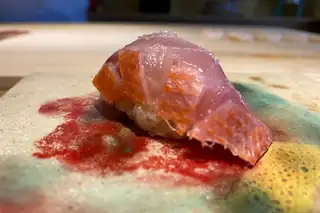
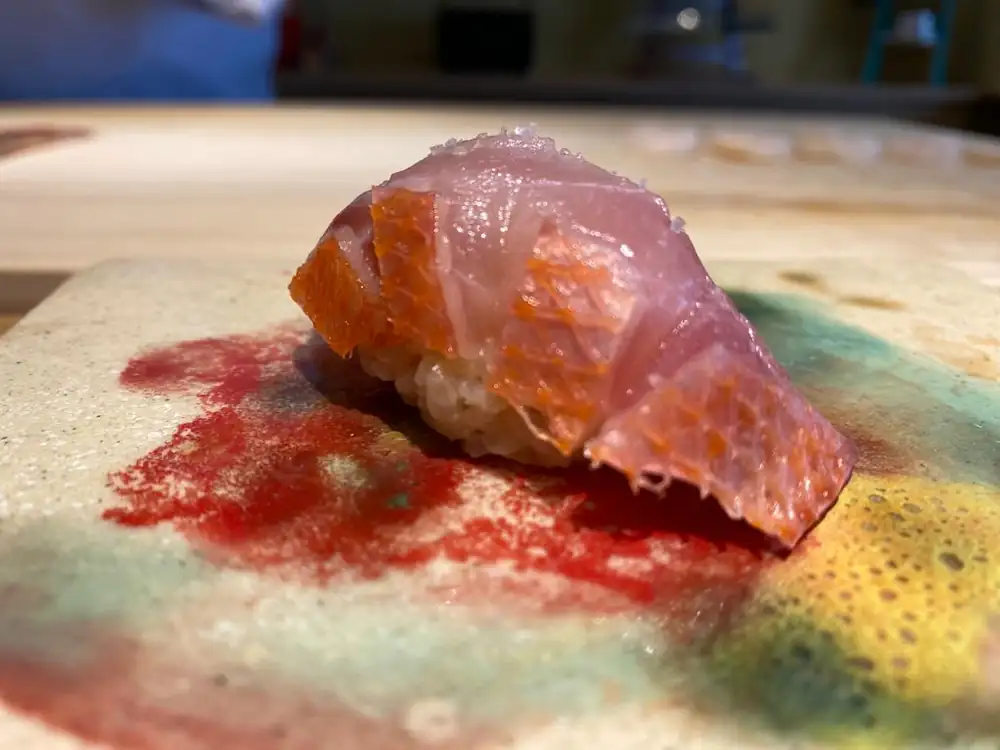
The parade of nigiri is impeccable, like the king with scalded skin, an ice bath and kombu wrapping; the scallop with lime zest, the matured red mullet or the whole set with different cuts of matured tuna, Tokyo style.
It pairs well with grilled dishes like the aforementioned eel or an outstanding bonito tataki. He prepares them in full view and uses Cuban marabou charcoal for its high heat output. The binchotán, which many boast about but is prohibitively expensive, is simply submerged in a jug of local water, offered free of charge, for its purifying properties.
Almost at the end of the nigiri festival appears the Mama 2.0 sandwich, which surprises as much as it pleases, because in this homage to the sandwich that her schoolmates used to fight over at recess there is love and flavor in the pure simplicity of a crispy combination of cheese and tuna, adorned with a dose of osetra caviar.
A soup of cockles, clams, red miso, ginger and chives brings the savory part to a close, and a simple and refreshing shaved ice with fig, peach and condensed milk bids farewell to the menu.
The liquid part (120 euros for the omakase menu, although you can opt for the à la carte menu) is handled by Metodiyka Popova, a sommelier of Bulgarian origin with extensive experience in Spain who is currently opting for a "reduced but dynamic" menu that includes champagnes, sakes, sherries and national and international white wines.
Just one warning: you cannot go to the restaurant wearing perfume because it interferes with the experience, something that according to Kobos is considered disrespectful in Japan.