Hazama in Milan, review: a rare example of kaiseki cuisine in Italy
The kaiseki culinary style, of which Hazama is, I believe, the only exponent in Milan if not in all of Italy, tends to be hastily defined as the Japanese equivalent of haute cuisine, say with two Michelin stars and up.
This is, however, a lazy comparison, because while it is true that this is haute cuisine, drawing from the highest spheres of Japanese tradition, including ceremonial and imperial cuisine, its raison d'être lies elsewhere. Rather, it is sublimation, the pinnacle of the quest for that communion with nature, both physical and spiritual, that pervades the Japanese experience and for which food is often a vehicle. And not only in the thoughtful rooms of a high-end restaurant, but also in far more prosaic and everyday acts and habits. Even at home, the meticulousness and artifice with which Japanese mothers prepare their children's bento boxes for school is an attempt to make food appear not only natural, but more perfect than nature itself could achieve. As anthropologist Anne Allison observes, in Japanese cuisine, nature is not only represented, but incorporated and surpassed.
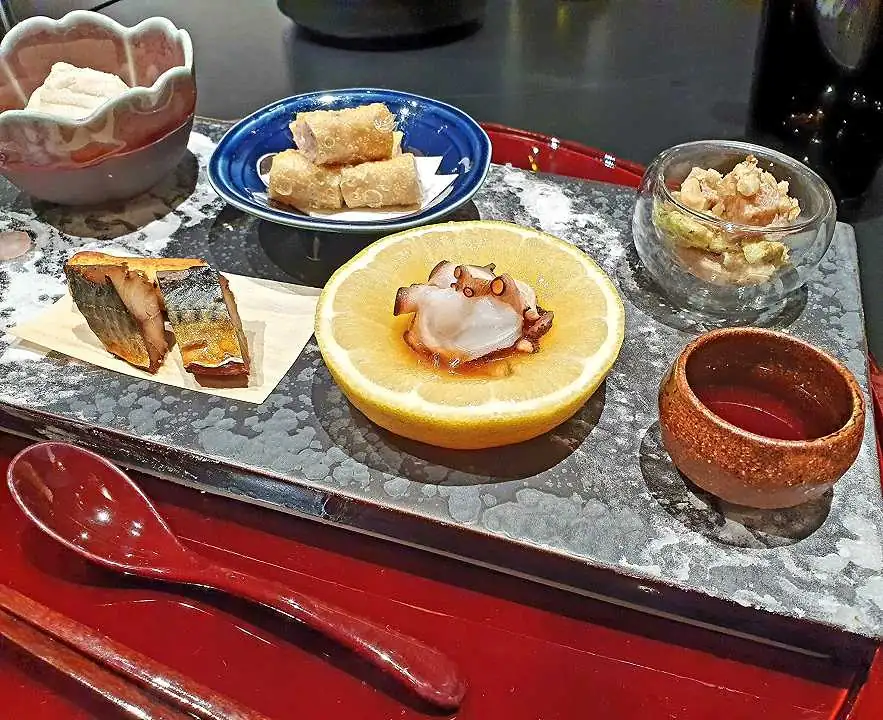
Nature on a plate means, first and foremost, seasonality. And perhaps the most poignant passage of the overview, significantly at the center of the rigid sequence marking the crescendo and decrescendo of cooking methods, colors, and textures, is the composition of seasonal samples. An evocative yet profane altar celebrating winter, a slab dusted with snow white and slivers of turnip macerated in red wine to recreate the petals of a winter cherry tree. The merry-go-round begins with a playful allusion to the quintessential inexpensive snack, surimi. Crab sticks from the supermarket, here octopus, white fish, and pressed squid, wrapped in tofu skin and lightly fried. The hake escalope freshly fried in rice flour returns to the play of white, its luminous color matched by a surface texture that is more of a light, powdery ripple than a fried appearance. All supported by a powerful emulsion of turnip tops and dashi broth.
The lightly seared octopus slices are crispy and surprisingly not rubbery for being almost raw. The bergamot sauce complements them in a sea-citrus unison that tastes like a fresh thrill. The landscape changes, perhaps even nocturnal, with the soy-cooked mackerel fillets and scorzonera (a tuber) marinated in miso paste. It's sweet, fibrous, and melting, reminiscent of carob, perfectly enhancing the fish's brittle flavor.
I won't delve into the perennial, unresolved question of whether food, at least in some forms, should be considered art, but if one fact points to the yes, it's this: in both cases, the narrower the regulatory framework, the more structured the framework, the more creative inspiration is driven to maximum originality. From five rigid lines of the musical staff and endless, tedious compositional rules, the freest and most extraordinary music is born. The same thing happens in kaiseki cuisine, with courses served in a rigid sequence that reflects the healthful properties of the foods, with the meticulous balancing of flavors, textures, and colors, with the progressive and graphic narration of the season in question. With the calibrated succession of cooking methods, from light to more aggressive, and then decreasing again until the meal is complete.
So we begin with a small appetizer (here's the menu), a cauliflower cube pressed and steamed like tofu, on a light, dense Romanesco cabbage cream. The journey continues with a steamed course: a grouper fillet, albeit dry and stringy, immersed in a delicate, clear soup brimming with all the winter imaginable. A citrusy aftertaste, pumpkin sticks, and Brussels sprouts rounds like water lilies in a forest pond.
The sashimi features squid carved into strips, silky and sweet like homemade pasta, and the fresh, herbaceous kick of fresh shiso leaves (Japanese basil). After the aforementioned winter landscape, the fried dish features homemade tofu (who else makes that in Milan?) in a double layer with scallops and a precious sea urchin garnish. The grill (yakimono) section features char-grilled red mullet. The marbled fillets, rich in flavor and pinkish-orange in color, resemble pieces of raw coral nestled in a salty landscape of roasted endive ribbons and small, salty meringues like sea foam. It's reminiscent of a windswept winter beach. Flakes of fried artichoke pounded in a traditional mortar complement the best dish of the evening. The experience concludes with a hearty second course of rice flavored with grilled scorpion fish and green tea and puffed rice ice cream.
There are different levels of kaiseki cuisine, naturally commensurate with cost. At Hazama, a relatively simple, essential version is served, albeit within the scope of the intrinsic complexity of this style. Eating kaiseki in Japan, for example, I encountered a cuttlefish innards, extracted whole with a single, precise gesture and thanks to a small knife created specifically for that purpose. Raw, immersed in an indecipherable sauce and gulped down in one go, it was a truly extraterrestrial morsel. I've seen (and eaten) compositions that are hard to believe are standing together, given the complexity and meticulousness of their forms. I paid, however, much, much more. With a €95 offer (excluding drinks), chef Satoshi-san brings a more accessible and uncomplicated take on kaiseki cuisine to Milan. And certainly a remarkable value.
Opinion
The only restaurant in Milan (if not in all of Italy) offering kaiseki cuisine, the pinnacle of Japanese gastronomic culture. Lazily assimilated to Western signature cuisine, its true essence lies in the celebration of nature and seasonality through a tasting menu of sophisticated small dishes. Hazama honors this tradition with appropriate skill and imagination. The atmosphere is understated and refined.
PRO
- A very rare (and welcome) example of kaiseki cuisine, the highest level of elevation of Japanese gastronomy.
- Refined ingredients, imaginative, evocative creations, very well executed for the most part.
AGAINST
- The kaiseki style can reach higher levels of sophistication than what is proposed here.
- Of the two rooms, only the first is very beautiful and stylish.