Hostaria da Franz, review: comfortable fine dining in Venice's most gastronomic district
If we were the kind of people who launch new trends, who sense the wind, who anticipate gourmet destinations, we could say that Castello—the Venice district home to, among other things, the Arsenale and the city's only "street," Via Garibaldi—is the lagoon city's new gastronomic destination.
The story
Taken over in the mid-1980s by Gianfranco Gasparini – with decades of experience in the sector – and initially located near the Biennale Gardens, after about thirty years the restaurant changed location, moving closer to the Arsenale: its current location is a few steps from Campo de la Bragora in a side street (a branch of the bakery, confirming the place's gastronomic vocation) away from the main direction.
History has it that the name of the establishment derives from that of its founder Franz Habeler, an Austro-Hungarian soldier who at the end of the 19th century transformed a rope factory – a factory producing ropes and cords for the city's naval industry – into an inn.
The name has retained its lexical connection to the past (the "Hostaria"), but today's renewed context has managed to simultaneously distance itself from both the sirens of the sly call to hyper-Venetianness and the tendency to transform everything into a bacaro or fake-antique tavern—emphasizing wood, barrels, counters, and sometimes references to the therapeutic virtues of wine—and from the opposite tendency, which transforms the perhaps rustic characteristics of the past into frills with narrative ambitions that lead to various declinations of bistros, wine bars with kitchens, and the like.
Here, the direction set has been, and continues to be, clear, focusing on craftsmanship (in the kitchen but also in the careful design of the spaces and the choice of furnishings), following tradition without entrenchment but instead using it as a starting point for contemporary thinking about techniques and raw materials. Franz's character today is owed to Gianfranco's son, Maurizio Gasparini, who has succeeded in firmly and consistently managing the name and identity of the place, treating the generational transition not just as a matter of demographics but also as an opportunity to keep up. It's perhaps no coincidence, then, that his son Gianluca, serving as sommelier, displays the same aptitude for sobriety and expertise.
The environment and the service
There are about thirty seats, arranged in a single room, but each table feels like a separate space, thanks to a number of thoughtful touches both in the tables and the overall furnishings. The use of poldinas of varying heights to create intimate spaces, the overall lighting avoiding excessive glare but creating a sense of warmth, further enhanced by the wood, the use of Murano glass chandeliers and sconces, and mirrors to amplify the space, a focus on subtraction and elegance rather than excess: everything points to the overall decision to ensure that every detail builds an overall narrative.
From the moment you are welcomed to the service—which is conducted with courtesy, especially towards foreign customers to whom the dishes are explained calmly and in detail—to the dishes on the menu, the impression is one of overall consistency and good taste.
The menu and prices of Hostaria da Franz
The menu successfully focuses on a few dishes: four or five options per section, with fish taking center stage and meat serving as an alternative. As is often the case with other establishments in this segment, the menu changes seasonally and, in the case of the fish of the day, daily. The Venetian lagoon remains the reference point, not only for the fish dishes but also for the vegetables.
The menu manages to play a dual role, satisfying both those who prefer to approach the city's gastronomic history through a leisurely pace—perhaps because it's their first time in the city—and the more adventurous, who prefer more innovative pairings and contemporary references. In both cases, the menu is well-crafted, there's no excess, and the overall impression is one of universal pleasure. Prices range from €26 to €32 for appetizers, €26 to €27 for first courses, €32 to €34 for second courses, and €10 to €12 for desserts. The wine list is extensive, with interesting options by the glass as well.
The Dishes: How to Eat at Hostaria da Franz
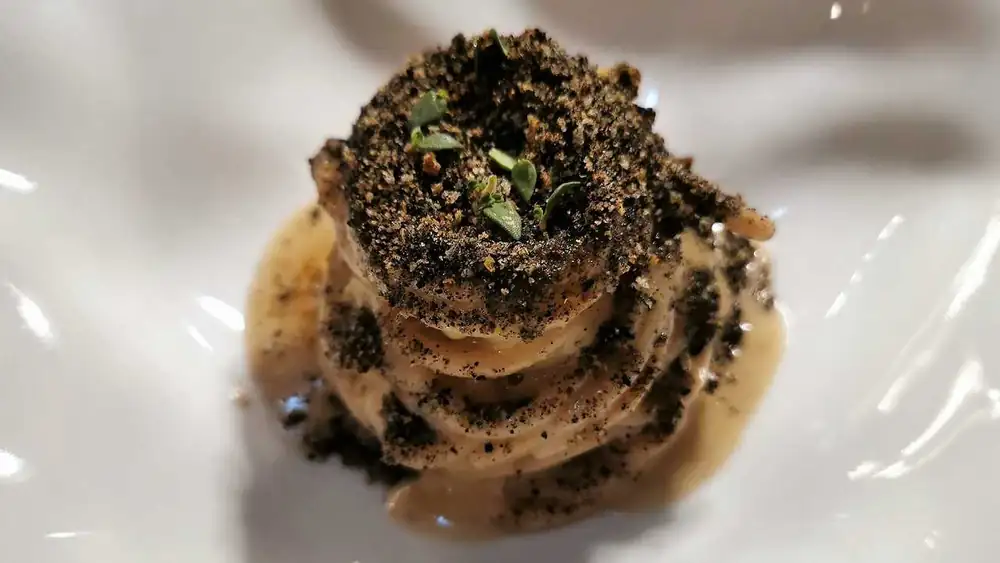
The opening dish features baby calamari in mole sauce: the quality of the ingredients is undeniable, revealing a touch that enhances the dish, focusing on cooking and a few ingredients: meaty and almost crunchy, they are enhanced by a sauce that isn't too overpowering and by the vegetable element that picks up the crunch and plays on the contrasts with the bitterness. Intentionally muted in tone, but with a result that reveals refinement and velvety on the palate, the spaghetti with smoked butter and anchovies follows in the footsteps of the bigoli in sauce, softening their savory flavors and allowing the onion to be a mere drizzle of air in the finished dish. Applause for the colors and serving temperature, which maximizes the smokiness. Often penalized by banal preparations, here the red mullet, among the second courses, finds its place: paired with friggitelli and chicory in garum, it not only manages to bring out its own voice but also to dialogue with both vegetables.
The use of garum is very interesting: while we will probably never be able to understand exactly what the taste of the ancient Roman sauce was, the version proposed here plays on the umami but doesn't go so far as to overwhelm the flavor of the chicory, which remains a tasty but not overly strong condiment.
The finale is all about wonder, play, and fun: atop a nest of kataifi pastry, "El vovo" appears, a fake egg made of white chocolate and passion fruit, closing with the restrained sweetness of the chocolate and the fresh, slightly tart notes of the passion fruit. Non-cloying and highly enjoyable, it hits the mark, with each spoonful following the previous and leading to the next. Venetians, people from Veneto, and even dialect lovers, are left with not only a satisfied palate but also a smile at the use of a vernacular term. Someone with a good memory, or simply someone who had grandparents with a liquor cabinet in the living room, might remember "El vovo." Regardless of their reading level, a fitting finale.
Opinion
In Castello, Hostaria da Franz is a surefire destination: family-run, the setting elegant but not overbearing or cloying, and the menu features carefully selected dishes that reflect seasonality and market availability. The dishes draw on traditional references, but those working in the kitchen have the savvy to keep pace, lightening, modernizing, and introducing techniques and ingredients that bring a fresh twist.
PRO
- Well-made homemade bread and very pleasant welcome entrées.
AGAINST
- The type of clientele perhaps does not allow one to dare to the fullest in the kitchen, where the hand would allow it.