Fictional: New fine dining restaurant in Budapest
A lot has changed in the life of Fiktív in the months since its opening in September. What impact have these new developments had on the development and organic growth of the restaurant concept?
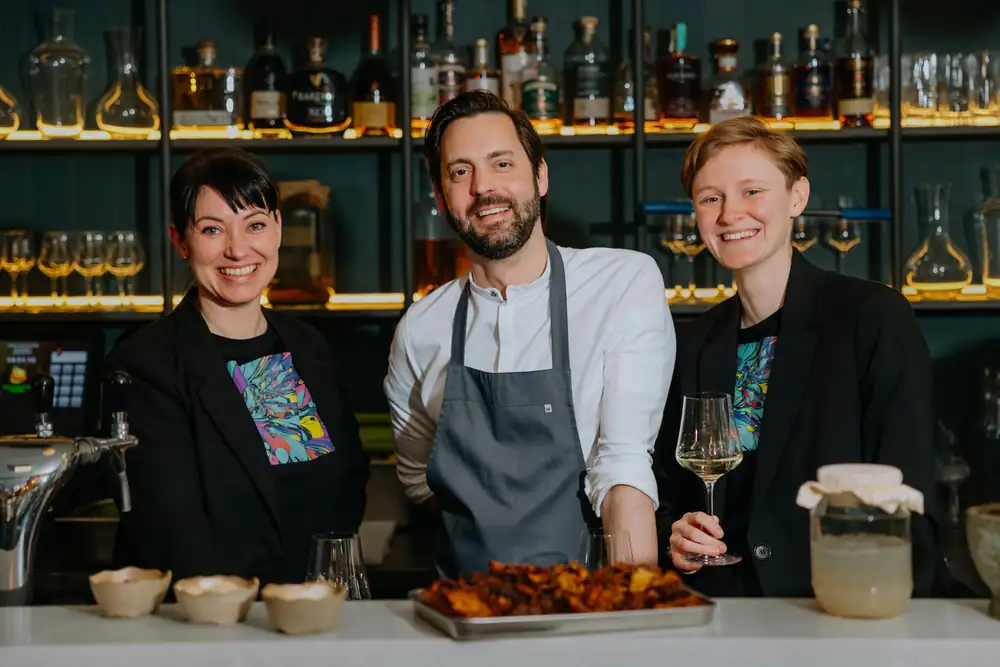
Márton Tatai: The most important event of the recent period was the joining of Zoé Péli. Zoé is responsible for the non-alcoholic drink pairings, and we can also thank her for the changes that have taken place in the guest space. The space is full of life and objects that enrich the guest experience, we have started to move in, we feel very comfortable in it.
Orsolya Kovács: We have had a busy and intense period behind us, with a lot of shared thinking. Thanks to the work of the past few months, the restaurant concept has become much more complex, and with the launch of Zoé and non-alcoholic drinks, Fiktív has come to fruition very nicely.
Non-alcoholic drink pairings are becoming increasingly popular in Hungarian restaurants – can you tell us about how you got into this world? What do you think are the most interesting aspects of creating a non-alcoholic drink menu?
Zoé Péli: I worked abroad in many places, including Germany, Malta and Slovenia at the three-MICHELIN-starred Hiša Franko. I spent a long time searching for my next step. Hiša Franko was a very important stop, I was able to learn everything from the person in charge of non-alcoholic beverages there, I was completely absorbed by this world and it put the genre of beverages in a different dimension for me. Just like wine, non-alcoholic beverages have an identity, you can experiment with them a lot – with sweetness, saltiness, acidity, vegetables, fruits, fermentation techniques. This topic is inexhaustible.
When you opened the restaurant, you emphasized how important it was to find what authentic Hungarian cuisine meant to you, and how important it was to be punk, brave, and free in this scene. How have these thoughts shaped up over the past few months?
Márton Tatai: The goal is still to kick the house down a notch and show that fine dining can be done this way – with common, accessible ingredients, with coolness, bold pairings, a spicy dessert, a salty drink, or even a cocktail pairing instead of wine. I think we have gained serious strength and are increasingly able to represent what we want. We are constantly working to take our thoughts to the extreme, to the extreme, to give guests an experience they cannot find anywhere else. We are maximalists, while also wanting to leave room for development and experimentation. We want to take this all so seriously as long as it is comfortable, emotionally and mentally sustainable, and most importantly: as long as we enjoy what we are doing. When you start to overthink or overcombine things, over time you lose the identity and concept that you were originally enthusiastic about. One should not box oneself in and get stuck in what one does.
Orsolya Kovács: As we mentioned in our previous conversation, at the beginning of the work we often had the question 'Is this possible, is this allowed?' - perhaps now we are less worried about such things. We have experienced that these three areas, which we have now nicely linked together - food, wine and non-alcoholic beverages - have a very exciting interaction with each other, which the guests also perceive. This work is a continuous dance on a razor's edge, the goal of which is to convey the trinity of joy, quality and professionalism.
Zoé Péli: We want to get our guests out of their everyday lives with what we present. Part of this identity is how closely we work together as a team.
Could you tell us about the creative processes in the restaurant? How do the three different areas of food, wine and non-alcoholic beverages complement each other? How should we imagine the team dynamics?
Orsolya Kovács: The creative process often begins with a wine arriving, we sit down, taste it, and discuss our thoughts. After the tasting, everyone goes away for a while, we think about what would be worth getting out of the pairing, what flavor profile would suit the wine, both in terms of food and non-alcoholic drinks, and then we share our ideas with each other. Zoé's personality has added a lot to the past period, her energy and drive, her experiences abroad, and last but not least, the fact that she belongs to a younger generation, brings completely different perspectives to Fiktív.
Zoé Péli: Our days are very intense, we think, talk, taste, listen to each other's thoughts, create flavor palettes. It means a lot if you can work in a place that not only stimulates your brain, but also lets you think, be creative, and doesn't stop your crazy ideas. Orsi and Marci's thinking and professional experience give me a lot. I think the key to everything is to respect each other and the other's work.
Márton Tatai: In this profession, you can often feel that you are alone in the field you are in, and it means a lot when this circle opens up and you can be with like-minded people. It is a privilege. These human relationships mean a lot both at work and in everyday life.
Just like the food, the wine pairings also represent a bolder, not necessarily conventional line. How much have you changed the wine list compared to the beginning?
Orsolya Kovács: A lot of exciting things have happened with wines in the past. Previously, we had a Hungarian and a foreign selection, but we realized that it would be best to create a line in which we could show our favorites, so the Fictitious Drinks Line was born. It includes Hungarian, foreign, sweet, dry, white, red wines, but also cocktails and champagne, all of which are aromatic pairs with the dishes.
When the restaurant was launched, we paired wines with existing dishes, but now the opposite often happens, with Marci looking for the right dish for a specific, particularly exciting wine. Wine is a living substance, it changes, while we ourselves cannot change it, so it is interesting to match the dishes to it. There are some pairings that we have not disturbed, for example, the smile-making unity of mushroom soup and Tokaji.
Márton Tatai: These are the examples that perhaps best characterize the identity of Fiktív – flexibility, being in constant motion, and tuning into each other's work.
What were the most important considerations when putting together the non-alcoholic beverage line?
Zoé Péli: There are so many surprises in this area, and the possibilities are truly endless. The drinks are made from different vegetables and fruits, and with fermentation techniques. We cover the entire spectrum of flavors, from sweet to salty to sour; I use miso, celery, vanilla, chili. It is exciting to observe how a non-alcoholic drink goes with a dish. It blends in or counterbalances it, enhances its earthiness, or adds to its sweetness. When it comes to non-alcoholic drinks, it is important to look at the wine, observe its properties, and even start from these. It is exciting to watch how guests are increasingly interested in this direction, those who choose wine pairing often ask to taste a non-alcoholic item. This world is just beginning to open up for many.
You don't change the menu all at once, but rather item by item, sometimes reflecting the availability of an ingredient or wine. What are the practical benefits of this process?
Márton Tatai: We are basically a small restaurant with a small team. We continue to work on and develop the dishes after they have debuted, looking for mistakes and improving them. The advantage of gradually changing the dishes is that we can also add vegetables to the menu that are only available seasonally for a short time. What is perhaps even more important is that the error factor is much lower if you do not change seven items at once, but gradually, course by course, ingredient by ingredient. We do not want to make any compromises, so it is important to clearly understand each process step by step.
Which dish or pairing elicited the most surprising reactions from your guests?
Márton Tatai: Reactions vary greatly. The sweet wine and mushroom soup pairing is very divisive, as is the spicy dessert. There are usually two extremes, some are very enthusiastic about surprises, some are skeptical. Different dishes make every guest smile, and different dishes mean something to everyone.
Fiktív offers its 5- and 7-course menus at much more affordable prices than other fine dining restaurants. How sustainable is this model from a business perspective?
Márton Tatai: If we look at the menu, we can see that we work with domestic and seasonal ingredients, often with undervalued vegetables such as Jerusalem artichokes or beets. These ingredients are very exciting, you can get a lot out of them, while they are not expensive. We could put more large-scale ingredients on the menu, so to speak, but our goal at Fiktív is to present an alternative Hungarian gastronomy in which these ingredients dominate.
You have mentioned several times before that the concept of Fiktív also places a high priority on making fine dining understandable. How can the concept of fine dining be brought closer to the younger generation, who are fundamentally open-minded but perhaps still have little knowledge of the subject?
Márton Tatai: This is still a very important goal for us. We have a lot of plans, including visiting EFOTT in the summer, where we would like to show ourselves to the university audience. We are preparing an exciting concept, and of course, in addition to food, wines and non-alcoholic beverages will also be a big focus here. We would like to address this audience, show them how many choices they have, how diverse the gastronomic world is here, that for the same price as eating a burger, you can try something cooler. We would like to show another, more colorful face of ours at these events.
Orsolya Kovács: Events like EFOTT are important from an educational perspective, the younger generation needs to be addressed on their own terms. This audience is very receptive, and we think that if even a small group starts to be interested in this topic, we have already achieved something.
How much do you plan to expand the team?
Orsolya Kovács: It is very important for us to interpret Marci's thoughts about the dishes during the service, and to have complete knowledge of the dishes and all the details. This work is only worth doing if all members of the team have this knowledge. Since we basically do not operate as a place with a high number of guests, it is now enough for two of us to provide service, but in time we will probably want to add one more person to the team, but that is still a matter for the future. We have also refined the service a lot, we want to be professional while maintaining a relaxed, informal atmosphere.