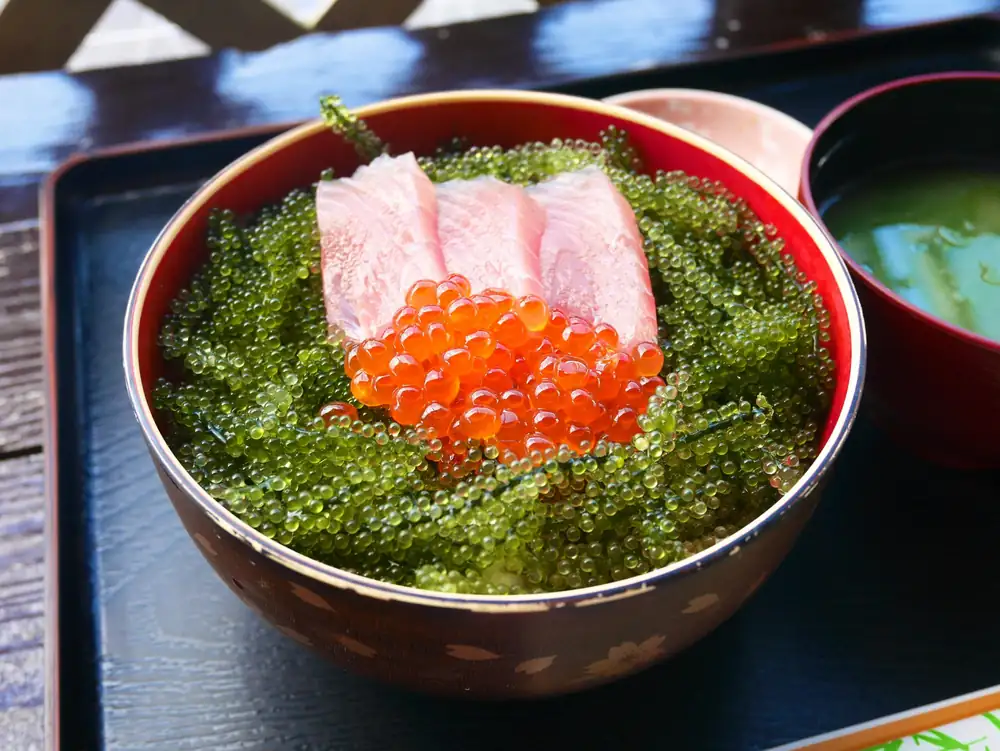
Green caviar, or sea grapes: the small luxury of the ocean
Despite its name, green caviar is not fish roe, but a seaweed. Tiny, bright green beads line up on thin stems like miniature grape clusters: this is Caulerpa lentillifera, a marine plant known as umibudō in Japan.
Texture that pops
The key to its appeal lies primarily in its texture. When eaten fresh, the tiny spheres delicately pop open, releasing a slightly salty, clean flavor reminiscent of the sea. Its crunchy, juicy, and subtly umami character simultaneously adds elegance and playful contrast to a dish.
It is usually served raw – with soy sauce, citrus or miso – as heat quickly destroys its delicate structure. It is no coincidence that it is also a popular ingredient in ASMR videos: the characteristic popping of the pearls provides a unique experience in both sight and sound.
In addition to its culinary delight, it is also notable for its nutritional content: rich in iodine, calcium, and vitamins A and C, while low in calories, it still contains significant amounts of fiber, omega-3 fatty acids, and vegetable protein.
From an Asian specialty to a global trend
Traditionally harvested in coastal waters of Japan, Vietnam and the Philippines, sea grapes are now increasingly being grown in sustainable aquaculture. The growing demand is not only due to gastronomic interest, but also to an open-minded, forward-looking approach to raw materials. European chefs are also showing increasing interest – especially in Scandinavia, where marine plants have long been the basis of modern Nordic cuisine. In this context, the “little pearls of the sea” are an integral part of the regional cuisine. In Japan, especially in Okinawa, green caviar has long been a local specialty, sometimes referred to as the “algae of longevity” – not without the fact that the region is home to one of the world’s most long-lived populations. Although its price tag is far from modest, green caviar easily transcends its tropical roots as an accompaniment to a fish appetizer or a fresh, seasonal salad.