The bread of the Italians – we talked about focaccia with Giorgio Cavicchiolo
Ancient roots
Most historians believe that focaccia originated with the Etruscans, who lived in north-central Italy before the rise of the Roman Empire. However, other theories suggest that the first versions appeared in ancient Greece in the early first millennium BC. It is important to note that flatbreads similar to focaccia, but unleavened, had been made in many parts of the Middle East for thousands of years - so the universal presence of this type of bread makes it difficult to pinpoint a single culture as the origin.
The Romans and “panis focacius”
The name focaccia comes from the Latin phrase “panis focacius”, which means “bread baked on embers”. In Roman times, this bread was traditionally baked on the embers of the hearth (or “focus”). The recipe at the time was simple: coarse flour, water, olive oil, a little yeast and salt – without spices or toppings. It was also practical to eat: it was torn into pieces by hand and dipped in salty, vinegary soups – similar to how it is still served with olive oil and balsamic vinegar in many Italian restaurants today.
Distribution: From Italy to Europe
With the expansion of the Romans, focaccia also traveled further, finding a home in France and Spain. Initially, it was mainly a food for the poorer classes – servants and rural peasants. From this, for example, it developed:
Pan de hogaza – a local version of focaccia in Spain, which served as a simple bread for the rural people. Fougasse – developed in the southern regions of France (Burgundy, Provence, Languedoc), often enriched with spices, olives, and occasionally bacon.
Regional variations in Italy
Although it is made all over Italy, focaccia is native to Liguria, particularly the city of Genoa. Focaccia Genovese (locally known as “fugassa”) has a thicker, softer dough and is generously drizzled with olive oil and salt before baking. Some variations use onions, rosemary, or even grapes.
Focaccia barese – comes from the Puglia region and is often made with tomatoes, olives, and potatoes. Focaccia di Recco – also popular in Liguria. Melted cheese, usually stracchino, is often placed between the thin layers of dough.
Focaccia dolce – A sweet version made with sugar, honey, raisins or grapes, mainly eaten in Tuscany or during the autumn harvest.
Focaccia in Aleli
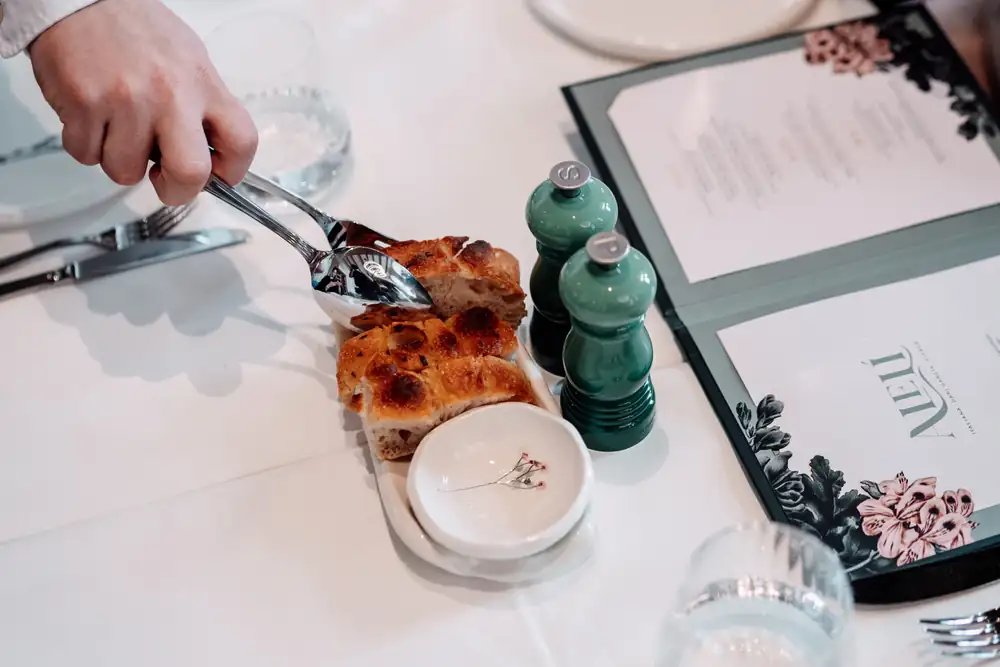
“At Alelí, the very first bite that the guest encounters is our own focaccia, which we offer with olive oil. Focaccia is different in each region of Italy, as the ingredients – water, flour, olive oil – vary from region to region, so no two are the same. We thought a lot about which type to make, there are thinner and thicker versions. In the end, we decided on a type that is cloudy and soft. Because of the quantities, we make it with yeast, from very high-quality 00 and semolina flour. We leaven it for a long time to achieve the perfect consistency. Coarse salt and rosemary are added on top,” says Giorgio Cavicchiolo. We also make pizza at Alelí, and there are many similarities between the two doughs, as the bases are the same. But while pizza is 2% olive oil, focaccia is 10%. A sheet of focaccia is made with about two kilos of flour and baked for 40 minutes. It is often on the Sunday table at our house.”