“Food is a love language” – A conversation with Norbert Krasznai about his first cookbook
When did small plate style become your passion?
I have worked in quite a few styles over the years, but I really found myself in the small plate approach. I am a closed type, so it is interesting that such a communal genre is the closest to me. Fleischer Restobar in Budapest was the first international small plate place where I worked, and I have completely moved in this direction in my private cooking. This is the best way for me to show what I love and represent. It is a relaxed, informal, less rigid genre, you can serve more food at the same time, there are fewer rules. I also see from the guest side that people enjoy it more: you can eat anything with anything, everyone is free to choose.
The term small plate now goes far beyond serving size. What does it mean to you?
It's much more than a series of smaller portions. It's an approach. It's about people sharing food and talking and connecting. I often see strangers sitting at a table and starting to communicate through the food. You don't have to commit to one dish, you can taste everything that's on the table. We listen to each other, we share, we experience something together.
Moreover, this method works very well not only in restaurants, but also at home. You can prepare a lot of things in advance, it doesn't matter if a dish gets cold, or if it is prepared the day before. It's not a big job, it's just more convenient. And it gives you an experience at the same time.
What was the point when the idea for the book was born? Why is this topic important to you?
I never felt like I had to write a cookbook. The idea for the book first came to me, my partner, Noémi Korcsmáros. The goal was for people to be able to prepare the same dishes at home as they had tasted at my place. We wanted to show that the small plate concept works well in a home environment.
You and Noémi wrote the book together. What was the division of labor like? What was easy or difficult about collaborating?
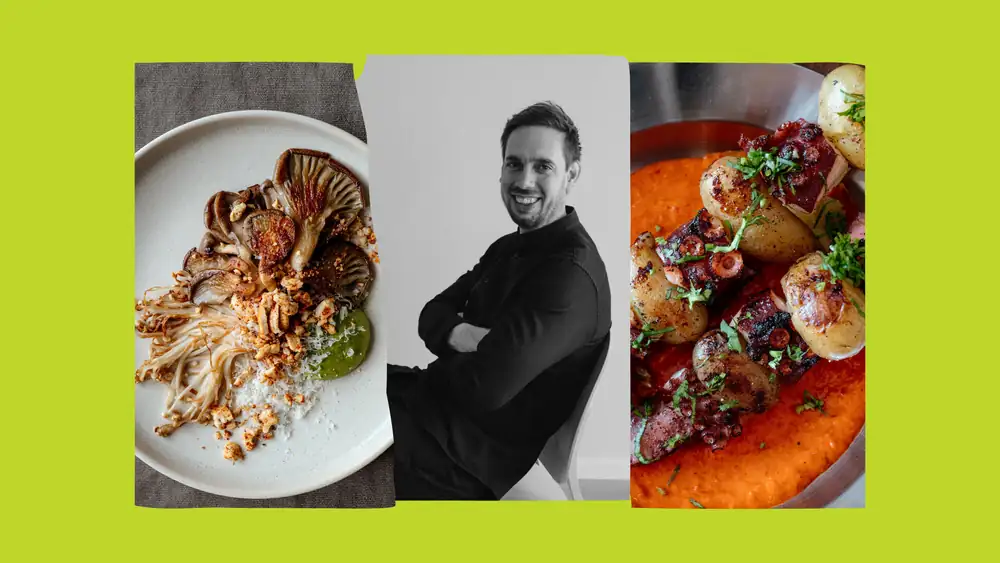
We did everything together. The photoshoots took place in our home, and in our neighbor's when the kitchen was finished. The book was photographed by Bálint Széll, who we had worked with before. We knew he would capture the food exactly as I imagined it.
The work wasn't always easy. We cooked and photographed nearly forty dishes in a single weekend. I wouldn't recommend writing a cookbook together as couples therapy. The goal was the same, but we both had different priorities, and it wasn't always easy to coordinate.
The biggest challenge was not to overcomplicate anything. The book is for everyday people, not beginners. We used ingredients that can be bought in almost any supermarket.
You often talk about the small plate genre as an approach. What has it taught you about food and people?
That eating is much more than nutrition. There are people who don't care what they eat, as long as they're not hungry. For me, eating is quality time spent together.
People love to connect. When more food is on the table, they automatically start talking about it, sharing it with each other, recommending it to others. This makes a meal a social experience.
The title of the book is Let's Eat Together. Why do you feel it's important to highlight this?
For me, gastronomy is primarily about togetherness. It doesn't matter who you eat with and who you spend that time with.
The experience of eating together has remained with me since childhood. Food is a love language. Everything I put on the table is in it.
Vegetables are increasingly the main characters in your diet. How do you see the meat-free, vegetable-centric diet changing in your country?
I find that people have become much more open-minded. Of course, we also operate in an environment where vegetables play a more important role, but I clearly see a change.
The vegetable section is also the longest in the book. These are the dishes I enjoy making the most, and they are the ones that guests have highlighted most often at private dinners. A vegetable can be presented in many more ways than a meat. You can bring out so much texture, character, and flavor from it.
I prefer to cook vegetables at home. I don't particularly like to cook meat, and classic Hungarian dishes have never been close to my heart. Influenced by Asian cuisines, vegetables have also become increasingly important to me.
Do you have a favorite recipe from the book?
Every recipe is my favorite. I chose them in the book because they are all close to me in some way. If I had to highlight something, I would say the vegetable and vegan dishes, and the exciting, characterful flavors. I love it when vegetables are not supporting characters, but really play a leading role in a dish.
Is there a recipe that has a special personal connection to it?
Two dishes definitely stand out from the book. One is the duck leg strudel, the other is the cottage cheese dumplings. Both were iconic dishes at Lake Balaton. It happened that someone ordered four servings of the cottage cheese dumplings and then went home satisfied. These simply could not be removed from the menu, so it was natural that they would be included in the book.
What are your favorite ingredients?
I really like Middle Eastern, Mediterranean and Asian ingredients. I often use fresh coriander, za'atar, sumac, cumin. My use of ingredients is distinctly international: I also use hummus, gravlax, ceviche or even chicken liver cream with cherries.
I love it when an ingredient carries the influence of multiple cultures.
Did writing the book change anything in you?
I learned to let go of perfection. At Societe, I worked in a very tight, fine dining world where everyone was striving for 100 percent. At Balaton, however, I often had to solve everything on my own and I realized that there was no need to overcomplicate things.
The small plate approach reinforced this in me. A dish can be more relaxed, freer, less perfect. If the atmosphere is good and people enjoy it, then everything really falls into place.
I'm really curious about the reception of the book. The feedback will definitely show a direction. And yes, I would easily jump into another book. I still have plenty of recipes in my head.