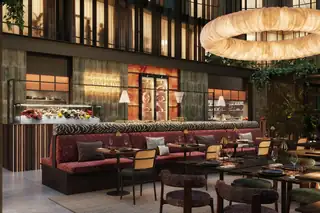
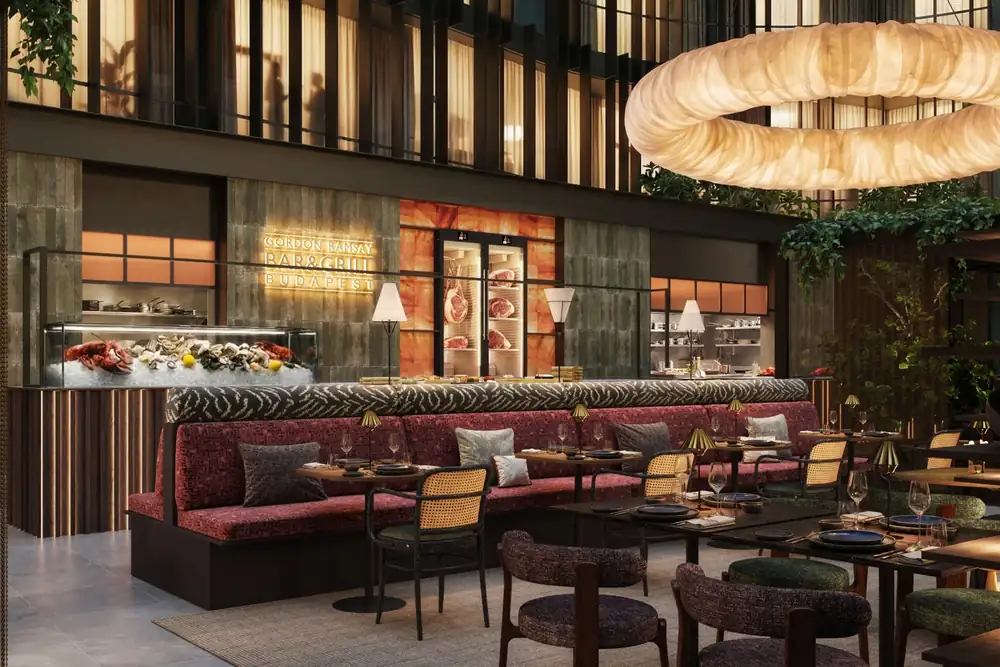
Gordon Ramsay Bar & Grill Budapest will open at the end of July, where London and Budapest philosophies meet
Lilla, you returned to the region after many years. Please tell me about this change!
IL: I have indeed lived and worked abroad for a long time. I grew up in Slovakia, I left my country many years ago. Over the years I have participated in many pre-opening projects in London and the Middle East, which were professionally defining for me.
I am very excited about my current assignment for several reasons. On the one hand, Gordon Ramsay Bar & Grill is a prominent, strong and credible brand on a global level, and it is a huge responsibility to represent it in Central Europe and open it in Budapest. On the other hand, it is also special on a personal level, because I feel like I have been able to return to my roots, close to my home, after many years. So this project is both a professional and personal motivation for me.
What does Hungarian gastronomy mean to you, and what drew you back here?
IL: I think Hungarian gastronomy is fundamentally beautiful. It is very rich, has character, and many of its dishes are known worldwide. However, it is always a different experience to experience a cuisine in your own country than abroad – especially to represent it.
András, what were your most important milestones abroad before you came home from the English capital?
KA: I moved back to Hungary about seven years ago. I built my entire academic and professional journey in London, where I was able to work in several well-known and respected places. After a while, I felt like it was time to return home. I always wanted to start a family in Hungary. That's why I consciously chose restaurants – The Savoy, Corinthia London, The Fat Duck, Gordon Ramsay Restaurant – where I could learn as much as possible, so that when I came home, I would arrive with a strong professional background.
Often the construction, design, or tight budget are considered the most difficult part of an opening. Lilla, how do you see it: is it possible to predict whether a project will be successful?
IL: I see it the other way around. The construction, design or technical background are the easiest parts to control. The biggest challenge in every pre-opening project is building a team culture. This is an invisible, yet very decisive component of a good restaurant experience. If we think about our own restaurant experiences, there are places where we feel that something is much more pleasant, better, more homely. There is good chemistry between the servers. We like to go to such places. In the case of this opening, the Marriott and Gordon Ramsay trainings together provide assurance that we will be able to create the team culture that is essential for this together.
Who holds this culture together in a project of this size? The HR manager, management, or perhaps an external consultant or coach?
IL: In the long term, as a leader, of course it is my mission to enforce, but it is actually a team effort. From the beginning, it is very important for everyone to have a vision, and this is not the job of one person, but a shared responsibility. We help each other. There is no such thing as “my department” or “your department” – this is our project. HR, marketing, the kitchen, the service team, the management all have the same mindset. And I can already feel that, which is a very good foundation.
András, how can you build the same culture in the kitchen?
KA: The team is also the basis of good cuisine. If you look at Gordon Ramsay's story, it's all about thinking as a team. Communication is key: you have to work with clear, unambiguous directions. Lilla and I have a very good relationship, we represent the same approach. Many people still see a "star chef" image behind such a restaurant, but in fact it's a very strong, coordinated team effort.
Do you miss something from London?
KA: What I miss the most is the buzz (it's not easy to describe it in Hungarian, but it's the "buzz"). Budapest also has its own energy, but in London there was constant pulsation and competition. There you could constantly feel that you "have to improve". If you don't keep up, you fall behind. It's a constant pressure, but it's also inspiring because it always pushes you forward. Since I moved home, I've been looking for this inspiration for myself.
Lilla, how has your idea of the guest experience changed over the years?
IL: There are huge differences in the world by region. In the UK, the guest experience is more about professional, fast, precise, almost invisible service. In the Middle East, on the other hand, relationship building and experience dominate: guests spend a lot of time in the restaurant, attention, spiritual presence are important to them, and if they are repeat guests, then getting to know them. It feels good when we see the guest not as a consumer, but as a person. I find that Budapest is now between the two hospitality styles. We have to be professional and personal at the same time. This is what guests expect: authenticity and connection.
KA: Exactly. The point is that the guest doesn't just come to a restaurant, but that we can create an atmosphere for them where they feel at home – as if I were hosting them in my own home. In the restaurants that we visited with the Gordon Ramsay team in London, even during full dinners, they tried to have a kind word for everyone.
IL: We talk a lot about guest satisfaction in both Marriott and Gordon Ramsay trainings – it is of utmost importance to both international brands. How do you welcome a guest at home? How do you want them to feel? This is not simple service, but hospitality. If someone learns the masterstrokes of this and uses them consciously, then that is the artistic standard of creating a good restaurant experience.
KA: And when that comes together, it creates a truly memorable experience. Often, the memory of a pleasant relationship is stronger than the actual food we eat in a restaurant.
András, how can international standards be harmonized with Hungarian raw materials?
KA: The brand works to very high standards, and this must be maintained everywhere. Gordon Ramsay's iconic dishes must be prepared the same way in all units. We participated in serious training courses, where we learned these complex recipes in the kitchen, first-hand, from the source. We also met several extraordinary chefs who have become masters of an iconic Gordon Ramsay dish over decades. It was a great experience to learn the mastery of these exceptional professionals. Beef Wellington, for example, is the same everywhere: three days of preparation, precise recipe, strict process...
Hungary has very good ingredients, gastronomy is developing. The task is balance: harmonizing London quality and local ingredients. There are also differences – for example, in the available seafood – but Hungary is strong in game meats, mangalica, goose, duck. Every country has its own identity, this must be connected to international standards. The English team is also a full partner in this, they specifically asked us to think as locally as possible.
Lilla, how do you see the future of the restaurant?
IL: I want this restaurant to be as successful as the brand itself, and the foundation for that is focus and consistency.
Do you have a favorite dish from the menu?
IL: I wouldn't single out any dishes from the menu because everything is strong, but the aforementioned Beef Wellington and the Sticky Toffee Pudding are particularly memorable for me. The latter I've only loved since I tasted Gordon Ramsay's recipe.
András, how do you see the future?
KA: I think it will be a successful project and we can become a flagship, since we are the first in Central and Eastern Europe. It is of utmost importance for Marriott to give young people the opportunity to develop, which is why the Marriott Voyage Program was created. It would be good if later they would come here from other units to learn, and we would become a kind of reference point.
Finally, we would also like to share the exact date of the summer opening with our readers – what would it be?
KA: The restaurant will debut on July 31. I can also tell you that although the sushi and grill concept has been present in world gastronomy for a long time, it will be an absolute novelty in Hungary in this form.