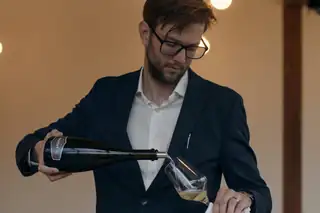
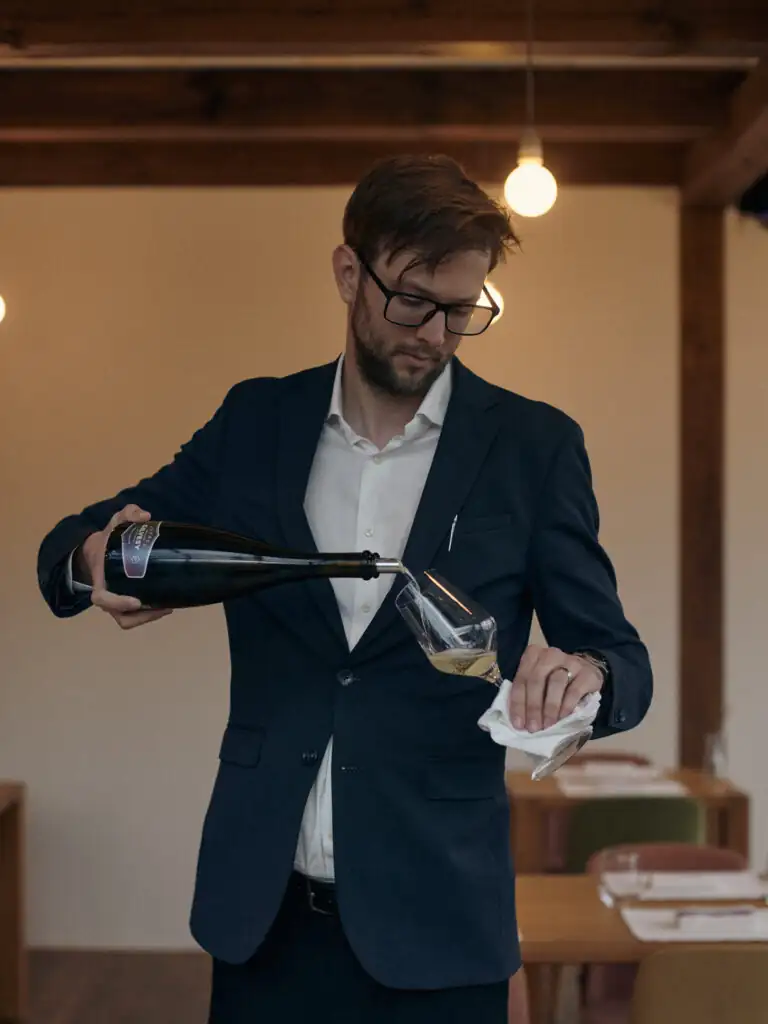
A story in a stemmed glass: interview with Márton Király, sommelier of Pajta
In the heart of the Őrség, just a few kilometers from the Austrian and Slovenian borders, we find the Michelin-starred Pajta. A restaurant that also functions as an accommodation, where Hungarian and Mexican flavors meet in the kitchen courtesy of István Akács and Yazmin Salazar, where dinner is accompanied by deer from the garden and where the wine pairings do not follow classical principles. We
How did you arrive at Őrség?
It’s been a winding road, but wine has always been the connecting thread in my life. I went to university in Budapest and studied something completely different, while I started working as a student worker in a wine shop. It was my old passion, and here I got the opportunity to continuously train myself – for quite a few years now. I went from student worker to assistant store manager, then store manager at the head of a wine shop in Budapest. In the meantime, I graduated in art history, and although the two may seem distant at first, I think there are many common denominators between the worlds of wine and art. In very broad terms and simply put, for me wine is much more than simple food. In every glass lies the terroir, the story of a landscape, and the work of the people who brought it to life from the grape to the bottle. That's why I consider a truly great wine not just a drink, but a work of art - something that is as much a privilege to experience and enjoy as looking at a painting, listening to a symphony, or reading a poem.
Since nothing really connected me to Budapest except for my studies and work, my wife – and then my girlfriend – didn’t either, so we decided to move. First, we went to the Balatonfelvidék region, where I ran a wine shop in Balatonfüred, and then we moved back to Western Hungary, to Szombathely, where we currently live. There was a period of about a year and a half when I stepped away from the active wine trade – I held independent wine evenings in local restaurants, told people about wine at tastings and events – and then one day I came across an advertisement from Pajta that they were looking for a sommelier, which I naturally applied for. I’ve been working here ever since.
What has changed in you since you joined Pajta?
Practice was the most important thing, but it was also the most difficult: to recognize the rhythm of service as quickly as possible, to find the right tone with the guests, to understand what kind of experience they come to us for, and what part of this experience lies beyond the plate, in the story that can be poured into the glass. I think what changed the most was that I gradually managed to shape this a little in my own image, while fully aligning it with the philosophy of Pajta.
There is no classic division of wine pairings by variety or style. Why did the arrangement principle become Határ Újí and Határ Újí?
This is a conscious decision that we handle very flexibly. Határon úden shows a cross-section of Hungarian wine regions, strongly based on grape varieties found in Hungarian wine culture and small, independent wineries – hidden treasures that our guests do not necessarily encounter elsewhere, or at least not often. It is also a conscious decision that nowhere is it described exactly what items make up the line: we represent personalized service, which is an ongoing dialogue – it starts the moment I walk up to someone and we start discussing how the wine can support their lunch or dinner experience. For example, if it turns out that someone does not like the character of volcanic wine regions, or the juhfark grape variety is not close to them, we immediately modify it – just like when the weather changes: in rain, cold, a warmer red wine is better, and in summer forty degrees we adjust the entire line to a lighter one. The common denominator is always the food and the menu, as the wine should support, highlight, and color this.
Beyond the Border is also a concept that can be interpreted broadly: here we want to show hidden treasures from the entire Carpathian Basin that are also not available anywhere else. Franz Weninger, a winemaker working in the Sopron-Kőszeg-Burgenland region, once said that he does not like to think in terms of borders, but rather in terms of wine regions. I think this is a very good attitude, because the borders may be drawn elsewhere on the map, but there are many common cultural and historical denominators that connect the region that literally lies along our borders. Of course, if someone wants to go out into the world and get to know more classic wine regions from the world of fine wine, we are also open to that, as our wine selection gives us the opportunity to discover the iconic wineries and defining wines of the world's most famous wine regions, from Bordeaux to Marlborough.
What criteria can a wine be included on the list?
There are no other restrictions beyond unquestionable quality and the preference for small, independent wineries. However, incorporating a wine is always the end result of a long process that starts in theory. We receive a description of the dishes on the new menu, we learn about the focal point of the plate, the role of the ingredients, the strength of the flavor, we discuss it with the chef – and I consciously use the plural here, because Krisztián Paksa, my store manager colleague, is also fully involved in this process. I outline wine suggestions in theory, the queue is formed, and then, when the menu change approaches, we start tasting: the wines compete with each other, which one adds what to the dish, how accessible, how rare or special it is – and everyone has a veto right. The chef, the store manager, the owners and me too.
We taste a lot of wine at this time, but on the other days we also go to tasting rooms continuously, winemakers come to us, we go to winemakers, we get samples. The hardest and most exciting part is that you have to build up a kind of memory bank in the process. Let's say, for example, that if I tasted a small-cellar Rhine Riesling last September that might work for next season's corn risotto, I have to be able to recall it and test it live to see if it really works. And if it works, that's happiness itself.
In addition to the wine pairings, you also have a separate wine list – how is that structured? Is there a winery with which you have a particularly close relationship?
We have a domestic and an international selection, the wine list is two-volume and changes very often, because we are constantly trying to update it with exciting small items. On the domestic side, there is a place for well-known, top-quality wineries, as well as for the most serious international champagnes, representatives of the largest red wine regions and curiosities.
I would like to emphasize that neither in terms of food nor wine do we operate exclusively with local or regional products – we also offer the world’s wine range, from Bordeaux to Rioja to Champagne, from the New World to the Old World. But among Hungarian wineries, we are truly grateful to be able to work with a few names. Without claiming to be exhaustive, these include Lenkey Winery from Tokaj-Hegyalja, Unger Winery from Kőszeg, Turay Family Winery from the Neszmély-Tata wine region, Maurer Oszkár from Szerémség – but I could mention many other examples. The common thread here is that an item can only be included in any wine list or on the wine list if it has a story, if it carries value and if its quality is impeccable. If these three conditions are met, then there are no exclusionary factors, because ultimately we convey value.
How does your work relate to the creation of the menu, i.e. when does the creation of the wine selection enter the process?
There is a major menu change twice a year – one in autumn-winter and one in spring-summer – and in between we are constantly fine-tuning and changing dishes. As soon as a new menu is launched, the kitchen starts working on it, and I am constantly working on it: I regularly go to tastings to find interesting things, but also to discover wines that will soon come in handy for a dish I am preparing. If I come across an outstanding quality wine that does not have a matching dish, I still make a note of it, because it can be recalled at any time later.
Was there a dish that was particularly difficult to find a wine to pair with?
I wouldn't say it's difficult, but rather exciting. There are always tricky elements – a dill-sour cabbage salad, a Székely cabbage salad-flavored sauce, for example. In such cases, you have to find what aspect the wine can add to the experience. It's more of a challenge than a difficulty.
And how new was working with Mexican flavors?
The heritage of our chef duo is definitely present on the menu, and this fusion of flavors is always exciting – I really enjoy the challenge. I tend to choose wines that are a little more spicy, representing flavors that are less familiar to the Hungarian palette: a more fragile, classic Hungarian white or a heavier, classic red would not necessarily fit in there. Just as the food operates on the borderlands, the wine should also be a little exciting, a little unorthodox.
For example, the last menu had a Mexican-Hungarian fusion dish, accompanied by a fantastically spicy, very limited edition Slovenian orange wine – a kind of exciting chaos. As always, the wine was the first thing on the table: the guest got to know it, I told him about it, what it was made of and why I chose it. Then the food arrived, and the whole chaos came together. But the food always comes first: we work at Pajta to convey the vision of our chef duo in the fullest possible form, and this also applies to the wine.
How smooth is working together, either with the chefs or the owners?
Maximum – it couldn't be otherwise. We have to respect each other's work, communicate constantly, and have complete professional trust in each other, because it doesn't work otherwise.
What do you think is the experience that makes most people visit you?
Pajta is located in a unique corner of the country, in the Őrség region, and no matter where you start, it’s a relatively long road to get there. I think this is a huge advantage, because the very arrival encourages those who come to us to slow down. We are in the green heart of the country, right in the middle of a national park: the landscape is beautiful, deer almost always come up to the accommodations in the evenings, there is peace and quiet, there is no signal. This is a rare value in itself. This is what the very high-quality kitchen work of the chef duo István and Yazmin is based on, as well as the service of Krisztián Paksa’s team, in which the owner couple also actively participates – this, in my opinion, elevates the whole thing to a celebration. And I work to ensure that the wines that are opened also contribute to this experience.
Are you working on anything related to the wine list right now?
We are working, we are constantly working. I can't be more specific than that, because for us it's not about one big project, but about continuous, small refinements that may not be spectacular in themselves - but these many small fine-tunings ultimately add up to an overall picture that would be different if we didn't do them.