Record harvest, regulation, and international tensions mark the final day of the Santos International Coffee Seminar
Panels on foreign trade, supply and demand, and the impacts of geopolitics brought together industry leaders in Santos (SP), highlighting optimistic projections for the Brazilian harvest and debates on adding value to national coffee.
Producers, exporters, researchers, specialists and representatives of the coffee industry met in Santos (SP), between May 19 and 21, to attend the 25th edition of the International Coffee Seminar, held by the Santos Commercial Association.
The final day of the event featured important debates. One of them was the "Regulatory Panel," with Marcos Matos (Cecafé), Bill Murray (National Coffee Association of the USA), Kevin Lardner (Rainforest Alliance), and Augusto Billi (Ministry of Agriculture and Livestock). The debates revolved around the tariffs imposed by President Trump, reaffirmed the importance of consumer education about Brazilian coffees, and the European Union's repositioning regarding the EUDR, aiming to simplify and reduce the costs of regulatory compliance.
Another highlight was the lecture on geopolitics, “The End of Hyperglobalization and Brazil,” by economist Eduardo Giannetti, who explored current political tensions and highlighted how this context can be a window of opportunity for Brazil in the deglobalization process. The country's potential, such as its clean energy matrix and its role as a global player in food production and rare mineral reserves, represents a competitive advantage that Brazil should use to reposition itself globally. Furthermore, the country's strategy should be one of a more open economy, increasing its imports and exports of manufactured goods. “In coffee, we will sell less raw coffee and more processed and industrialized coffee in Brazil, to add value,” he pointed out.
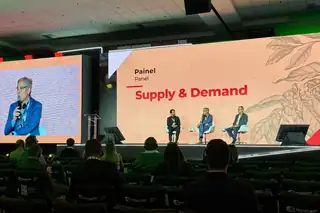
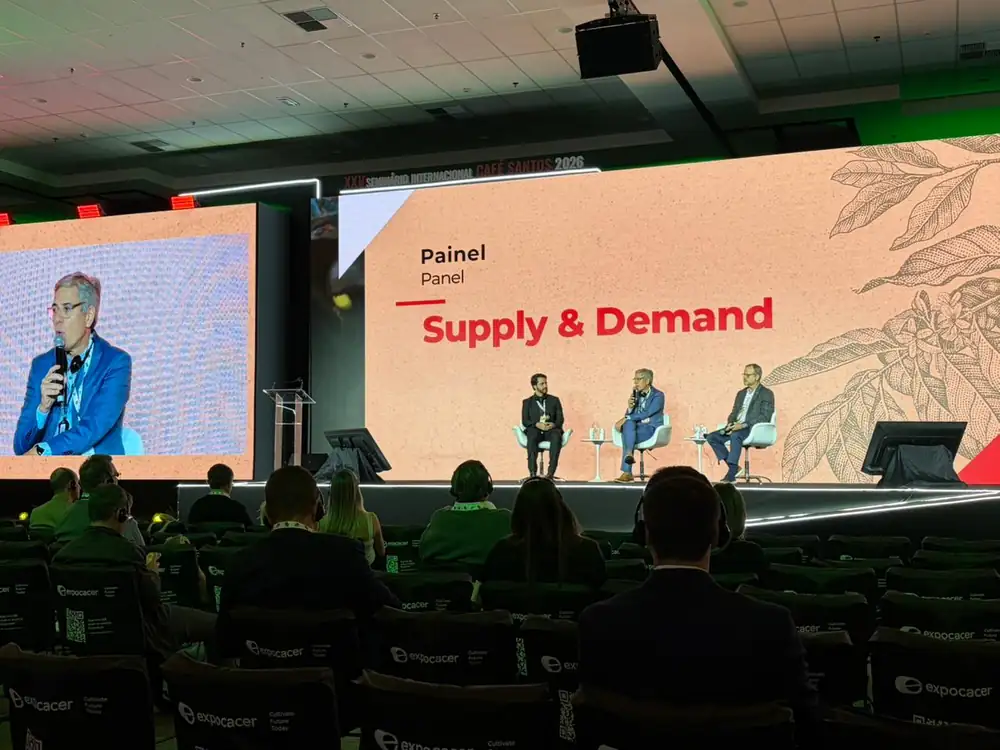
The vice-president of the Santos Commercial Association, Carlos Santana, led the panel “Supply & Demand”. Guests Claudio Delposte (Rabobank) and Oscar Schaps (StoneX) provided estimates of coffee harvest, climate and consumption in Brazil and worldwide, as well as issues of logistics and volatility of international prices and expectations for the next harvests in the main producing countries.
Both consulting firms predict a Brazilian harvest exceeding 70 million bags – 73.2 million (Rabobank) and 75.3 million (StoneX) – with Arabica reaching 48.7 million bags (Rabobank) and 50.2 million (StoneX), and Robusta, 24.6 million (Rabobank) and 25.1 million bags (StoneX). Thus, both project a global consumption surplus of between 8 and 10 million bags.