More Than Functional Fungi: How Mushrooms Are Flavoring Wine and Spirits
Extolled as closer to humans than plants and waxed poetic at the end of the world, mushrooms are having a moment (and have been for years).
Culturally, edible mushrooms capitalize on their seductive relation to health as much as danger, but when incorporated into an alcoholic beverage, mushrooms are flavor, first and foremost. In beverage alcohol, mushrooms cater to an audience that’s not afraid of drinking the funky, or at least savory.
Mushroom Country
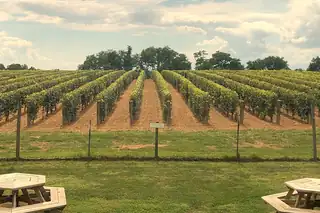
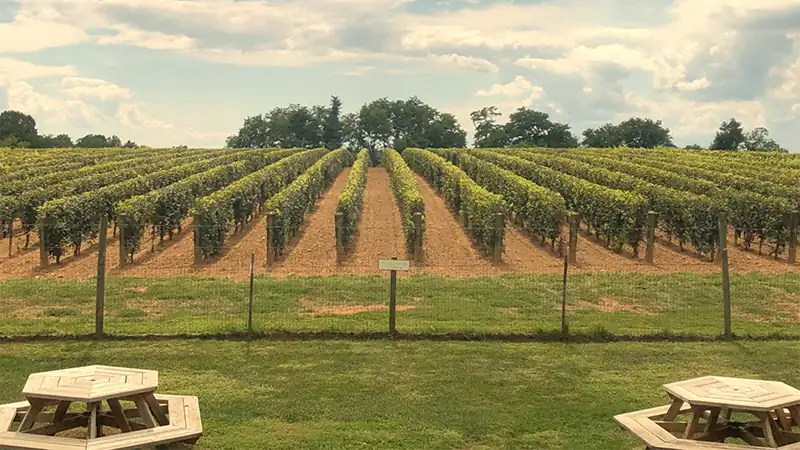
Anthony Vietri, winemaker at Va La Vineyards in Avondale, Pa., knows a thing or two about fungi. Vietri’s family grew mushrooms for 50 years before he started growing grapevines, and his neighbors are still churning them out, with constant processing and composting right next door to Va La’s vines. Tasters of Vietri’s wines comment on their mushroomy qualities, which today Va La leans into to help tell its story at the tasting room.
“There are certain outside influences on wine that happen, but we don’t know exactly how” says Vietri. “Like eucalyptus growing nearby, or light smoke, I assume what’s happening within our surrounding area makes a similar impact.” Chemical reasons left undefined, tasting Va La’s wines is proof enough that the soil and neighboring agriculture have shaped the liquid as much as Vietri’s attentive and exploratory approach to cultivating grapes. The wines are funky, rich, and unexpected.
Vietri replants his vineyards using massal selections, propagating individual vines that have recognizably mutated to thrive in this area. This means there are versions of Nebbiolo at Va La that are the best versions for the terroir of mushroom country. Heaps of compost neighboring Va La’s vines, cultivated as strata for crop, fill the air with a distinctively musty aroma and heat from fermentation. These two ingredients together create a thick fog, what Vietri calls the “smelly ghost.” One of his early grape plantings was an Italian Nebbiolo, a notoriously hard varietal to cultivate. It established well, Vietri suspects, because the fog from the mushroom compost was replacing what Nebbiolo traditionally loves — Piemontese valley fog.
Fungi for Gin
Where mushroom character for Vietri is a harnessable inevitability from the byproduct of large-scale agriculture next door, other producers are making deliberate choices with mushrooms, weaving specific varietals into recipes as a way to capture the essence of place. Two such producers are Morgan McLachlan of Amass Botanics in Southern California and Jake Sherry of Isolation Proof in the western Catskills of New York.
Isolation Proof crafts single-distilled gins from local botanicals like ramps, orchard fruits, and mushrooms. Sherry thinks about gin “as a reflection of the place and time it’s from,” he says. His Mushroom Gin was developed in part to serve the industry’s new obsession with savory cocktails.
“Sometimes, you’d just end up with something tasting like dirt.”
Sherry landed on a trio of fungi: Shiitake for what he calls “pure mushroom flavor,” maitake for its earthy, buttery character and its endemicity to the Catskills, and chaga, a parasitic fungus growing on white birch trees. Chaga adds a golden hue to the spirit, of which Sherry is particularly fond. “The mushrooms are a subtle undertone, like a base note,” Sherry explains. On the nose, mushroom dominates; on the palate, it recedes into something closer to an oxidative quality, with umami lingering at the mid-palate and beyond.
The approach to extraction matters as much as the selection. Early experiments with distillation produced a cooked quality that Sherry didn’t love, but maceration preserved something more true. McLachlan echoes Sherry’s notes on the challenge of distilling mushrooms, suggesting that in her research and development experiments, “sometimes, you’d just end up with something tasting like dirt.”
Flavor Over Functionality
“Funk,” McLachlan says, “is the antithesis to a lot of commercially made products,” and mushrooms, in her formulation, add a certain je ne sais quoi. For years, Amass, known for crafting complex botanical combinations to channel regional terrain, used reishi and lion’s mane in its 29-botanical gin. A few years ago, McLachlan noticed TTB (Alcohol and Tobacco Tax and Trade Bureau) agents beginning to scrutinize functional mushroom ingredients in alcohol — a consequence, McLachlan believes, of the broader cultural surge in mushroom wellness products — and Amass was subject to their measures. As a result, the formula shifted to use porcini in order to maintain the original flavor of the gin as much as possible without running afoul of regulations.
For Sherry, making a mushroom gin leaned into “all this attention on mushrooms for various reasons,” whereas for McLachlan, that attention led to a real hurdle: reformulation. These distillers’ motivations, alongside regulatory challenges, point to the ways in which beverage alcohol exists in a space of illusory non-medicine, adjacent to wellness without being able to claim it.
You might ask, “Could adaptogenic mushrooms in a spirit be functional for me?” Probably not. Getting good flavor out of mushrooms is a different game than extracting medicinal quantities. McLachlan’s nonalcoholic, adaptogenic brand, De Soi, uses lion’s mane and reishi, and you can’t taste them at all. In beverage alcohol, on the other hand, the most remarkable thing mushrooms can do is taste like themselves.
Whether terroir agents that help foreign grapes thrive or deliberate ingredients in a craft gin, the applications of mushrooms in beverages are as vast as the kingdom itself. An umami that conjures place. A fog that coaxes a grape varietal into thriving somewhere it has no business thriving. A base note that lingers on the palate and ties a whole world of botanicals together. Wellness trends may come and go, but in beverage alcohol’s health-severed sphere, flavor is what has the staying power to keep people drinking mushrooms.