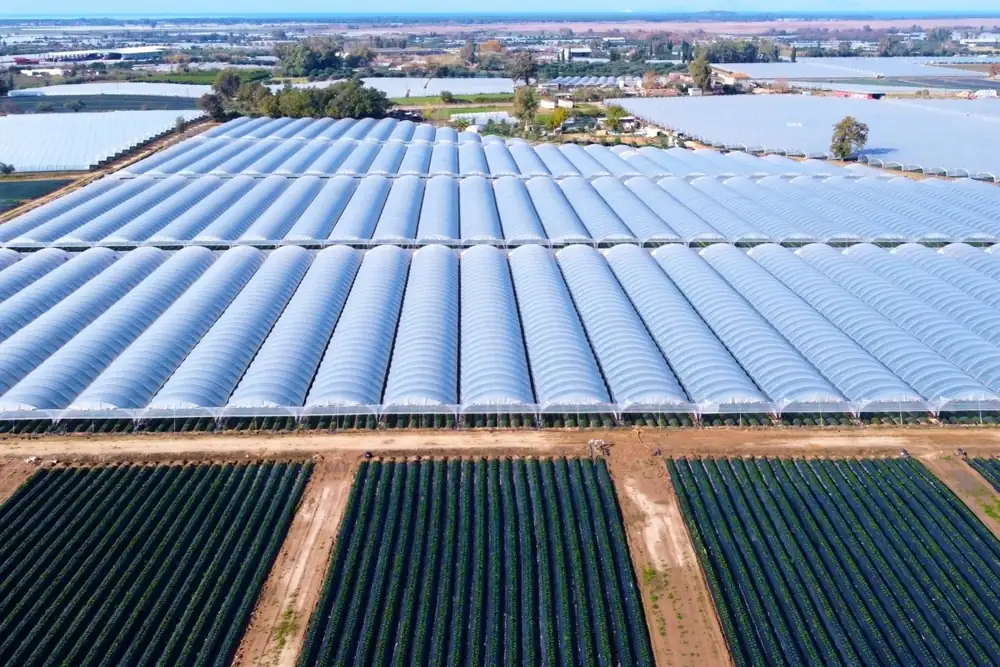
“We are seeing strawberry growers significantly expanding their acreage”
The strawberry planting period is just around the corner in Ilia and Achaia, Greece. The first plants, the so-called "tray plants", will arrive from September 20, and planting is expected to be completed by October 15. From October 2-3 onwards, bare-root plants will also begin to arrive.
Antonis Arvanitakis, owner of Arvanitakis Fruits, estimates that "At the regional level, around 50 hectares have been added, although it is difficult to calculate the exact area, as the expansion is uncontrolled and cultivation has now spread over a very wide area, which includes not only strawberries but also other berries. The point is that you cannot put pressure on any grower. Everyone decides for themselves what they want to cultivate and, as long as they have the means and can afford it financially, they will proceed with new plantings." As for his own company, he states: "We have dedicated around 15 additional hectares exclusively to strawberries. All 15 hectares we planted are new and do not involve the renewal of previous crops."
Arvanitakis describes the driving force behind the continued expansion of strawberry cultivation: "The large production units that have now established contract-farming agreements need their own production. They do not want to depend exclusively on purchasing product from third parties. This is why we are seeing growers significantly expanding their acreage, with some having as much as 50, 70, 80 or even 100 hectares." "In this way, they have greater security regarding the quantities they will have available. When you rely exclusively on others, sometimes you can find product and sometimes you cannot. Large businesses want to have a stable base of their own production."
Regarding the choice of varieties, he says: "This year, several thousand more Arwen plants are going to be planted compared with last year. At the same time, Victory, Marisma and Fortuna are also being planted. Around one-third of the new plantings involve tray plants, while Victory is the main variety among the bare-root plants. Arwen, Lozana and Victory currently appear to be the strongest varieties in the region. There are also other varieties, such as Marisma, but they are planted on a smaller scale and mainly on a trial basis."