Quality to support implementation in a challenging market environment
After a particularly quiet August, the market is beginning to pick up a little momentum this week, which coincides with the start of the new school term. While stone fruit still features prominently on the shelves, grapes and citrus fruit are gradually beginning to take over.
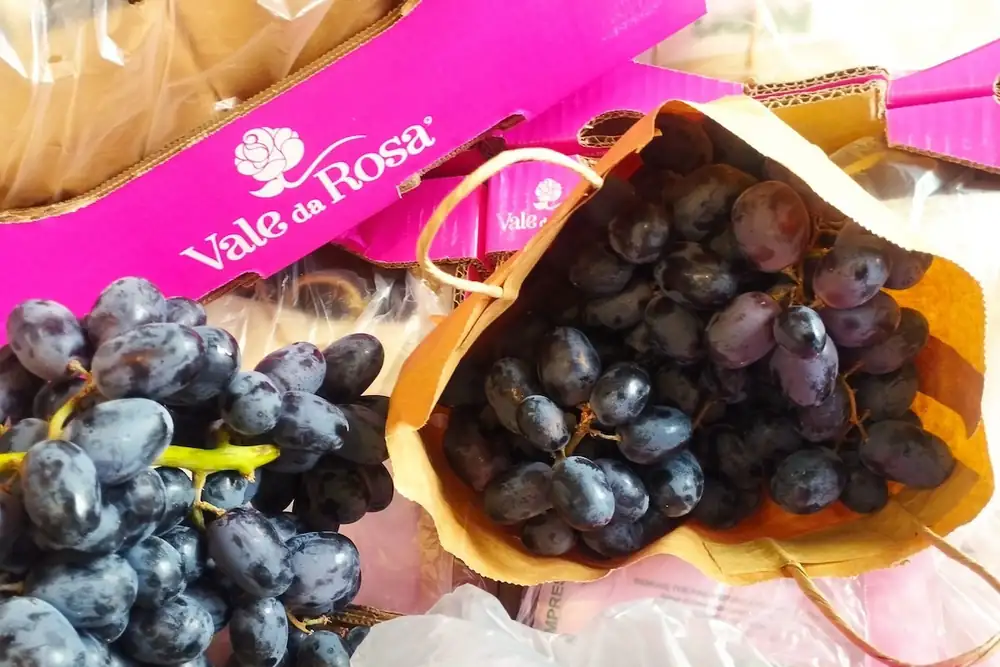
Particularly promising grape quality All signs are positive for the grapes currently in production. "Volumes are starting to arrive from the various European production regions. Generally speaking, the quality is very satisfactory, whether from Italy, Spain, Portugal or France, for both seeded and seedless varieties," explains Benoît Maillard-Guillon. The first Italian grapes stand out in particular for their quality, with "well-formed bunches, good berry size and excellent flavor." Only the Chasselas variety seems to have suffered slightly more this year, with the drought having affected berry size.
At Ets Meseguer, the range is based on Portuguese grapes, exclusively seedless varieties whose aromatic profile seems to have gained in intensity this season. "We offer white, pink and red. Although volumes are not particularly high this year, the quality is, once again, excellent. Sugar levels are very high, and we have a product that is more fragrant than last year."
The grapes must now cope with a summer that is dragging on© Ets Meseguer This excellent quality, however, is entering a market that has required a little patience. Following a difficult August, Ets Meseguer deliberately delayed their market launch. "We did not want to risk bringing in top-quality produce only to have to sell it off at a loss. We preferred to wait in order to market the product more easily," explains Benoît Maillard-Guillon. This cautious approach now seems to be paying off, as buyers have begun to show greater interest over the past few days. "At the end of August, few customers were asking about grapes. Today, we can sense that interest in the product is growing." This trend should gradually lead to higher turnover.
However, the start of the new school year no longer brings about the same shift in the market as it once did. Milder Septembers mean peaches, nectarines and plums remain on the market longer, fuelling competition between the different varieties. "In the past, September was clearly the period when the transition took place between stone fruit - whose season had ended - and grapes, which coincided with the start of the new school term. Today, this transition is much less pronounced. Nevertheless, we are still seeing this desire to move on to other produce, such as grapes or citrus fruit, which bridge the gap between summer and autumn. Some retailers are therefore deciding to reduce their range of stone fruit to highlight grapes and citrus fruit. From now until the end of October, grapes are at their best, with some excellent varieties available. And this is where quality really helps us with our product placement. When the product is good, it naturally encourages repeat purchases."
Prices lower than last season but still acceptable As for prices, although deemed 'acceptable', they remain lower than last year, due to increased competition between different origins and varieties. "There is more competition and larger volumes all coming onto the market at the same time. Stone fruit, which is at the end of the season and of a more delicate quality, is being offered at lower prices than at the height of the season, which inevitably has an impact on the grape market."
However, the momentum brought by September should help sales to pick up. The start of the new school year and the return to a more regular routine are all favorable factors. However, as is usually the case, this momentum could slow down after September 20th, a period when promotional campaigns generally begin to increase.
Citrus fruit is also kicking off its season As for citrus fruit, the South African season began around two weeks ago and is following a trajectory quite similar to that of grapes: a gradual build-up, but a high-quality supply that should gradually find its place in the market.
However, not all products are experiencing the same momentum. "For lemons, the situation is really very complicated this year, even catastrophic," explains Benoît Maillard-Guillon. Available volumes are too high given insufficient consumption, while import costs remain particularly high. This situation is all the more frustrating given that the quality is, in fact, excellent.
As for pomelos, the outlook is slightly more favorable, with consumption slightly higher and quality still very satisfactory, though sales remain relatively low and import costs are still high.
Orri: Excellent value for money at the start of the season The situation is much more promising for oranges and mandarins. South African citrus fruit is gradually gaining ground on the shelves, with one product that is particularly well recognized by customers: the Orri mandarin. "We have the advantage of starting the season with Orri, which has really become a must-have. We have been working with this variety for 16 years now and have never been disappointed."
Even when the launch coincides with a slow market in August, the quality of the product helps to build momentum quickly. "This is true of all products. Consumers try it once, like it and come back for more. And with prices currently low relative to the quality on offer, the Orri mandarin offers particularly good value for money this year."
As for oranges, following some difficulties with the first shipments of table oranges in August - mainly due to bad weather - the situation has now improved significantly, and volumes are increasing. "We have both volume and quality. The table oranges we receive are colorful, juicy and fragrant, with thin skin; all the quality criteria are met."
South Africa: a key factor in launching the Spanish season For Ets Meseguer, starting the citrus season with South Africa offers a strategic advantage: kicking off the citrus season with a high-quality supply before the arrival of Spanish produce. This initial step undeniably facilitates the introduction of Spanish citrus fruit onto the shelves.
Grapes and citrus fruit are therefore approaching the start of the new season with different strategies, but a shared strength: quality. Following a particularly sluggish August, the market is showing positive signs of recovery. Consumers seem gradually ready to move on from summer fruit, while retailers are reorganizing their shelves. This recovery is still gradual, but it is starting to be felt on the ground and will hopefully gain momentum over the coming weeks.