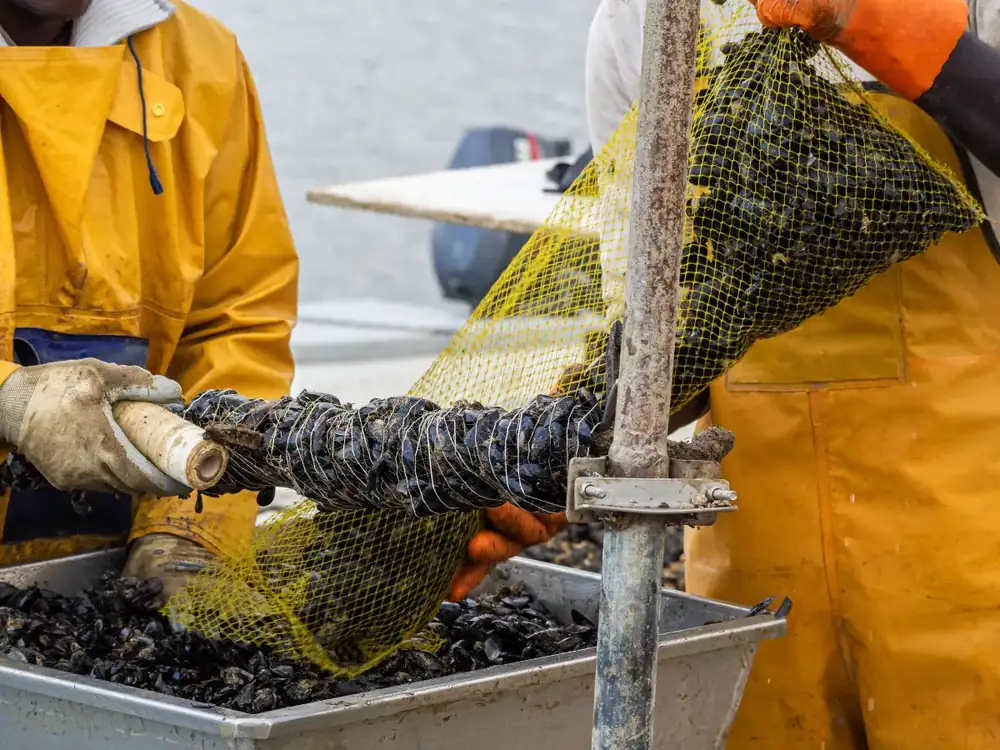
Mussels aren't just food: they can help clean water and reduce eutrophication
Italy has over 8,000 kilometers of coastline, a domestic demand that exceeds 8,000 tons per year, and some areas naturally suited to farming.
“Una Fiscalità mission-oriented per la Blue Economy: un’opportunità per la filiera ostricola italiana”
Yet, when it comes to oysters and—to a lesser extent—mussels, we depend almost entirely on foreign supplies. Domestic production hovers around 300 tons annually, and over 90% of our needs are imported, primarily from France.
This is one of the paradoxes highlighted by the study "Mission-Oriented Taxation for the Blue Economy: An Opportunity for the Italian Oyster Supply Chain," conducted by Professors Pasquale Sasso and Benedetta Coluccia of the Agrifood Tech & Innovation Observatory at Pegaso University. In this regard, Professor Sasso, following our article on the state of mussel farming in Europe, provided us with food for thought, starting from the aforementioned study and focusing on aquaculture. As Professor Sasso points out, mussel farming produces protein without using agricultural land or requiring feed and, if well managed, can contribute to water quality, nutrient cycling, and biodiversity.
But it's precisely the mussel's environmental value that could change its ecological perspective, not just as a food or traditional product. This requires research, investment, and policies capable of measuring and recognizing ecosystem services. But how much is a mussel really worth to the sea, its landscapes, and its coastal communities?
The research's starting point is a broader assumption: that oysters—like mussels—are not just food, but a sort of living ecological infrastructure. A single adult specimen can filter 6-7 liters of water every hour and exceed 160 liters a day under optimal conditions, removing phytoplankton, particulate matter, and nutrients from the water column.
Farming both also contributes to nitrogen removal and the reduction of eutrophication, while reefs create habitats favorable to biodiversity. Their carbon footprint is therefore much lower than that of the main terrestrial proteins. These environmental benefits are even more significant when considering the growth of global aquaculture, given that, according to the data reported in the study, global production has reached approximately 94 million tons of farmed aquatic animals, exceeding capture fisheries for human consumption.
Europe, on the other hand, has been stagnant for about twenty years at around 1.2 million tons per year. In the Old Continent, bivalves account for almost half of aquaculture production, with oysters alone accounting for 9%.
China dominates the world market, with over 6.6 million tons in 2023. In Europe, the giant is France with around 90,000 tons and a value of over 550 million dollars.
Italy appears almost invisible, with just 300.9 tons, but it has the surprising average price of 7.70 euros per kilo, the highest in Europe, compared to 5.30 euros in France and 4.93 euros in Ireland. According to the authors, there is also a uniquely Italian peculiarity that is holding back growth.
Oysters are subject to the standard VAT rate of 22%, while mussels and clams benefit from a 10% discount. This difference helps keep oysters in the mental—as well as fiscal—category of luxury products.
Across the Alps, the picture is radically different, as in France, both mussels and oysters intended for human consumption are taxed at 5.5%. This difference, in addition to impacting the final price, reflects two different approaches to fiscally supporting shellfish farming.
And this is where the concept of "mission-oriented" taxation comes into play. Instead of simply raising revenue, taxes could reward production capable of generating measurable environmental benefits, using rates and incentives to drive investment and consumption.