From animal to table
(October 2, 2026) – Three days, one Ibérico pig, and a question that often gets overlooked in the daily grind of gastronomy: What does it actually mean to process an animal holistically?
What happens when top chefs leave their familiar kitchens, routines suddenly cease to apply, and they face a challenge they couldn't prepare for? This is precisely when the JRE Culinary Lab 2.0 begins. Once a year, this format creates space for new perspectives, unexpected encounters, and genuine engagement with products and their origins. The focus is not on competition or perfection, but on curiosity, craftsmanship, exchange, and the courage to embrace the unknown.
The unique thrill: Participants only find out on-site who they will be teamed with and which course they will be responsible for. Each JRE member is paired with a personality from the food and content scene. Together, the teams then develop the dishes for a final menu.
This year's hosts for this special edition were JRE member Frédéric Morel ("Cœur D'Artichaut," Münster) and his wife Elisabeth Morel, together with Annika and Christian Vincke of Ibérico Westfalia. JRE member Tobias Bätz ("AURA by Alexander Herrmann and Tobias Bätz," Wirsberg) once again shaped the JRE Culinary Lab 2.0 as patron and creative force behind the format.
Get to know it first, then process it
But before the challenge began, the group first went to where it all starts on Sunday: to the animals. Annika and Christian Vincke led the participants around their farm and gave insights into the keeping of their Ibérico pigs, their working methods, and how they handle the animals and food on the farm.
It was then announced who would be tackling the challenge together: Ruben Baumgart (“Rubens – Das österreichische Restaurant” in Düsseldorf) and Beatrice Jäger aka @mrswildboar formed Team Defender, Franz Berlin (“Hotel Kronelamm” in Bad Teinach-Zavelstein) and Torsten Hülsmann aka @herr_totti formed Team ASA Selection, Michael Ammon (“AMMONS Sankt Englmar” in Perasdorf) and Anton Behnke (@antonbehnke) formed Team de Buyer, and Klemens Gold (“Rau – Nature-based Cuisine” in Großraming, Austria) and Achim Oecal aka @kitchenachim formed Team AKI Kaviar.
It was precisely these unusual constellations that opened up new perspectives. For patron Tobias Bätz, this is a central idea of the format: "If you don't leave the beaten path, you don't learn anything new. That's why it's important to ask the right questions and listen to each other. It's about bringing people along, approaching things together, and acting responsibly. We need to explain where we come from and create appreciation for it."
Then the draw was held a second time: This time, it determined which cut of Ibérico pork the teams would use. Team Defender received the brisket tip, Team ASA Selection the heart, tongue, and kidney, Team de Buyer half a pig's head with brains, and Team AKI Caviar the hind leg with shank. This meant each team faced a different challenge: The less common cuts, in particular, demanded creativity, skill, and innovative ideas. The resulting dishes demonstrate just how differently the teams tackled this challenge.
A morning that changes perspective
On Monday, the focus was on the traditional processing of Ibérico pork. Under the guidance of butcher Andi Neumann, who has many years of experience and specializes in home slaughtering, the participants explored the individual steps of the process and the most holistic use of the animal possible. The emphasis was on a respectful and transparent look at a part of food production that often remains in the background in everyday gastronomy. Origin, craftsmanship, and appreciation were thus directly linked.
For many participants, the palpable shift between two worlds was particularly impactful: the killing of the animal was an unfamiliar, quiet moment, unlike anything the chefs experienced in their everyday culinary work. With the subsequent butchering and processing, however, they returned to familiar territory: their craft. It was precisely at this transition that the transformation of a life into food became especially clear, along with the responsibility that comes with it. Annika Vincke particularly emphasized the respect with which the participants treated the animal and the entire process.
For JRE member Michael Ammon, this was not an easy task. “I had great respect for it and didn’t actually want to see the slaughter. In retrospect, it was the best decision to go along with it. As a chef, you should know everything that goes into it.”
From craftsmanship to a shared meal
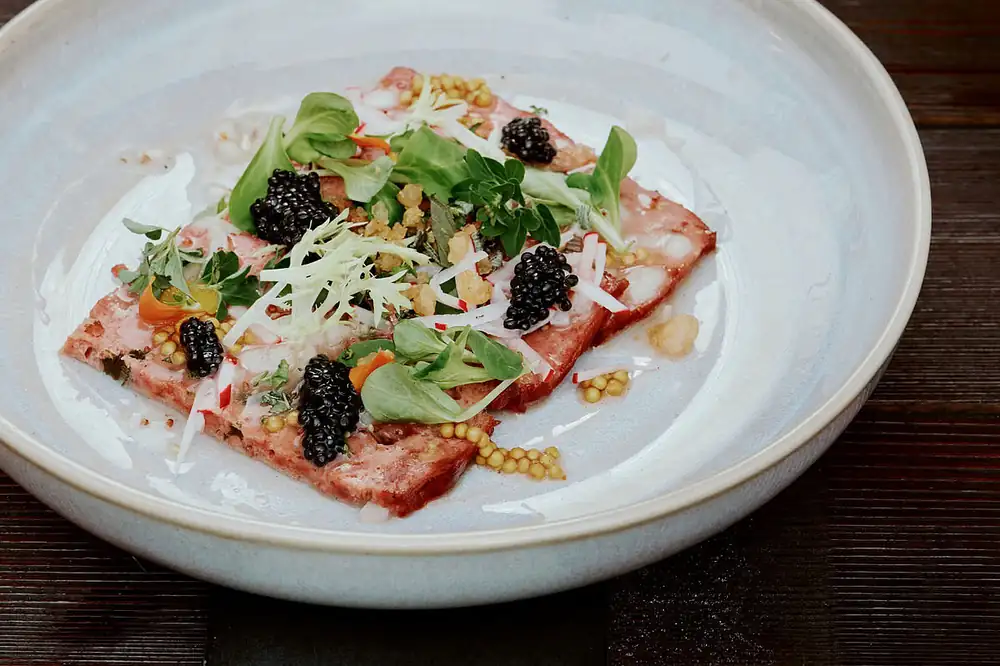
On Tuesday, the experiences of the two previous days culminated in a shared menu. Team Defender, with Ruben Baumgart and Beatrice Jäger, served dishes including lángos with homemade cream cheese and cracklings, Leberkäse (a type of meatloaf) with herb vinaigrette and caviar, and Austrian cream goulash. The randomly drawn brisket tip was also used to create a rolled roast with market vegetables and homemade smoked mayonnaise.
Franz Berlin and Torsten Hülsmann from Team ASA Selection focused on the animal's "inner values": They processed the kidney into blood sausage, thus reinterpreting the Rhineland classic "Heaven and Earth." The tongue became a ragout with roasted maitake mushrooms, lamb's lettuce, and rapeseed, while the heart was grilled and served with wild broccoli and a curry-Ibérico mayonnaise.
Michael Ammon and Anton Behnke from Team de Buyer used the pig's head in two different ways: In addition to an Ibérico Westfalia ramen, they served baked pig's head with potato and brain cream, mustard, and apple. Team AKI Caviar, with Klemens Gold and Achim Oecal, combined nose-to-tail cuisine with their partner's signature product: They served a pork knuckle and caviar toast, grilled Ibérico pork loin with peppermint oil salad, and Ibérico pork roast.
The sharing menu was then served to invited guests at a long table. A wine pairing from Lobenbergs GUTE WEINE, curated by sommelier Antonios Askitis (@asktoni.de) and carefully selected to complement the dishes, accompanied the meal.
These dishes perfectly illustrate what the JRE Culinary Lab 2.0 aimed to convey: It's not just the supposedly prime cuts that determine an animal's value. Offal, head, or hock can also become the starting point for sophisticated and surprising cuisine. Even butcher Andi Neumann, who had guided the participants through butchering and processing the previous day, was impressed by how the chefs reinterpreted the individual cuts in their culinary creations.
Partners become part of the culinary result
JRE partners were also directly involved in the culinary outcome. AKI Caviar contributed its sturgeon caviar, which was used, among other things, in the pork knuckle caviar toast. de Buyer provided the pans for preparing the dishes, and ASA Selection set the table for the communal menu. For an additional special touch, host Frédéric Morel and professional chef Zoltan Okolicsanyi created a black pudding crème brûlée using Président Professionnel Gourmet whipped cream.
The lasting impact of the three days was evident in the final group discussion. For Beatrice Jäger, a forester and passionate hunter, the opportunity to broaden her perspective was particularly formative: "For me, the parallels and differences between hunting and agriculture were incredibly fascinating. Being able to experience 'nose-to-tail' so directly was a great enrichment. It's worthwhile to engage with things you don't know. You think more consciously about food, lose your inhibitions, and learn so much from each other."
What remains of the Culinary Lab 2.0 is therefore more than a jointly developed menu: a sharpened focus on where food comes from, what its processing means and what responsibility is associated with it.