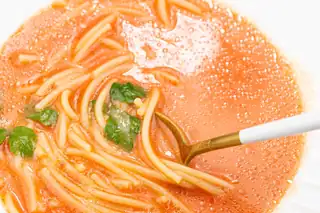
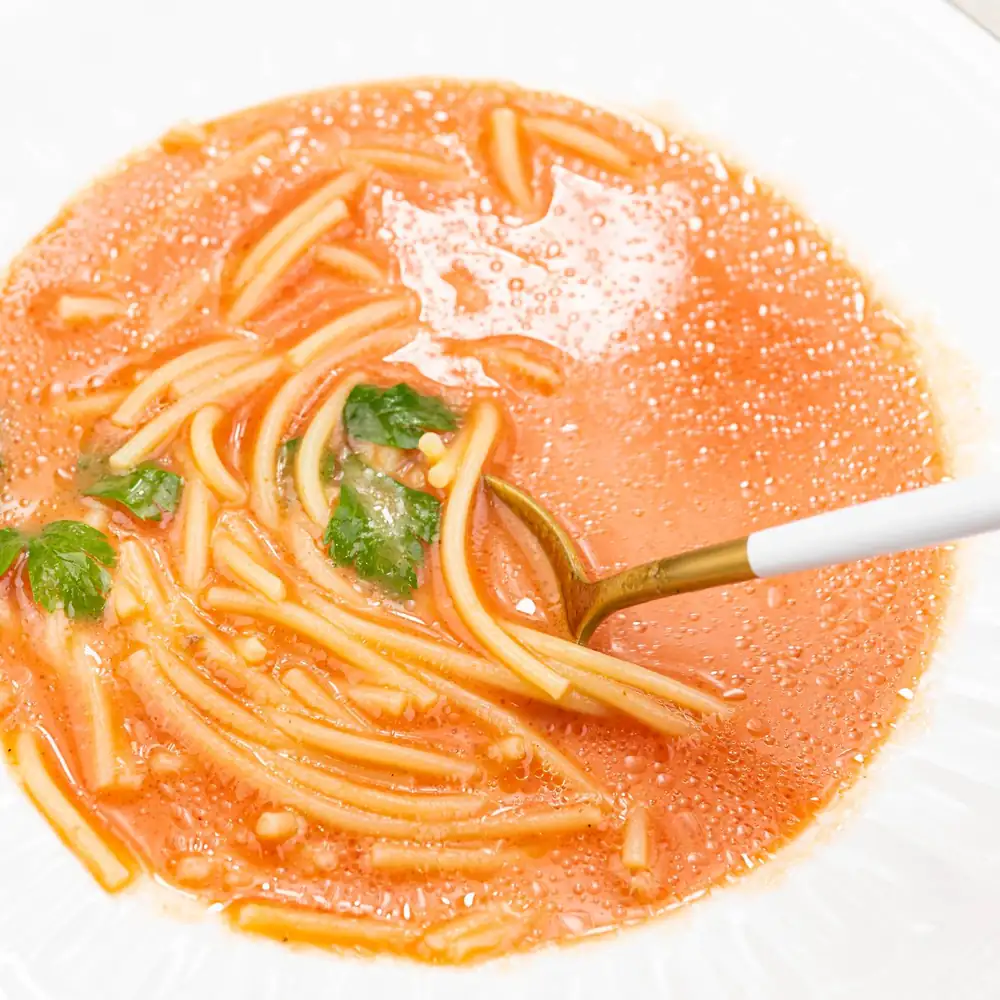
Tomato soup
Tomato soup is truly the queen of soups. Here's my favorite recipe for homemade tomato soup. You can make and serve it in several ways, and you'll find full instructions and tips in the post.
- tomato soup with rice or pasta - several suggestions for soup broth - loved by children
- Preparation time: 30 minutes Broth cooking time: 2 hours
- Number of servings: 1450 ml of soup
- Energy value 25 kcal
- Carbohydrates 3 g
- Including sugars 2 g
- Protein 1 g
- Fat 1 g
- Diet: gluten-free, low-sugar.
1 kg of meat for the broth: I used 2 chicken quarters and a beef shank with bone*
2 medium carrots - about 280 g
1 small parsley root - about 90 g
a piece of celery root - about 80 g
1 small onion - about 100 g
1500 ml of water - tap or filtered
spices and herbs: 2 allspice grains; 1 bay leaf; 1 teaspoon of salt; 1/2 teaspoon of pepper
1 small jar of tomato paste - 200 g
4 tablespoons of sour cream 18% - about 80 g
to serve: parsley and pasta or rice
Tomato soup
NOTE
If you are looking for a recipe for tomato soup made from fresh tomatoes, please find the recipe
Tomato soup made from fresh tomatoes.
My glass holds 250 ml. For soup, I recommend a pot with a capacity of at least 2.5 liters.
The vegetables were weighed before any peeling or preparation. I always provide the weight of the vegetables I use. However, you don't have to follow the guidelines exactly to the gram. I provide the weights to help you understand the approximate amount needed to make the soup.
The calories were calculated based on the ingredients I used. This is an approximate calorie count, as your ingredients may have a different calorie count than the ones I used. I didn't include any additions like pasta or rice in my calorie count. The listed ingredients yield approximately 1450 ml of tomato soup.
You can make tomato soup with poultry, beef, or a vegetable-only broth. The preparation is the same. The only difference is that you cook the vegetables and poultry for about an hour to an hour and a half, while beef takes two to three hours. I also recommend combining chicken and beef. Important: You don't need to boil the broth I listed in the recipe. You can use about 1200 ml of previously prepared vegetable, chicken, or beef stock. If you make a large amount of broth the day before, simply pour off 1200 ml of the broth and reserve it for the next day's tomato soup.
Tomato soup recipe
First, here's a very short version of the recipe: 1 - In a pot, combine: about a kilogram of meat (chicken only, or with the addition of bone-in beef); two peeled carrots; parsley root; an onion; and a piece of celery root. Add two allspice berries, a bay leaf, a teaspoon of salt, and half a teaspoon of pepper. Pour in 1500 ml of water. Cover the pot and bring the soup to a boil. Reduce the heat to a simmer and cook for 90 minutes if using only chicken, or 120 minutes if using bone-in beef.
After two hours, remove the scum from the sides of the pot. Using a strainer, remove all the meat, vegetables, and spices from the soup. You should have about 1200 ml of broth left. If more broth has evaporated, top up with boiling water. The vegetables and meat from the broth can be ground and used to make a pâté, or as a filling for pierogi or pancakes. 3
Add a small 200 gram jar of tomato paste to the broth. Before the tomato soup begins to boil again, add four tablespoons (or more) of 30% heavy cream. If using 18% sour cream, temper it before adding it. Stir the soup and check its taste. Season with salt, pepper, and a pinch of sugar, if necessary.
4 - Serve the tomato soup with your favorite pasta or rice and fresh parsley, a bit of fresh lovage leaves or dill.
Tomato soup recipe
And now a very detailed version of the recipe with step-by-step photos:
Either you already have about 1200 ml of ready-made, flavorful broth (vegetable, chicken, beef, or previously strained broth), or you're making it with me. Since this is a tomato soup, I'm not worried about whether the broth will be clear or not. The vegetables and meat from the broth are going to be ground, so they can be very soft or (in the case of beef) even slightly hard. The most important thing for me is a nice, strong broth. * I know I'm using a lot of meat for this amount of soup. I like it that way, but I should point out that you can also use less (even half as much). I used two chicken drumsticks and two thighs, so if you combine them, you'd have two chicken legs. You can also use the neck or wings from chicken or turkey. And that's about it, but I also use bone-in beef. I usually manage to find a bone-in beef shank, but a bone-in piece of beef brisket that's not too fatty, or a tail, or another bone-in cut of meat, will also work perfectly. Pay attention to the meat being cooked. If you think it might be overcooking, simply trim off the excess beforehand. Turkey wings and some cuts of beef can be quite fatty. Place the cooked meat in a large, heavy-bottomed pot.
I also add peeled carrots, a parsley root (I don't peel it), a piece of celery root (I don't peel it), and an onion halved (I don't peel it). If I have celery, a piece of leek, or fresh lovage on hand, I add them to the pot as well. Then I fill the pot with cold tap water and rinse. I don't soak the meat in tomato sauce beforehand. I also don't pour boiling water over it or boil it separately. A quick rinse and that's it .
After rinsing, I add a bay leaf, two allspice berries (one can be lightly crushed), a teaspoon of salt, and half a teaspoon of pepper. I pour in 1500 ml of cold tap water (6 250 ml glasses). I cover the pot with a lid. I set the heat to a higher than medium setting. When the soup begins to boil, I reduce the heat to a level that is just barely flickering. If you're making broth with just poultry, about an hour to an hour and a half will be enough, from the time the soup comes to a boil. If you're making broth with beef, extend this time to two or even three hours.
I simmered the tomato base for about two hours. I turned off the heat and set the soup aside for about 30 minutes to cool slightly and reduce the steam. This helps me strain the broth from the meat, vegetables, and spices. First, I wipe the edges of the pot clean of any scum with a piece of paper towel. After a long simmer, the set egg whites darken, "dry out," and settle on the edges of the pot.
I set the drained vegetables, meat, and spices aside. I debone the meat. I remove the tough layers from the onion and, if necessary, peel the parsley or celery. I'll grind everything once it's cooled and use it to bake a pâté, as a filling for pierogi, or for pancakes or potato dumplings.
In the end, I ended up with 1200 ml of broth. If more of your broth evaporated, simply add boiling water. My broth turned out darker because I made the soup with beef. Using only poultry would make it lighter. At this stage, check for excess fat floating on the surface of the broth. If a layer of fat covers the broth, I recommend removing the excess with a spoon. Tomato soup, like chicken soup, shouldn't be too fatty.
To make tomato soup, simply add 30% tomato paste and sour cream or heavy cream. I usually use a small jar of 30% tomato paste, which is 200 grams. I use Pudliszka, and for me, the tomato soup turns out perfectly sour and sweet at the same time. However, it's worth mixing the broth with half the jar the first time you make it, then test the tomato soup and add the remaining paste if necessary.
The broth doesn't have to be boiling or simmering when you add the concentrate. It just needs to be very warm or hot. It's much easier and safer to add 30% whipping cream to warm broth (four tablespoons are enough). However, the soup should be brought to a boil before serving. The cream doesn't need to be tempered, but sour cream/homogenized cream should be tempered before adding it to the soup. Pour a ladle of the already boiling broth mixed with the concentrate into a small bowl and stir well with four tablespoons of 18% whipping cream. Add more boiling water, stir, and then pour the mixture into the pot with the boiling tomato soup. Stir constantly. Bring to a boil and turn off the heat.
Whitening tomato soup isn't necessary, and you don't have to. If you'd like it to be slightly whiter, add a little regular milk. Tomato soup is a slightly sweet soup, which is why it's so well whitened with heavy cream. If you want to get a little more adventurous, you can also whiten it with coconut milk. However, you have to like those kinds of flavors.
After turning off the tomato sauce, check its flavor. You might want to add some pepper, salt, or perhaps a pinch of sugar. If the tomato soup seems too strong or you want a little more to make it lighter, add some unspiced tomato puree/passata or pure tomato juice.
Finally, the eternal dilemma: Tomato soup with rice or pasta? I love tomato soup with pasta and serve it with all sorts of pastas. It's not always pasta for broth. Sometimes I'll serve tomato soup with pasta shaped like shells or bows, and sometimes I'll use spaghetti noodles broken before cooking. If I have the time and inclination, I'll cook my own pasta, mash, or make dumplings.
We cook pasta or rice separately anyway. So, everyone can enjoy their tomato soup with whatever they like best.
What do you eat tomato soup with? Pasta or rice?
Do you usually prepare it with reserved broth, or do you prepare everything fresh for soup? I'm also very curious if you accept tomato soup made with beef broth, or only the poultry version.
Also check out my krupnik and sauerkraut soup. I also recommend trying my excellent cucumber soup recipe.
Enjoy your meal.