Garum returns to Sexi
Its seafaring tradition and the lushness of its subtropical plain have made Almuñécar a gastronomic benchmark. This heritage, however, began to take shape more than 2,000 years ago when the city was occupied by Phoenicians and later by Romans.
The then Ex or Sexi was a prominent industrial center in the Mediterranean in the field of salting, which among other products produced garum, an exclusive fish sauce highly appreciated at the time, with the one from this enclave being one of the most prestigious.
In this constant search for innovation, often looking to the past and culinary tradition, in recent years various trials have taken place with the aim of recovering this seasoning whose preparation is based on fermented fish viscera.
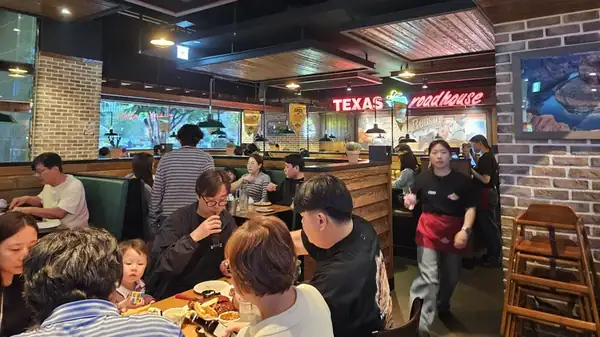
Living up to its name and local history, the Firmvm restaurant in Almuñécar has revived the traditions of the Phoenicians and Romans to create this delicacy. It's worth remembering that Sexi Firmum Iulium was the name given to the city in 45 BC, when it became a Latin-right municipality.
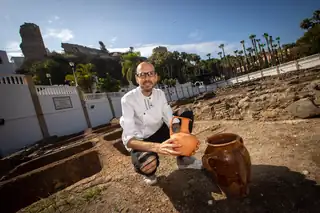
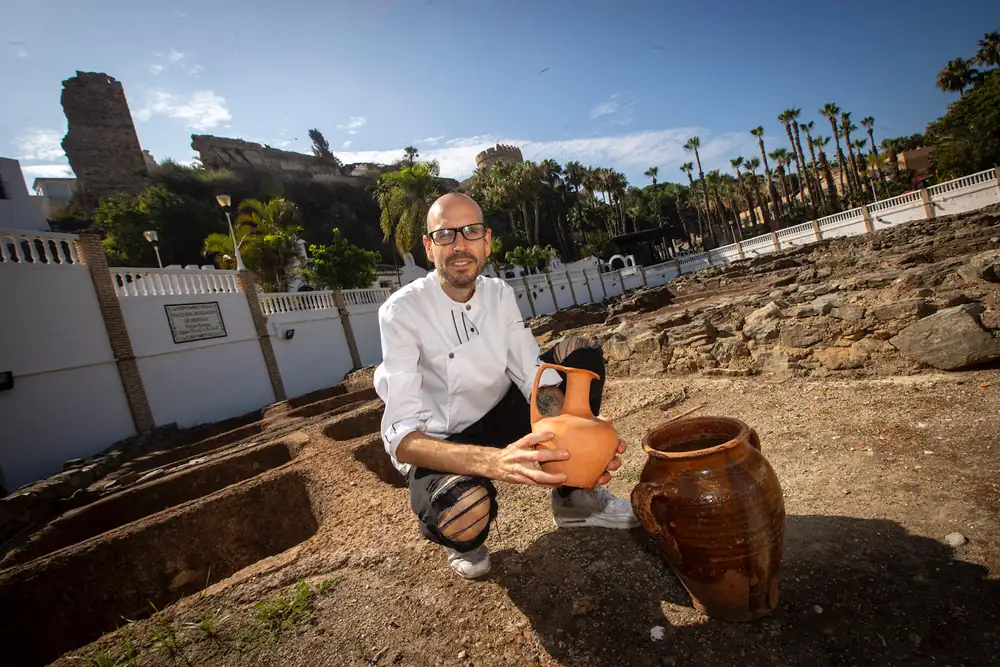
“We want to differentiate ourselves from other restaurants and we are searching for our identity,” explains the establishment’s chef, Sergio González, who emphasizes that “in Almuñécar, salted fish and garum are part of the local history,” as evidenced by the factory still preserved in El Majuelo Park, started by the Phoenicians in the 4th century BC and later exploited by the Romans until the 4th century AD.
In a pipette
González explains that they conducted tests and introduced it to the menu as a pilot program. "People liked it. We give it to them in small doses using a pipette so that customers can season their meals, since it's a delicate yet powerful flavor and everyone should adjust it to their liking. It must be used in precise proportions."
For example, it has been infused into monkfish, "a white fish with a very neutral flavor to enhance it" and they continue testing for the October menu, in which they want to "take a leap of distinction".
These tests also include the paste resulting from the garum filtering process.
Despite Sexi's prowess in its preparation, this historic product is not used in the area's restaurants, according to the head chef of Firmvm, who wants to put it on the gastronomic scene at the level of the Motril prawn or subtropical mangoes and cherimoyas.
He points out that there are different types of garum, depending on the fish used, resulting in "a different flavor and texture." He has conducted tests with mackerel, bonito, tuna, whiting, and even shrimp, and the resulting liquid is used to infuse other products such as eggs, vegetables, or potatoes.
"We are immersed in a sea of tests, it's a completely new world," he adds.
Garum has a "delicate and powerful" flavor that is added to food to enhance its taste, but it must be used in adjusted doses.
Learning from the ancestors
This work of gastronomic experimentation follows the path of our ancient ancestors, "who did it with the fish they had on hand such as mackerel, sardines, red mullet or herring, and mixed it with salted fish scraps and different spices."
He adds that "each one has its own unique character, aroma, and flavor that changes considerably. Even the same garum can have different flavors from one day to the next." Regarding its use, Sergio González compares it to Japanese soy sauce or Korean kimchi, which are flavor enhancers.
Modern techniques
The preparation is similar to that of the Punic-Roman era, as it consists of placing various layers of fish and salt interspersed and letting it ferment for several weeks, up to two months, where the salt will play a fundamental role in preserving the product.
The next step is to strain it to extract the liquid on one side, which will be the garum, and the remaining paste on the other, which is used as a pâté.
In Firmvm's version, the old technique has obviously been adapted to current resources, so that it is prepared in a controlled environment in the restaurant's kitchen – at a constant temperature and humidity – and with all hygiene measures; not like in the past, in full sun in the pools of El Majuelo.
The chef also points out, "before, all the crushed fish scraps were used, including viscera, bones and heads, while we use already cleaned fillets."
The use of this elixir in the establishment in Almuñécar began with a few days but has been incorporated into its menu to add it to dishes such as octopus rice, monkfish or tomato salad with mackerel cured with soy and garum.
Its inclusion on the menu also serves as an excuse to tell the customer the story of Almuñécar and its commercial importance as an exporter of this product throughout the Mediterranean world, which they are generally unaware of.
For Sergio González, this challenge has involved, in addition to the culinary work, an intense research project on the production of garum. An enriching experience.
The sexy garum
Many Roman cities produced garum, such as Baelo Claudia, Gades, Malaca, Hispalis, and Carteia, some of which still have ruins. However, the garum from Sexi was among the most prized for its flavor.
This is stated by Elena Navas, municipal archaeologist of Almuñécar, explaining that "written sources already mention in the 3rd century BC the famous salted fish of Sexi, exquisite for its flavor.
"The best salted fish comes from Amiclas and also from Hispania, called 'sexitano,' as it is the finest and sweetest. We are talking about it not only being the best in Hispania, but in the entire Mediterranean, comparing it to the Greeks of the Peloponnese," according to Navas.
He adds that the species of tuna abundant in Sexitania may have influenced its delicious flavor, different from the rest.