New to Barcelona: Escribà-Sihuay and Josep Maria Masó
Passeig Escribà, high-flying Nikkei with Roberto Sihuay
The multifaceted Joan Escribà, son of the well-known Barcelona pastry family, champion of aerobatic flight - he has been able to build his own plane by hand - a reference paella chef on the city's beach with his Chiringuito Escribà (and in Tokyo and Osaka, under the same name), chocolatier - about to open his own bean to bar on the Costa Brava - and I don't know what else, has just opened a large Nikkei-inspired venue next to the Passeig de Gràcia: Passeig Escribà.
He's done it in style, enlisting Mariana Silveira (La Picantería) and the renowned Peruvian chef Roberto Sihuay, the man who created the legendary Ceviche 103 in Barcelona, who, along with Virgilio, earned a Michelin star at Lima in London (a restaurant he still runs), and who also manages Cantina Canalla in Ibiza. "My idea," he says, "is of course to continue in Ibiza and London, but moving my headquarters to Barcelona."
Roberto didn't hesitate when Joan and Mariana called. Within a day, he was tinkering in the kitchen. The result of their partnership has generated not only unprecedented interest in the local scene (he'd been away from the city for years), but also the arrival of a new, high-flying player on the city's culinary stage. Because Roberto's Nikkei approach, while always maintaining authenticity, reflects a strong personality and a restless—in this case, Mediterranean—perspective that seeks to see beyond the surface.
Thus, their ceviches transcend the ordinary, speaking the language of refinement, something already evident from the start with the sea bass ceviche with sea urchins, glazed sweet potato, and a perfectly balanced yellow chili tiger's milk. And of course, no dish is complete without champagne, because Joan doesn't compromise. Another example of Sihuay's virtuosity: the chaufa rice, simply perfect.
We continue in the same vein with the tuna tiradito with Nikkei tiger's milk, salmon roe, charred avocado, dehydrated fish skin, and crispy purple potato. The urumaki that follows is filled with shrimp and avocado, topped with flamed salmon, and wrapped around a rocoto and sriracha sauce.
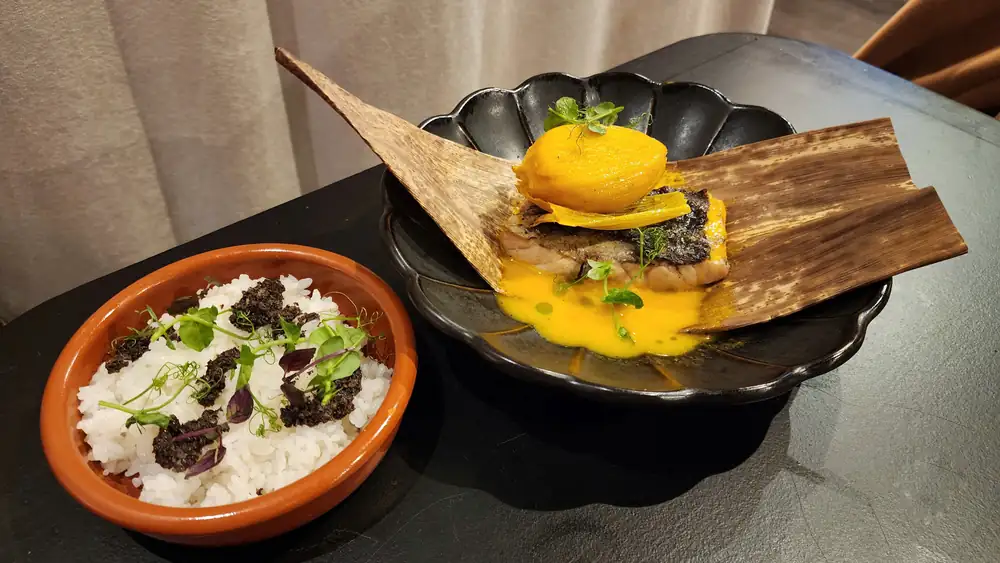
However, it's the hot ceviche that truly defines this as something more than your average Nikkei restaurant: grilled sea bass with corn tamale, yellow chili tiger's milk, and truffle rice. A house specialty, without a doubt.
The final touch comes with the slow-cooked beef rib with corn cake, teriyaki sauce and yellow chili pepper, sautéed pack choi with garlic and Creole chimichurri.
Sweet time… Chocolate cake with lucuma ice cream, picarones with fig honey and black sesame ice cream and tres leches cake.
And that nothing is lacking.
Valencia, 249
Barcelona
Tel. 937 04 23 03
The discreet (but explosive) return of Josep Maria Masó in Tangana
Although primarily remembered for having put the celebrated Bar Cañete (much more than a bar, of course) in Ciutat Vella on the podium and for his nomadic advisory work in restaurants such as the panoramic Martínez in Montjuïc, Josep Maria Masó was actually quite a phenomenon in the Pyrenees years ago, with his own restaurant, where I met him, by the way.
I even had the good fortune to celebrate with him the ancient Pyrenean recipe of buried chicken: "red-legged" birds, weighing close to six kilos (4.5 dressed), raised free-range, with a naturally spontaneous diet. Truly gastronomic "pieces"...
The ritual of preparing them lasts no less than 15 days. The first step is to bury them one meter underground, in the mountains, in freezing terrain, embedded between the meat and the skin of the black truffle (Truffle melanosporum). A demi-deuil, to put it simply. Then, once "resurrected," already with pheasant-like nuances, they are stuffed with a mixture of bread, butter, and truffle (plus a touch of foie gras).
They are roasted at about 120°C for approximately two hours, taking into account that towards the end of cooking they should be turned over so that the stuffing releases all its fat to the breasts. They are served in their own juices.
But let's get to the point. Because it was in Cañete where Masó met the young Àlex López, and he liked the boy so much that he took him under his wing and, after taking him to different restaurants to let off steam - Fermí Puig, Nandu Jubany, Arzak or Jordi Cruz - and working together on his many consultancies, he has ended up partnering with him in the recently opened Tangana, one of the establishments that is turning the Gracia neighborhood into a true gastronomic benchmark, in this case (noblesse oblige), beyond the "neighborhood cuisine".
Tangana's success—with its fresh, lively atmosphere and refined Catalan tradition—has been instantaneous. Getting a table or stool at the bar in the large open kitchen is a real challenge. There, you can feel the gastronomy, the class, the exceptional ingredients, the flavor. Everything seems informal, a culinary exchange between chefs and diners that never stops. And of course, the gildas are flying off the shelves.
The potato salad is so light and airy… Direct, hearty cooking. Look at the croquettes: fricandó (pure metaphor) and undisguised ham.
If we're talking about extraordinary products, we must include in the conversation those small, creamy Santa Pau beans with baby squid (not tiny squid, mind you), simply dreamy. Or the pickled bluefin tuna, exquisitely fine.
The lazy tortilla (always with the great Sacha hovering overhead), juicy and tactilely delightful, is made with cod and artichokes. Sweetbreads and prawns, one of the menu's great stars, create a emollient surf and turf dish that is nonetheless powered by a robust demi-glace.
Vigorous savory finish with the celebratory kid goat in salmorejo (inspired by Fermí Puig's famous enfangat) and with the very remarkable hare civet ravioli, which could easily compete with a royal.
And, although it's not on the menu, Masó occasionally makes a great flan, like those that populated family childhoods, flambéed with rum, which demands to be shared with bar or table companions.