Terrae: from fabada to flor cheese
There's nothing better than starting a gastronomic event by tantalizing the palate. And that's precisely what Terrae has done, which runs until April 30th in various locations across Gran Canaria, but has Gáldar, its former capital, as its main stage.
In the central Plaza de Santiago, Roberto Ruiz, from Hika Gastronomiko (Villabona, Guipúzcoa), lit the stoves with his marmitako made with potatoes, green pepper, onion, fumet from the bones of the bonito and chunks of fish added at the last moment "so that it doesn't dry out", explained the cook.
Beside him, a local chef, Richard Díaz, from Sorondongo (Las Palmas), was serving his salted wreckfish stew with chickpeas, a dish he prepares using two broths (one from the fish and the other from the chickpeas) with a touch of cream. At his restaurant, you'll find Canarian cuisine that celebrates local produce and its creators. The queue outside his stall proved that his approach is spot on.
Nandu Jubany (Calldenetes, Barcelona) was missing quite a few customers with his cannelloni filled with roasted free-range chicken, bacon, béchamel sauce, and roasting juices with onions and aged wine. "If we didn't use local products, we'd be nothing," explained the Catalan chef.
Braulio Rodríguez, from Majuga (Las Palmas), successfully presented a creamy mushroom rice dish where one of Gran Canaria's star cheeses, queso de flor, played a starring role. The freshness of basil sprouts, the tang of onion seeds, and the crunch of crushed tortilla chips completed a dish that won over a crowd eager for seconds. Rodríguez, who champions the "island's traditional cuisine" at his restaurant, wanted to highlight the work of his right-hand woman, Lin Zheng, who was always by his side in the kitchen.
Having arrived from Peru to receive a tribute at Terrae for his promotion of Peruvian cuisine linked to native products and his advocacy for farmers' work, Gastón Acurio was one of the team at his Yakumanka restaurant in Barcelona, with Tomás de la Paz at the helm. They presented a ceviche-style causa made with local fish, which, as the Peruvian chef explained, linked "the Canary Islands and Peru through the potato."
For Acurio, the tribute paid to him by this gathering of rural chefs is "especially moving" because it's a platform that "seeks to value, preserve, and give visibility to everything we did in Peru: defending regional products and producers, bringing chefs who weren't visible into the spotlight... And all of this happened 20 years ago." Incidentally, his La Mar restaurant in Madrid has an opening date "if all goes well": November.
Carmelo Florido, head chef at El Equilibrista 33 in Las Palmas, presented a maki roll made with bigeye tuna caught in Agaete and gofio, one of the ingredients he champions most in his kitchen for its versatility in both sweet and savory dishes. Fortunately, he noted, this tuna, once caught by Japanese trawlers and shipped directly to Japan, can now be enjoyed in abundance in the Canary Islands. At his restaurant, they prioritize the product over the menu, and this product is 100% Canarian.
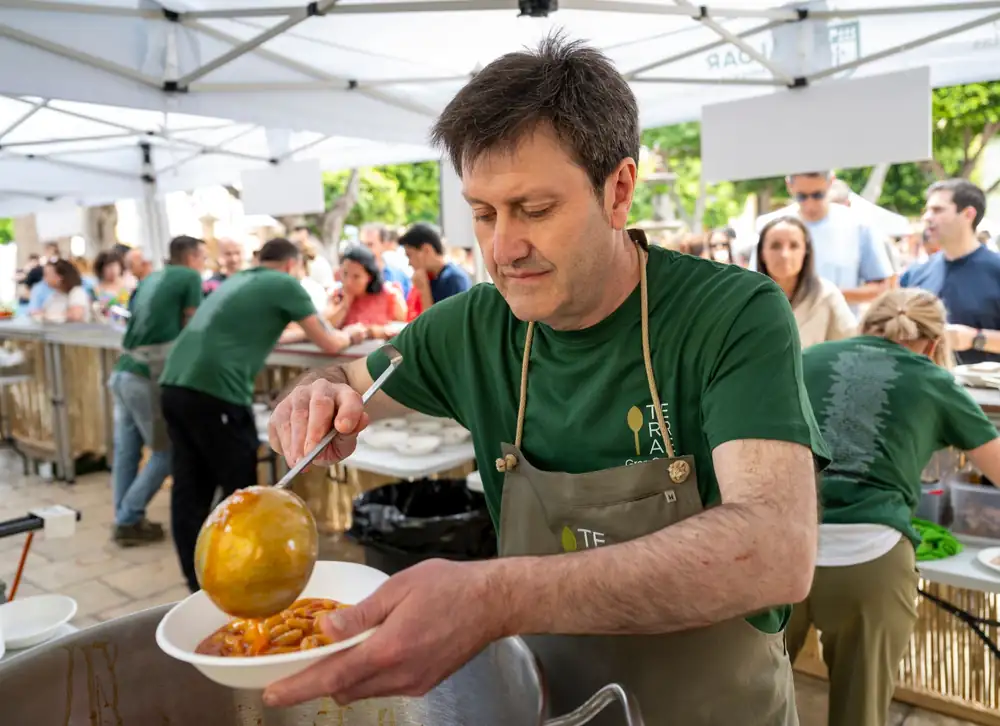
Pepe Ron (Bar Blanco, Cangas del Narcea, Asturias) triumphed with his fabada - although he would have liked to showcase his Asturian stew - made with "a good broth of ham hocks that gives it more depth, fresh beans, chorizo, black pudding, ham hock, saffron and halfway through cooking a sofrito with garlic, paprika and a pinch of flour."
Ron is at Terrae because he is a rural chef, something he considers a "real stroke of luck" because "living in villages means what is now being called kilometer 0 but which we have been doing all our lives: buying vegetables from local women, immediacy, freshness, real seasonal cuisine."
And these marvels of pure cow, goat, sheep or mixed milk, treated with vegetable or animal rennet and represented by the Asoquegran association, which brings together almost thirty small producers from 12 municipalities who only work with raw milk on an island of 1,500 square kilometers where each cheese expresses its territory, could not be missing from "the island of cheeses".