Gianfranco Pascucci: I fight to prevent wild fish from running out
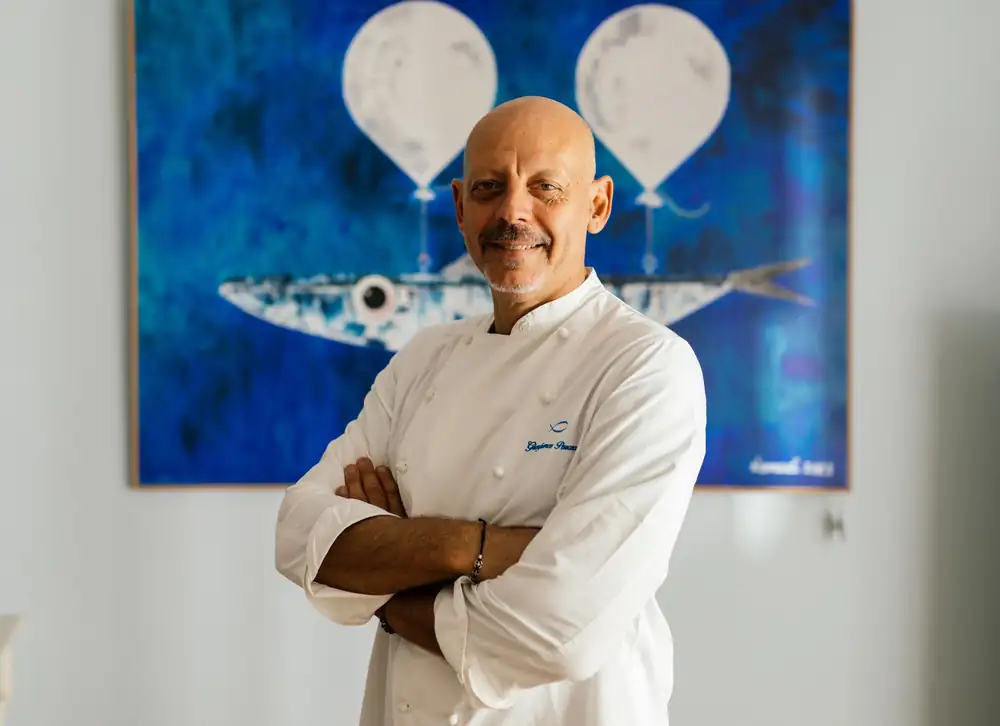
Gianfranco Pascucci's culinary universe can be defined in three words: seafood cuisine. A simplicity that is not so simple, because it encompasses sea and land and social commitment, as he will explain at the Meeting of the Seas, which takes place in Tenerife from June 16 to 19.
For those of us not from Italy, Fiumicino probably only sounds like the large airport where we land to see Rome and its wonders. But Fiumicino is also—and first and foremost—a small fishing village on the Tyrrhenian coast, a place brimming with seafood restaurants and a love for the sea.
Hugging the Tiber Delta, its low, sandy coast is the birthplace of one of the Italian chefs who best embodies the maritime spirit, Gianfranco Pascucci. A chef who tirelessly repeats that his cuisine, “is not just fish cuisine but seafood cuisine, because the sea has the power to influence the lands that surround it.”
Their culture, their fruits, their vegetables are all influenced by it. “The sea isn’t just the salt water, it’s also the land that surrounds it,” he explains. A belief he clearly demonstrates at Pascucci al Porticciolo, the restaurant he runs with his wife Vanessa in this coastal town in Lazio.
“The taste of the sea begins in the scrubland, the salty soil, the bay leaves, the rosemary… Often my dishes are the result of a walk along the coast,” confesses this self-taught chef who likes to remember those afternoons when, in the company of his grandfather, he would collect clams on the beach for the restaurant that his grandfather had in the same place that years later Gianfranco recovered for his own culinary adventure.
And from those clams and his first spaghetti at age 12 - "I have always felt this passion for cooking and even as a child I would prepare breakfast for the whole family and then lunch, always remembering everyone's taste" - Pascucci has made a name for himself in Italian cuisine where he is recognized not only for his passion for fish but also for his commitment to the sea that is his main supplier.
Gianfranco is aware of and actively working to "safeguard the sea at all costs because we not only love it, but we also benefit from it, and to ensure this continues, we need to protect it." In this spirit, the chef has created an association called Periferia Iodata, in which "we are 14 restaurateurs from Fiumicino who are aware of the problem, committed to using sustainable ingredients, and fighting against plastic pollution in the sea," he tells us.
In a world threatened by so many environmental challenges and where each territory struggles to preserve its identity, Gianfranco Pasucci exemplifies why the social dimension of the chef makes more and more sense.
Beyond pans and pots, the chef takes a stand and protects his environment, contributing his bit to this global fight; something that Pasucci gladly accepts because he believes that "as chefs our greatest contribution to this cause is to spread awareness, a commitment we must have every day."
Proof of this is also his appointment as a WWF ambassador for the protection of the Macchiagrande oasis, 280 hectares of maritime pines, honeysuckle, heather, and mastic trees that form part of that land with the taste of the sea that Gianfranco celebrates in his dishes. In collaboration with WWF, for example, Pasucci works to promote the value of mistreated fish species, such as the red mullet from Lake Burano, which turns out to have "great flavor at a low cost."
Pascucci suggests opening our minds to less common species as a way to value the land and diversify fishing; we shouldn't be closed-minded. “There isn't a single fish I don't like to cook. What I don't want is to cook an overpriced fish, one whose harvesting hasn't been environmentally friendly, or one whose primary characteristics I can't recognize. That kind of fish doesn't interest me,” he emphasizes.
The serious impact that human activity is having on the sea, whether in the form of overfishing or pollution, jeopardizes a way of understanding the relationship between the sea and cuisine that worries the chef. "What will happen if wild fish run out?" we ask him. "I live with that fear inside me, but I don't even want to think about it. I prefer to think about what I can do to prevent this from happening, what the solutions might be, which I believe involve more conscious and higher-quality farming. We have to protect this great resource that the sea offers us," Pascucci encourages us with his words.
Ultimately, the fears, hopes, and loves that Gianfranco projects onto his sea, the Tyrrhenian, are shared by all chefs who make the sea their pantry, be it Mediterranean, Atlantic, or Indian. The sea is one, perhaps that's why Pascucci says he can imagine cooking any sea, although he qualifies this by saying, "It would be an incentive to then return to my own and apply everything I've learned," because, as he understands cooking, "a dish tells us about an identity, that of the chef, but also that of a territory."
With this, we complete the circle that Pasucci himself outlined at the beginning of this conversation: the territory is a whole, which is why, beyond seafood, Pasucci includes in this equation what the surrounding land offers: the herbs, fruits, and vegetables his grandmother cultivated. And above all, as the chef himself says, “what drives us is passion, passion for the ingredients, the curiosity to understand them, to know them well, and to protect them.”