Quality, commitment and storytelling: keys to seducing Swiss palates
With fewer than nine million inhabitants and one of the most prosperous economies on the planet, Switzerland is a dream destination for any agri-food company with ambitions in the foreign market.
“It is, for example, the country in the world where Spanish wines fetch the best prices; more than double what they fetch in the domestic market,” explained María Naranjo, director of the Food Industry at ICEX, the entity that has promoted Spain Fusion Zurich with Alimentos de España and Vocento Gastronomía.
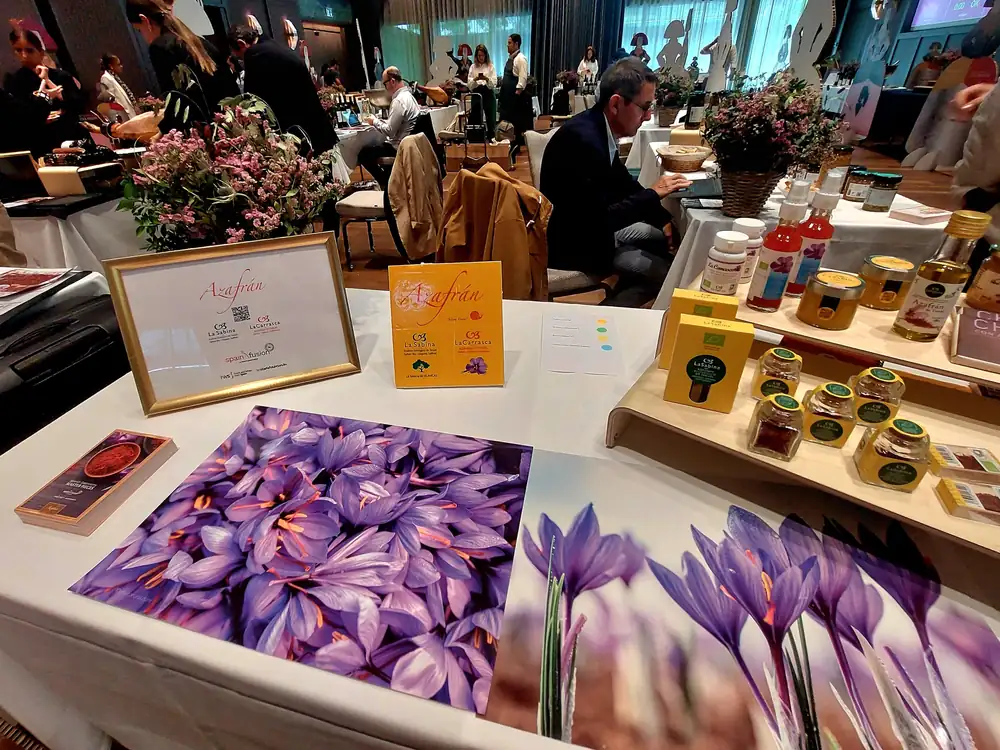
At the grand Park Hyatt hotel, seventeen companies – wineries and producers of olive oils, Iberian products, fresh fruit, saffron, truffles, seaweed or vegetable preserves, in addition to Raíz Culinaria de Castilla-La Mancha – have had the support of seven Michelin stars, two Masters of Wine and the best Spanish and international experts in gastronomy to present their products.
Switzerland offers as much as it demands. Concerned about health, sustainability, and social responsibility, the Swiss consumer demands organic products that are exquisite in both content and presentation and that are socially responsible.
Here, explaining the product is as important as offering a taste, and Spain feels confident in its ability to do so. Even artisanal cheeses were featured in Spain Fusion's food selection. In a cheese-producing country openly protective of its national products, this might seem audacious, but Clara Díez, founder of Formaje and ambassador for Spanish cheeses in Zurich, believes that "the most difficult thing is creating a culture around a product, and Switzerland has a cheese culture that allows the Swiss to appreciate a good cheese."
At Spain Fusion, the cheeses, all distinguished with important awards, were accompanied by a selection of great white wines presented by Master of Wine Fernando Mora.
One product that is well-known and loved in Switzerland is Iberian ham. “I’ve taken it with me all over the world,” said chef Ralph Schelling, who returned to Switzerland after working in some of Spain’s most prestigious kitchens, including El Bulli, and who attended Spain Fusion to learn about new developments.
He was particularly drawn to the seaweed from the Galician company Porto Muiños, especially the sea grape.
Hans Schneeberger, a well-known Swiss journalist who, after his retirement, has become one of the country's most influential wine critics, also confesses to being a great lover of Iberian products and did not want to miss Spain Fusion.
Schneeberger gave top marks to the five ham and sausage companies present at the event, and regarding the varied and ambitious selection of participating wineries, with organic wines, diverse areas (along with wineries from Rioja and Ribera del Duero, there was also a presence from Jumilla, Priorat, Aragon or Extremadura) and a very careful image, the critic acknowledged that he had tasted "very interesting things".
But he warned that the new offerings “are entering a mature market where Spain has traditionally been associated with Ribera del Duero, Rioja, or Rueda, wines that the average consumer finds difficult to move beyond. For newcomers, it's crucial to attract select small distributors and the hospitality sector.”
The importance of storytelling
A good story helps open many doors. This is what the olive oil and vegetable preserves company Apadrina un Olivo (Sponsor an Olive Tree) has discovered, revitalizing the economy of Oliete (Teruel) by recovering olive trees abandoned during the rural exodus.
And Gardeniers from Zaragoza, which makes preserved vegetables, soups and creams using only people with intellectual disabilities.
Or Las Truficas del Río Pilas, another family business from Teruel that produces Tuber melanosporum and offers everything from truffle sauces and cheeses to chocolates with truffles, with a young, careful and approachable image.
As Galician cook Lucía Freitas (A Tafona*) pointed out, “the story has power if it is true, and if it is true, it has all the importance in the world to explain where food is born and how it is made.”
Freitas was responsible for introducing canned fish and vegetables, one of the treasures of the Spanish pantry that needs to be explained in countries accustomed to seeing canned goods as a cheap resource with little gastronomic ambition.
He was part of a top-tier ambassador team that included, along with Alfonso Fernández, regular presenter of Spain Fusion and international taster, Master of Wine Andreas Kubach; Kerstin Barduhn, expert in EVOO, and the chefs Rocío Parra (En la Parra*), Fran Martínez (Maralba), Iván Cerdeño (Rte. Iván Cerdeño) and Luis Valls (El Poblet), all of them with 2 Michelin stars.
Spain has knocked on the door of the Swiss market with all its might.