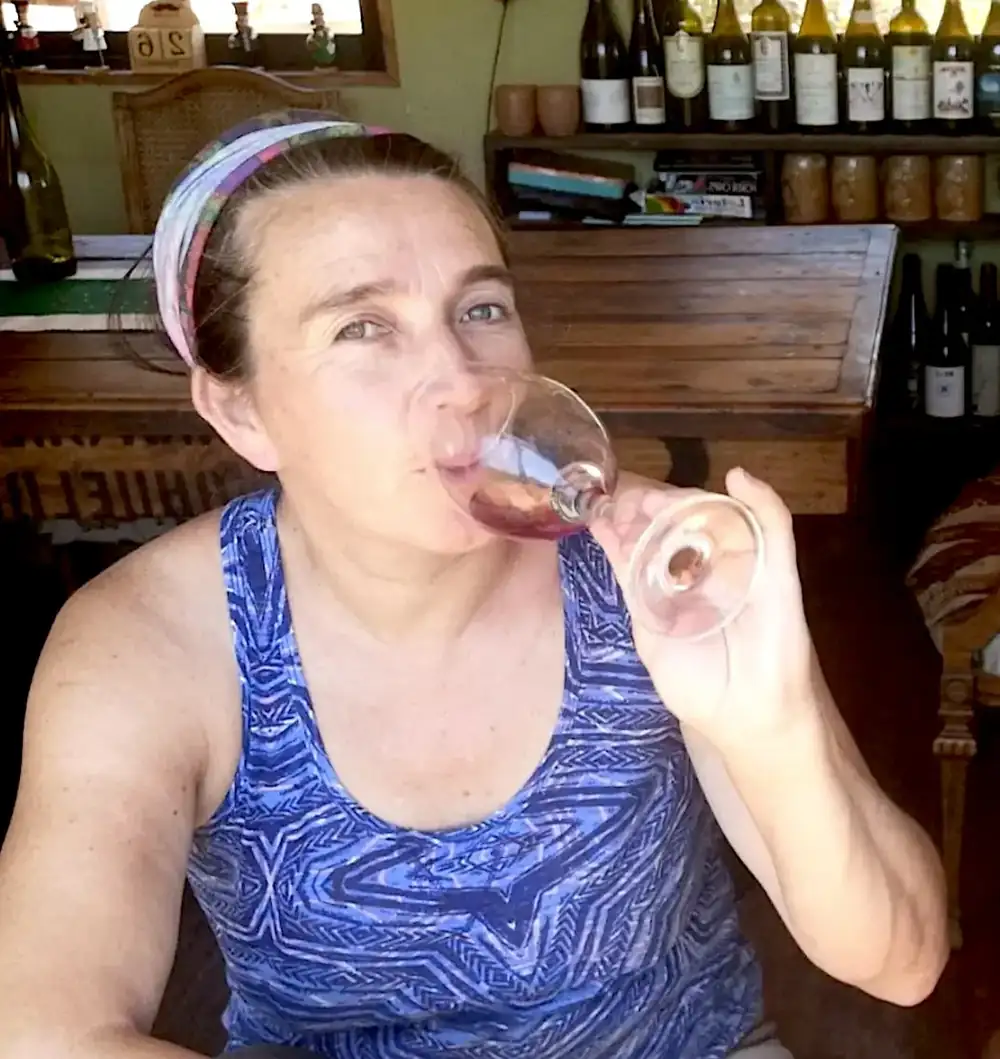
Carolina Alvarado, the voice of agroecology in the Marga Marga Valley
Every Sunday around 11 a.m., Carolina Alvarado and Arturo Herrera leave their house on foot, cross their small vineyard, and wait for visitors in front of the wooden sign that reads Herrera-Alvarado. She guides strangers to see the dense sclerophyllous forest surrounding the property with fresh eyes.
They're not winemakers, but grape growers. They learned the art of vineyards and winemaking from local veterans. Carolina is in her second year of a doctoral program in social sciences at the University of Playa Ancha. Her message centers on agroecology. At fairs, talks, and on her social media, she presents her wines as "unconventional because they're natural, because they show themselves as they are, because they nourish the spirit, because they awaken consciousness, because they're enjoyed without protocol, because they have their own personality, because they're down-to-earth and humble, because they don't appear in fancy magazines."
We talked to Carolina to learn more about some wines that are making themselves heard from Quilpué (DO Valle del Marga Marga) as the force of the Herrera-Alvarado resistance.
You studied agronomy, how did you become a winemaker?
“We have a history within the Marga Marga Valley, a territory steeped in community ties, built on more than just a geographical space, through dynamic processes, where there is culture and a producer economy. I was born here and was very involved with agriculture. My family lived in El Belloto on a country house with vineyards; we always made chicha, mistela, wines… This area had a very important grape harvest; there were vineyards everywhere. Wine was part of daily life; you participated in the harvest; many people still have grapevines at their homes. Therefore, you don't become involved with wine at a single point in time, but rather throughout your upbringing, and as you grow, you become more interested in it. The question should be, when did we start selling our wines?”
So, since when and why Herrera Alvarado wines?
“Arturo and I are from here and we studied agriculture, and right when we graduated, all the cooperatives in the area were in crisis. The neighboring Casablanca Valley started off very strong in terms of marketing and planted acreage, and people began to have purchasing power in supermarkets. Local production was diminished and devalued; it happened all over Chile. Twenty years ago, the last remaining cooperative, La Agrícola los Perales, went bankrupt, its winery was auctioned off, and the last producers scattered. We worked in collaboration with them. That's how Viña Herrera-Alvarado was born; from that feeling of 'where do we go from here?' Today there are very few of us making wine; some have built small wineries. But here we are, with great strength, moving forward because we believe that producing wines using agroecological methods in undisturbed spaces is what the planet needs today.”
Native yeasts
How do you define agroecology and why do we need it?
“We maintain a winemaking method that respects the knowledge that is passed down through generations. It’s not difficult when you tell yourself, ‘I’m going to make healthy grapes.’ But for that, I need healthy soil, I can’t use pesticides in the fields, I have to take care of my environment. My native yeasts depend on that. Sometimes, people from a different perspective feel that we do it out of resistance, but that’s not the case.”
“All of us who participate in this life don't think any other way. In this way, wine is born from spontaneous fermentations, then we take care of it, we don't abandon it. They say that wine makes itself, no, it has its processes. In our case, we use the sieve, we tread the grapes, we use vessels; all those elements that we use, we take care of and handle carefully so that the wine is also cared for.”
Now they call them natural wines…
“We’re categorized as natural wine, but we’re wine from an agroecological perspective. It’s holistic; it’s not just about being healthy. We’re not only committed to food security, but also to integrating other aspects and generating knowledge. Because our way of doing things continues to create knowledge, and we share it with young people. Agroecology is part of an active movement that we hope will be heard, especially now with the climate crisis.”
You produce wines from vineyards without irrigation, is agroecology a necessity?
“Agroecology is essential for future generations. If we don't start making this change in some areas, the situation becomes complex. Here, we had irrigated grape varieties—Chardonnay, Sauvignon Blanc, Pinot Noir—and they were lost because water was scarce. The focus now is on the more resilient varieties, like País, Muscat, and San Francisco. These varieties date back to 1586, so there's a wealth of material to work with. This has been happening for the last 10 years, when the central region has been affected by this uncertainty. It didn't rain for several years, and now we're getting quite heavy rains. In general, you try to adapt to these changes.”
They started selling their wines abroad, how did that happen?
“We always sold our wines in the fields. We tried working with restaurants in Chile, but there was no respect; you had to wait three months to get paid. Meanwhile, we started showcasing our wines, someone was interested, and they began to spread abroad. We entered the French market, they started to circulate, and only then did we begin to see them respected. Now we sell 50% here and 50% abroad.”
What do you think of natural wines, a label that yours also carry?
“I think there’s no going back; I feel that organic wines are no longer just a fad. If someone is wondering, ‘Where do I stand?’ I think that between a conventional wine, an organic wine, and a minimal-intervention wine, the choice should simply be between natural and organic wine. Today, we should all be thinking about how we can contribute. I feel there are very good wines in both categories, and they’re getting better every day. I also think this is a movement, and as such, it should continue to gain more followers. You can make good quality wines, and not just in terms of taste and flavor. What could be better than making a wine that’s like food, something you can enjoy without worry?”
Slow Wine
That's the direction the new labeling law in Chile is heading.
“The new labeling law requires you to include three warnings on the back label of wine: that pregnant women should not drink, that you should not drive after drinking, and that it is not for minors, in addition to the calorie content. It doesn't require you to disclose which ingredients are used in the winemaking process. It has to do with the more than 150 products that can be added, even if they aren't all added at once. What I think is that we should focus on wine as a food, something that is good for you. When we try to produce our wines, we try to make them good for everyone.”
That's why Slow Wine…
“We are the Slow Wine Marga Marga Community, and we are part of the Slow Food International movement, which also promotes food sovereignty. It's about the possibility of making wines and food locally: that are good, unique, clean, and fair, and that people have access to them. Being part of it is important because of the relationships that are built with other producers. So, with people who produce in Argentina, Peru, France, Italy… a dialogue of knowledge is established, which also contributes to the exchange of knowledge and support.”
“This movement allows you to showcase what you're doing. For small producers who don't have access to expensive marketing, it allows them to explain how things are made, how they protect their products, and their relationships with the community. That's why it's called a community. We don't just make wine; we connect with local goat cheese producers, honey producers, and vegetable growers. We exchange goods and support each other. That's why this movement has gained strength worldwide every day. It creates a powerful network of local economies.”
You often say that your wines are like your children and you love them all equally, even though they aren't all the same because they can vary in aromas and flavors. How do you explain this to someone who considers organoleptic qualities to be paramount?
“Imagine a wine in vats, spending over a hundred days in constant contact with its skins and polyphenols; no matter how much you try to interact with it, it will develop its own rhythm, its own path. We have to learn that organoleptic qualities must also reflect diversity, and that we all have different perceptions, and that must be respected. What I find excellent may not be so for someone else. By bottling here, we will give all the wines the same care. It's a valley with such a small production area that all the grape varieties are important; we want them to flourish, to endure over time. It's about surviving, despite adversity.”
Why your PhD?
“I studied at a very academic university. Entering this field of study allows me to draw upon many sources, foundations, and theories that inform an exercise I'm already developing. One has to prepare oneself, because just as you're interviewing me, the path to our communities must be with people who are prepared, and who allow us to continue strengthening them. So, where? In the Social Sciences. It's a path that opens dialogue with other disciplines, which we question and, in turn, enable us to propose new ideas. Ultimately, I want to start writing, because there are so many wonderful experiences that aren't being shared; very few people study rural life, and even fewer in the context of wine. Small-scale production cannot disappear, because with it, so much knowledge and culture will vanish.”
“Perhaps wine isn't perfect, but it's part of people's lives. People make a living from it, they enjoy it, and it's becoming increasingly impossible for them to continue doing so. Some have already given up. Before, they turned up their noses at us because we weren't what they expected… We have enormous richness, from the moment the grapes arrive, and that has never been lost. No one needs to come from outside and tell us how to do things; we already know perfectly well. Dialogue will never be easy because we are different worlds. That doesn't mean we can't talk. We just have to try to understand each other. We are all part of the wine sector, and each of us should be proud of who we are.”