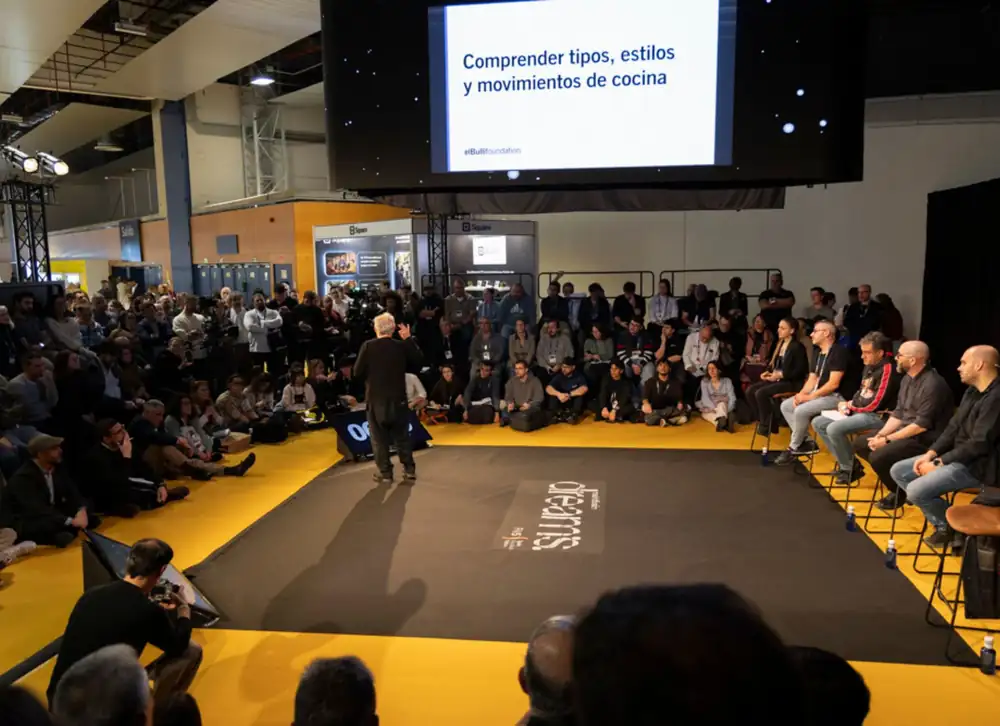
Dreams addresses the modernity of gastronomy in the age of Artificial Intelligence
This was demonstrated by Cecilia Tham, co-founder and CEO of Futurity Systems, who presented innovations such as the Tomito project, "which proposes growing meat, or any other food, inside a tomato; a digital twin of ourselves that can be programmed into a kitchen robot; autonomous food that arrives directly to our kitchen in only the quantity we need; and Herbie, a self-sufficient plant that move
Thanks to Visit Portugal, innovation in sustainability arrived, focusing on zero waste, “something absolutely impossible to achieve since the world isn't ready; it lacks the necessary patience,” asserted chef Rodrigo Castelo of the Portuguese restaurant Ó Balcão** in Santarém. Albert Franch, the Spanish chef who runs the Nolla* restaurant in Helsinki, believes that “every restaurateur sets their own limits; for us, innovation in this area is about survival, and it's easier if we work on it as a community.” Joining them was Pablo Sosa, CEO of OSCILLUM, a company specializing in smart labels that detail the condition of food. “We must strive for a triple bottom line: sustainable, social, and economic impact.” The best way is to find a middle ground that brings the improvements of the past into the future.” This same idea was expressed by Pedro Luis Prieto Hontoria, CEO of Be Food Lab, who came to Dreams to showcase the latest innovations in the food industry. He stated that “we must never stop reinventing or relearning, because in a hyper-technological world, the most disruptive element will be the human element.”
Promotion inside and outside the theater
The tasting menu must give way to more flexible alternatives, as concluded by chefs Albert Adrià of the Enigma* restaurant (Barcelona), who calls it a "tasting menu" because it limits the diner and reduces their likelihood of returning, but also allows for greater cost control. "The important thing is to design it with common sense, neither too long nor too heavy," and Juanlu Fernández of LÚ cocina y alma** (Jerez), who says, "because it's the best way to showcase your vision of gastronomy. Ideally, you should constantly reinvent yourself so that diners always come back, even though there are iconic dishes that you can never avoid."
And regarding promotion abroad, the biggest challenge for the Spain brand is “the lack of unity among the different regional governments,” according to José Miguel Herrero, Director of Food at the Ministry of Agriculture, Fisheries and Food, who believes that “we must work together to promote the diversity of our gastronomy, which, when presented well, is a strength.” María Naranjo, Director of the Food Industry at ICEX, agreed, adding that “we need large companies that convey the excellence of our products, a role currently filled by small artisan businesses, which are true treasures.” Oriol Castro of Disfrutar*** in Barcelona offered a culinary perspective, considering chefs “great ambassadors of Spanish cuisine, whether by taking it around the world or by hosting chefs and diners from all corners of the globe.”
Training and transmission of knowledge
Dreams also gives space to education, essential in any field, including the culinary one. Thus, John Regefalk, kitchen area coordinator at the Basque Culinary Center (BCC), acknowledged that “previously, training was very focused on the chef; now it is more open and cross-disciplinary, therefore offering many more career opportunities.” In this regard, Vinyet Capdet, director of the Bachelor's Degree in Culinary and Gastronomic Sciences at the CETT-UB University School of Hotel Management and Tourism (an affiliate of the University of Barcelona), explained that “30% of our students find senior positions, mostly in the food industry, a sector where companies were previously led by businesspeople or economists, and now require professionals with gastronomic and organoleptic expertise.” Antonio Obregón, academic director of the Madrid Culinary Campus (MACC), also spoke, revealing that “the profile of a culinary studies student is very diverse, but they share a passion for gastronomy, with a transcendent aim of reaching others.”
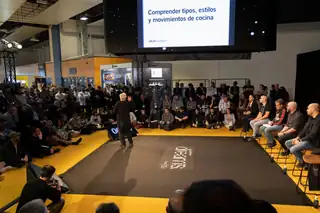
And precisely announcing that it will be a subject at the MAC (Museum of Contemporary Art), the master Ferran Adrià closed the day with an exercise in Haute Cuisine Theory to show those present how to conceptualize a culinary style, in this case, minimalism. Based on the Sapiens methodology of elBulliFoundation and the result of a final degree project by Alba Torres, who defined "minimalism as a style that prioritizes 'less is more' and is based on the preparation of few intermediate tools and main products, seeking to bring the purity and essence of the product to the maximum." This opened an interesting and dynamic debate led by Adrià, in which four chefs considered minimalists also participated. They did so by describing some creations such as the fried green pepper with freshly roasted oyster by Pedrito Sánchez of Bagá* (Jaén), "where I base minimalism on complexity and a hedonistic feeling"; Josean Alija of Nerua* (Bilbao) presented dishes like mixtamalized tomatoes with roasted eggplant, licorice root, and yogurt with olive oil, or avocado steamed with banana, “the fruit of a product-driven cuisine that identifies and motivates me, inspired by the core, essence, and soul.” Artur Martínez of Aürt* (Barcelona) explained his proposal as “a Japanese-Turkish cuisine closely linked to the product and its producers, who are the true heroes,” which he represented in dishes such as the salad of aged bonito, pea tears, and nasturtium. Finally, Rubén Zubiri of Enigma* (Barcelona) explained that there are several types of minimalism: those based on raw ingredients, those involving intermediate preparations, and those intended for tasting. He emphasized that in all cases, minimalism must have a creative approach and a focus on the product itself, as well as using few ingredients. “A blind person should know what they are eating,” he said, showing examples such as a mozzarella soufflé or a lobster with a pork belly base. He concluded by defining essentialism as the ultimate expression of minimalism, using a double-cooked asparagus as an example.