The soul of the cuisine lies in the villages
After a successful public event last Sunday that filled the center of Agüimes with rural cuisine, Terrae kicked off the professional portion of the International Rural Gastronomy Meeting yesterday at the town's Municipal Theater.
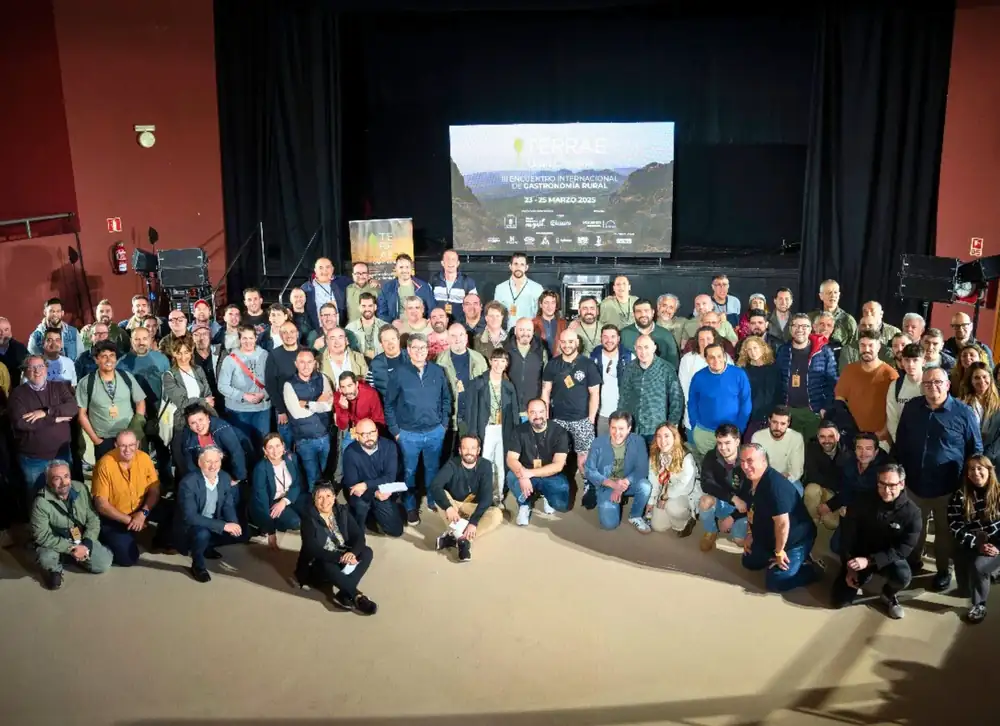
This is a task already being undertaken by many Spanish chefs, as demonstrated by the fact that Terrae brought together more than 50 chefs from all 17 autonomous communities in Gran Canaria, as well as chefs from rural areas of Italy and Portugal. A testament to all this work was evident during the presentation by Ignacio Echapresto (Venta de Moncalvillo***, Daroca de Rioja), who explained how the risky gamble he and his brother Carlos took to "earn a living in the village where we were born" had ultimately become a business that has helped retain the village's population, raise its profile, and forge a network of producers who have seen their products increase in value. Echapresto, who was speaking mainly to the younger members of the audience, also defended regeneration, "which goes beyond sustainability," and championed "the luxury of immediacy and cooking what the land gives us at any given moment" as key elements of rural cuisine.
Along the same lines were Portuguese chefs Octávio Freitas (Desarma*, Funchal, Madeira) and Filipe Ramalho (Páteo Real, Alter do Chão, Alentejo), who brought to this gathering some of the charm of their regions through local products and recipes inherited from previous generations. Freitas affirmed that “customers today are not just looking to eat, they want to experience the region,” which allows both him and his colleague from Alentejo to freely explore the traditions of their respective areas.
The traditional Canarian wrestling arena, transformed into a cultural space to host the first professional day of the congress, became a kitchen and a hub for exchanging ideas for a few hours. As the congress director, Benjamín Lana, reminded everyone, “Terrae is a space for sharing ideas and experiences so that we can all continue to grow.” Minerva Alonso, Councilor for Economic Development of the Gran Canaria Island Council, also took the opportunity to highlight the important work of rural cuisine, “showcasing the landscape, cultural, and gastronomic diversity” of the island itself, the host of Terrae.
Something that the Canary Islanders Aridani Alonso and Víctor Lugo, chef and owner respectively of the Casa Romántica restaurant (Gran Canaria), know well, who have turned this estate in the Agaete Valley into a true “ambassador of the product, which has not only a restaurant but also an interpretation center for the product of Gran Canaria,” the businessman said.
Rural business is multifaceted
Casa Romántica is a good example of a type of business that is proving successful in rural areas, a business that seeks to combine different facets to offer an experience that goes beyond gastronomy. This symbiosis of projects was also discussed at the round table featuring José Ignacio Jauregui, from Maskarada in Navarre; José Gordón, from the León winery El Capricho; Vicent Guimerà, from L'Antic Molí** (Ulldecona, Tarragona); and the Canary Islands winemaker Jerónimo Marrero. They spoke about leveraging all available resources to offer customers more than just a menu, and about understanding sustainability not as an empty word, but as a way of doing things right. Seeking the keys to success for this type of business, Jauregui warned that “in rural areas, profitability depends more on quality than quantity,” while his colleague from León emphasized “knowing the land, understanding what it can offer, working it, and leveraging all available resources, and then knowing how to communicate that.” Finally, Guimerà looked to the future, asserting that today’s work “must serve as an example so that young people see that these businesses have a future and continue to thrive.”
Lucía Torres, from Quesería Era del Cardón in Agüimes, highlighted the importance of knowing the tradition and enjoying the work, something key for this profession to continue with new generations.
Terrae concluded its first professional day with a visit to the Tenefé Salt Flats, a site where a working session also took place in which all the participating chefs debated and shared proposals, whose conclusions will be presented at the end of the congress, to make the rural environment and its gastronomy values of the present but also of the future.