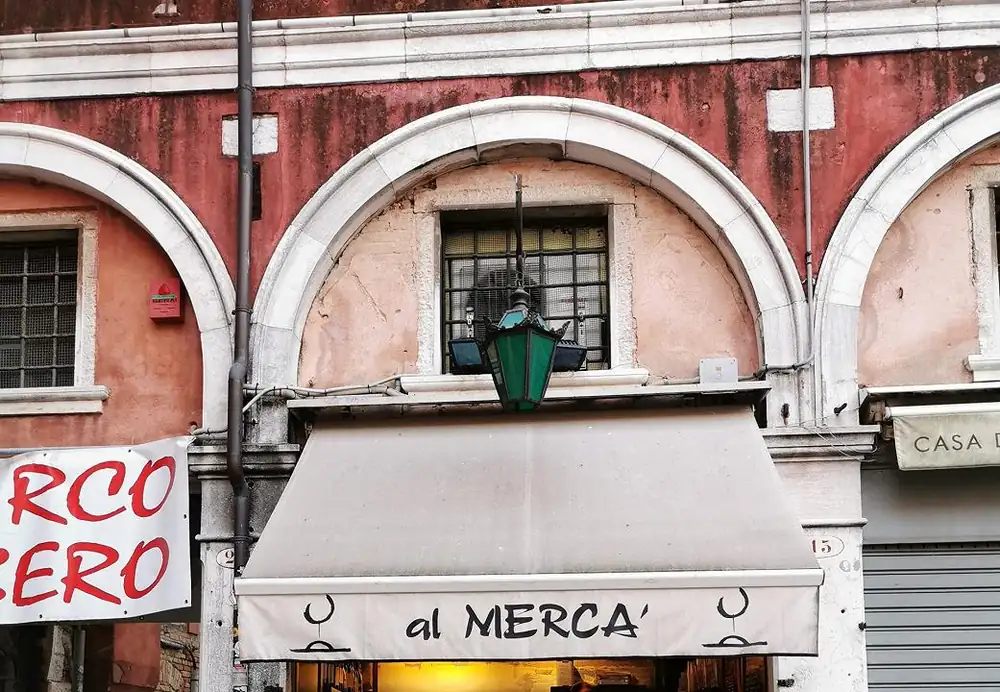
At the Mercà in Venice, a review: this tiny bacaro is worth more than a spritz
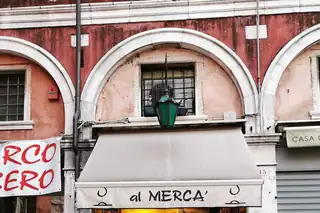
How to sum up the essence of Venice in a handful of square meters. For those who dream of embarking on a tour of the city's bacari, but have no experience with the ritual most celebrated by locals and "foresti" (as non-Venetian residents ironically call all non-Venetians), the advice would be to start with this tiny, strategically located hole-in-the-wall just steps from the Rialto Bridge. Al Merc
It is located near the Erbaria, a place once dedicated to the fruit and vegetable trade. Nearby, for those interested in toponymy, are the Pescarìa, the fish market; the Naranzerìa, for the sale of citrus fruits; and the Beccarìa, the meat market. Milk and cheese also had their place, the Casarìa. Of Rialto's glorious commercial past and the wide variety of shops (and banks) that once occupied the area, little remains today: fish, fruit, and vegetables, all of which are still worth a visit.
Al Mercà is therefore perfectly at home in a historically "food" context, and thanks to its location or perhaps a substantial honesty about its identity devoid of gastronomic pretensions, it is an essential stop for lovers of spritz, glasses and cicchetti.
The place, more like a studio flat
There's no getting around it: the Mercà is a hole-in-the-wall. There's a counter, a display case for cicchetti, four blackboards listing the wines—divided into whites, reds, sparkling wines, and rosés—and one for aperitifs and spritzes. The places to sit are improvised and makeshift: a small piece of marble shelf under one of the aforementioned blackboards, which can hold a glass and saucer at most, or a couple of barrels placed in the square in front, Campo Cesare Battisti, "formerly known as Bella Vienna," or a few steps.
Let's say that going in company, besides representing the very essence of enjoying a bacaro, is a good practical solution that allows for the distribution of tasks: someone orders, someone takes a seat, someone holds the cicchetti until everyone is seated. Finally, although the lack of chairs and tables might initially be perceived as a disadvantage, it could actually be interpreted as an incentive to consume. You start with a glass and a cicchetto, return to the bar to order a second cicchetto, look at the wine list, and order a second glass. A loop.
Cicchetti and wine
While elsewhere, a bacaro's identity is measured by the creative flair of its cicchetti, the soul of Mercà is essentially two pillars: small stuffed sandwiches and meatballs (€1.50 each). Neatly displayed, with information about the fillings and prices, they're the primary reason you come here, forming an orderly line. The fillings are basic: cheese, cured meats, with a few extras (cod, truffle cream). Then, in succession and in combination or individually: prosciutto, coppa, sopressa, speck and gorgonzola, mortadella, prosciutto, robiola and truffle, lard. The fillings, in just the right proportions, provide a balanced bite between filling and bread. Meatballs come in three varieties: meat (soft and flavorful), tuna, and eggplant. Sandwiches, meatballs, and that's it. A niche, a perfect location, manageable space: the bacaro's marketing strategy.
The second reason people frequent Mercà is the wines, which disprove skeptics who associate the place's size with low-quality bulk wines: here, the selection demonstrates expertise, is measured (there are no lengthy lists, the focus is on quality), and allows you to find little gems (Orto di Venezia, for example, by Michel Toulouse, a former French television entrepreneur, now a winemaker who has transformed a piece of the island on Sant'Erasmo into a refined vineyard) usually available only in certain types of city restaurants.
The service, finally: courteous, quick but not rushed.
Opinion
Strategically located in the heart of the city, with the Rialto Bridge on one side and the Grand Canal on the other, Al Mercà is a bacaro recommended for those wishing to embark on a city tour of cicchetti and ombre di vino. Its small size, almost complete lack of seating, and limited selection of food options don't detract from its appeal, which is further enhanced by a wine selection that demonstrates passion and expertise.