Gammon, Egg and Pineapple Pork Pie Recipe
5 hours with various overnight setting, chilling and cooling times over 4 days
- 300g of pineapple, diced
- 90g of cider vinegar
- 15g of caster sugar
- 1 smoked ham hock
- 200g of celery, roughly chopped
- 100g of onion, sliced
- 5 black peppercorns, roughly crushed
- 5 white peppercorns, roughly crushed
- 5 bay leaves
- 200g of unsalted butter, diced
- 50g of lard, diced
- 15g of sea salt
- 15g of caster sugar
- 110g of whole milk, at room temperature
- 90g of beaten egg, strained, at room temperature
- 500g of T55 flour, plus extra to dust
- 12 eggs
- 225g of chicken breast, diced
- 5g of sea salt
- 2.5g sodium tripolyphosphate
- 7g methocel F50
- 15g of potato starch
- 0.5g of ground white pepper
- 100g of crème fraîche, chilled
- 550g of pork shoulder, diced
- 250g of pork belly, diced
- 150g of pork back fat, diced
- 50g of smoked streaky bacon, chopped
- 20g of sea salt
- 5g of freshly ground white pepper
- 5g of dried sage
- 2.5g Cure No.1
- 2.2g of coarsely ground black pepper
- 1.5g of ground nutmeg
- 1g of ground mace
- 0.4g dried bay leaf, ground into a powder
- 2.8g sodium tripolyphosphate
- 90g of fresh breadcrumbs
- 50g dried onion flakes
- 90g of lardo, or cured pork back fat, finely diced then frozen
- DAY ONE
- Put the pineapple in a vacuum bag or shallow tray. Mix the vinegar and sugar together, then pour this over the pineapple. Seal the bag or cover the tray (ensuring all the pineapple is submerged) and leave to pickle in the fridge overnight
- DAY TWO
- Drain the pineapple and put the pieces in a dehydrator or in a 50°C oven with the door open. Dry the pieces out for around 6 hours until dry and tacky. Keep in the fridge until needed
- For the ham stock, Preheat the oven to 165°C. Put all the ingredients in a large ovenproof dish. Pour in enough water to cover the hock by 2cm. Cover with a tight-fitting lid and cook for 6 hours
- Remove the dish from the oven and leave to cool for 1 hour before removing the hock and picking the meat from the bone (try and keep the ham in as big pieces as possible). Reserve all the skin, fat and cartilage separately and don’t throw away the cooking liquor
- Weigh the skin, fat and cartilage and calculate 30% of that weight. Add that amount of the strained cooking liquor to a blender, then tip in the skin, fat and cartilage mixture. Blitz until smooth, then cover the surface with cling film and leave to chill. This makes the ‘ham jam’. Reserve the remaining strained cooking liquor too, as you’ll need more later
- To make the pastry, put the butter and lard in a bowl and microwave it until it’s about 80% melted. Allow to stand until cool (but still liquid)
- Whisk the salt and sugar into the milk until fully dissolved, then combine with the eggs
- Add the butter mixture to a stand mixer fitted with a whisk and mix on a medium-low speed until it looks like the butter is emulsifying. With the whisk still running, very slowly trickle in the egg/milk mixture as if you were making mayonnaise. Once it’s all added, stop the mixer and add half the flour. Turn it on at the lowest speed and whisk until the flour is fully combined
- Replace the whisk with a dough hook attachment and add the remaining flour. Continue to mix on a low speed for around 5-10 minutes until the dough is smooth and the bowl is clean. Wrap tightly with cling film (or vacuum seal if you are able to) and leave to rest in the fridge overnight
- To make the ‘long egg’, cook the eggs sous vide at 65°C for 70 minutes. While you wait, put the chicken in the bowl of a food processor, then put the bowl in the freezer for 45 minutes
- Transfer the eggs to a bowl of iced water. Once cool, gently crack them open and peel away the soft whites to reveal the yolks
- Gently rinse the yolks under cold running water and arrange on a cloth to dry. Any stubborn bits of egg white can be gently brushed off with a dry cloth
- Lightly brush a sheet of cling film with sunflower oil. Arrange the egg yolks end to end on the cling film, creating a roughly 40cm line. Carefully roll the cling film around the egg yolks, gently twisting the ends as you do so, to create a neat and uniform cylinder. The aim is to have the diameter the same as that of an egg yolk and also to not damage the texture, so make sure you don’t roll them too tightly. Put the yolk sausage in the freezer to freeze solid
- Take the food processor bowl and semi-frozen chicken out of the freezer and pulse in short bursts until coarsely minced. Add the salt, sodium tripolyphosphate, methocel F50, potato starch and white pepper, then leave the processor running for 4 minutes, scraping down the sides as needed
- Add 50g of the reserved ham cooking liquor and blitz again until combined, then add the crème fraiche and blitz again. This makes your ‘egg white’. Transfer the mixture to a piping bag
- Take another sheet of cling film and pipe a thick strip of the egg white, about 45cm long. Remove the frozen egg yolk sausage from its cling film and lay it on top. Pipe another strip to cover the egg yolk, then start to gently roll it into a cylinder, using your fingers to massage and shape the sausage so the egg yolk is completely covered
- Roll the long egg in the cling film and tie the ends to create a larger sausage, ensuring it is watertight. Cook the long egg in a 64°C water bath for 25 minutes, then chill in iced water. Remove the egg from the cling film, gently roll in baking paper, then put in the freezer overnight
- For the primary farce, put all the meat in a large mixing bowl. Whisk together all the salts and spices (except the sodium tripolyphosphate) so they’re evenly mixed, then work the seasoning through the meat, massaging to ensure every part of the pork is covered with the mixture. Cover and leave to rest in the fridge overnight. Put your mincer (or the metal attachments) in the freezer for tomorrow too – you’ll need an 18mm attachment
- DAY THREE
- Set up the frozen mincer with the 18mm attachment. Mince the pork mixture through it, then transfer to a stand mixer with a paddle attachment. Mix on a low speed for 5 minutes, then add the sodium tripolyphosphate and mix for another 5 minutes
- You’ll now start using the various reserved parts of the ham hock from yesterday. Add 80g of the ‘ham jam’, 100g of the reserved ham cooking liquor and the breadcrumbs to the pork mixture, mixing at a low speed until combined
- Put the dried onion flakes in a heatproof bowl. Bring a little more ham stock to the boil, then pour it over the onions to rehydrate them. Mix, leave to chill in the fridge, then add the mixture to the pork, mixing until just combined
- Use your hands to mix the reserved picked ham hock meat, the lardo and tongue confit (or whatever other diced meat you’re adding) into the mixture. You want to make sure they’re evenly dispersed but without breaking them up – it’s best to add each ingredient one after the other, mixing between additions. Finish with 120g of the dried pineapple. This is the completed filling – keep it in the fridge until needed
- To make the jelly, weigh out the remaining strained ham cooking liquor in a pan, then bring it to a gentle simmer. Meanwhile, work out 2.5% of the weight and put that much bronze gelatine into cold water to soften for 5 minutes
- Squeeze the gelatine to remove excess liquid, then add it to the hot stock and turn off the heat. Work out 5% of the weight and add that much pineapple to the stock. Leave to infuse for 10 minutes, then strain and put in the fridge to chill
- Now it’s time to build the pie. Assemble your pâté en croute mould and evenly brush the sides with softened butter. Set aside
- Unwrap the pastry and dust your work surface with flour. You need to roll it out to roughly the thickness of a pound coin, then cut out 4 pieces: 1 x 35x30cm, 1 x 40x13cm and 2 x 9x13cm. Reserve any leftover pastry to create decorations and chimneys later
- Take the largest piece of pastry and lower it into the mould, pressing it into the corners and sides, making sure the edges are straight and the right angles inside are defined. You should have some overhang
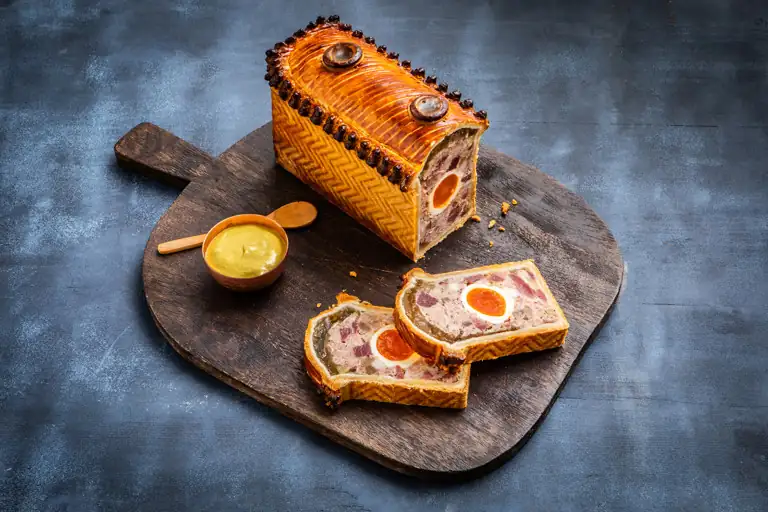
This absolute masterpiece from pie extraordinaire and owner of Leeds-based pie shop Finer Pleasures Josh Whitehead is as much a work of art and lesson in structural engineering as it is a very tasty pie. Taking the pork pie and elevating it into a play on the classic gammon, egg and pineapple, it’s a true labour of love, taking four days and a fair bit of kit. But those who persevere will be rewarded (and it just shows how much work and skill goes into a pie like this).
Ham stock
Pastry
Long egg
Primary farce
Farce additions
240g of pork tongue, confit, cooked pork cheek, pancetta, raw gammon and/or guanciale, diced
mincer
Sous vide equipment
Piping bag with 1cm plain nozzle.
Micro scales
250g of T55 flour, plus extra to dust
bronze gelatine leaves, as needed
Lightly brush the edges of the 2 small pieces with water, then use these to line the shorter sides of the mould. Press them firmly against the mould and use your finger to smear the edges against the sides of the larger pieces of pastry to bond them together.
Take two thirds of the farce and start filling the mould. Make sure to press the filling firmly into the corners and base of the pastry to avoid air gaps. Spread the pork mixture up the longer sides of the mould. You want roughly a third of the filling on the bottom and the rest up the sides and end.
Unwrap the frozen long egg and add it into the mould, trimming the ends so it fits snugly against the pastry. Gently press it down into the pork, then shape the pork mixture around it as much as possible. Add the remaining third of pork mixture, pressing to remove air pockets, to create a domed shape on top.
Lightly brush the overhanging pastry with egg yolks, then lay the final 40x13cm piece of pastry on top of the filling, gently shaping it around the filling to get a tight, even, uniform shape.
100g of egg yolk, beaten and strained through a fine sieve
Gently squeeze the edges to seal the pastry together, then use a sharp knife or scissors to trim the excess, leaving 1cm overhang. You can crimp this however you like, or just leave it as is.
Lightly brush the top of the pie with a thin, even layer of egg yolk and place in the fridge for 30 minutes to dry. Repeat this process a maximum of 3 times to build up a nice layer of yolks. The top should be nice and yellow without uneven streaks or thick patches.
Use a sharp knife to score the pastry however you like. It’s important to score the pastry as this creates tension lines that prevent the pastry from tearing and ultimately the pie exploding. Be careful not to score too thickly into the dough – aim for a maximum depth of 1-2mm.
Use a 10mm piping nozzle to cut out 3 discs from the leftover pastry, then use the smaller end of the nozzle to cut out a hole in the centre of each disc to create 3 chimneys. Cut 3 holes in the top of the pie, then sit the chimneys on top. Brush with more egg yolk. Add whatever other decorations you like at this point, remembering to glaze them with the egg yolk.
Preheat the oven to as hot as it will go. Put your pie on the middle shelf, then immediately turn the heat down to 210°C. Cook for 5 minutes, then turn the heat down to 180°C and cook for another 5 minutes.
Turn the pie 180° and cook for another 10 minutes, then turn again and cook for another 10 minutes. Keep cooking the pie, turning it every 10-15 minutes, until the internal temperature reaches 55-57°C.
Once up to temperature, remove the pie from the oven and leave to rest at room temperature for 3 hours, before chilling in the fridge overnight.
The next day, gently warm the jelly until melted but not hot. Use a funnel (or a piping nozzle) to help you pour the melted jelly into the 3 chimney holes of the pie until it reaches the top. Return the pie to the fridge for 45 minutes to soak and set.
Top up each chimney with more melted jelly as the meat will have soaked up some of it. Return to the fridge for another 45 minutes to set. Continue to do this until the set jelly remains at the top of the chimney.
Your pie is now ready to eat! When slicing, use long, gentle strokes with a sharp serrated knife. Slices should be around 2cm thick. Ideally, allow the pie to come up to room temperature for 30 minutes before eating.