Szabina Szulló's perfect cabbage casserole recipe
Kale casserole is a true classic that has been on the Hungarian kitchen table for generations – yet there are plenty of little tricks that can make it perfect, or ruin it. Szabina Szulló, chef of the two-Michelin-starred Stand Restaurant, showed us how to prepare it so that every layer is in perfect harmony.
Our best chefs naturally use the ingredients in their recipes that result in the best flavors and dining experience, but we have indicated in the ingredient list what more ordinary foods can be used to replace the gourmet ingredients.
We come with a true dish suitable for the early spring season, as rice and pork are not seasonal, fresh spring vegetables are still waiting for them, but kale is holding its own. It tastes good even in this season and does a good job in the kitchen.
A good tip from Szabina Szulló before cooking: a good-tasting stock is so important for the risotto that it is definitely worth sticking to this component. If you don't happen to have stock at home (or in the freezer), it is worth combining the preparation of the risotto with the preparation of a good meat broth.
"With us, one dish leads to another. Our beef broth is made from three types of beef, which we then eat like a tafelspitz. We make apple puree and fresh horseradish for the cooked meats, but this time, for example, we ate it with wild garlic sauce and mashed potatoes. A good half liter of the broth is also needed for the stewed cabbage, and the remaining portion can be portioned and put in the freezer, as a good-tasting stock can make many dishes even more delicious."
Chef's tips for making kale casserole from Szabina Szulló.
- When harvesting kale for its leaves, the outer, rough leaves are not used!
- It's important not to just blanch the cabbage leaves, but to cook them in salted, boiling water for a few minutes. This will give them a texture that will be nice to bite into in the finished kale casserole. This step will also remove the bitterness from the cabbage leaves.
- It should not fall apart – almost soft is the ideal state.
- Cooling in ice water also helps it retain its color. Do not overcook the vegetable, do not soak it in water!
- The leaves of kale are grooved, so if water remains in them, it will get into the food and make it soggy. That's why it's important to wipe them with a kitchen towel after cooking. Szabina lets them dry and air out for 10-15 minutes.
- We can add a little summer barbecue flavor to the kale casserole by lightly browning the cabbage leaves in a hot pan with some bacon.
- It doesn't have to be black, but don't be afraid to give it a little bit of a smoky flavor.
- Szabina Szulló also swears by duck fat as a fat for stew. Chefs prefer mangalica because the fat-marbled meat of this cold-raised pig breed is extremely tasty. Of course, it can be substituted for pork loin!
- Stew made from minced pork will be really tasty if you add the meat to the hot pan in batches. Divide the specified 70 decagrams into 6-7 portions. Brown one portion, then add the next portion of raw meat. This way, it will not start to soften or steam, but will be stew-like, and will be roasted.
- Make an onion base in duck fat: sauté and simmer the onion, garlic, and tomatoes for a long, slow time, up to an hour. On a very low heat, for a long time, so that there is no raw onion flavor left.
- Szabiná and her family have experimented with many things, but the best risotto-based dish is the cabbage casserole.
- The risotto rice is cooked with broth, but first the rice is also bathed in duck fat. This way it becomes really tasty.
- Because of the broth, the rice doesn't need salt. If you don't have stock, add salt at the beginning!
- When the rice is simmering over medium heat, you can pour in a little white wine, and only then add the ground paprika and fennel.
- It will be delicious without the chives, but this fresh herb goes very well with this dish.
- Although the chef tried to use only seasonal produce, tomatoes are needed for acidity. 4-5 cherry tomatoes are enough.
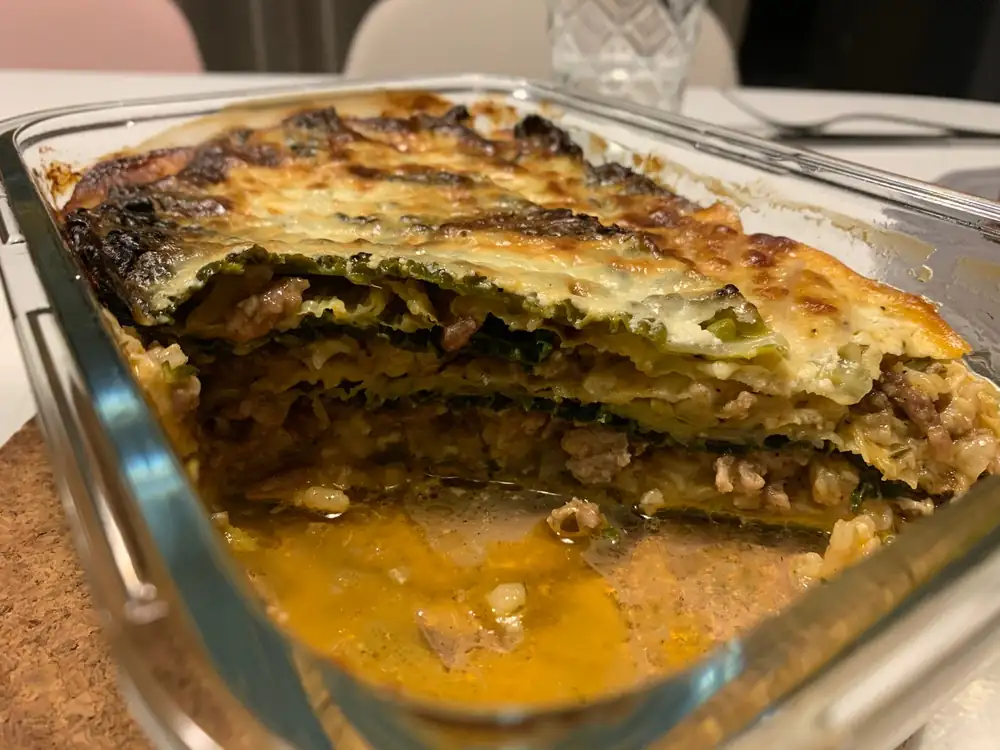
- You can layer in a Jena dish or porcelain: Szabina recommends starting with cabbage leaves at the bottom because it's better to have a bottom and top that are easier to remove when you take it out. So the order is: kale leaves, risotto-mangalic ragout mixture, sour cream, kale leaves, risotto ragout, sour cream, and finally kale leaves and sour cream again.
- You don't need to bake at a temperature higher than 170 degrees Celsius. It was beautifully baked in about 40 minutes with hot air.
- After frying, letting it rest for 10 minutes is good for it, it absorbs the fat, it becomes juicy, and it tastes good.
- We don't usually serve it, everyone takes it at the table and puts another layer of sour cream on top.
Ingredients:
- 1 head of kale
- 100 grams risotto rice (made with Arborio rice)
- 70 dkg mangalica or pork loin, minced
- 100 g shallots, finely chopped (can be replaced with red onion)
- 4-5 cherry tomatoes
- 1 tsp. smoked paprika (sweet and savory would also be delicious)
- 0.5 dl white wine
- 5 dl meat broth (if you have stock, if not, use the same amount of water)
- 70 g duck fat (duck fat is the tastiest, but who swears by what kind of fat!)
- 8 (!) cloves garlic, chopped
- 1 kg sour cream
- 2-3 thicker slices of smoked bacon
- fresh fennel from the garden, chopped to taste (this can be omitted)
- sea salt to taste
- freshly ground black pepper to taste – Szullló Sabina's favorite is Sarawak pepper
Preparation:
- We pick the cabbage leaves, cut off the stems of the tender leaves. We pre-boil the leaves in salted, boiling water! Let's do this for a few minutes, until they are almost soft, hard leaves are not tasty in stewed cabbage!
- Once they are soft, cool them in cold ice water (under the tap). Once cooled, dry them thoroughly on kitchen towels and set aside.
- Fry the mangalica in a very hot pan in duck fat, little by little.
- It's better to coarsely grind it yourself! Once it's done, set it aside.
- Let's make an onion base in duck fat: confit the onion, garlic and tomatoes for a long time, up to an hour!
- When the base is ready, add the risotto rice and white wine, and let the wine evaporate.
- We make risotto in the classic way with hot broth (no need to cook it separately, it's perfect with Sunday leftovers), i.e. we pour the hot broth over the rice little by little and simmer it over medium heat.
- When the rice is ready, add the paprika, chopped chives, and roasted mangalica ribs. Mix well.
- Place the bacon slices in a larger grill pan, heat it up, and thoroughly brown the dry, soft cabbage leaves.
- It's good if the cabbage is fried in stripes. When the bacon is cooked, I add stripes to the ragu.
- The layering can be done in Jena pottery or porcelain.
- It can go into a hot oven at 170 degrees for 40 minutes. Once baked, let it rest for 10 minutes before eating.