The future is being built behind the scenes – This is how the A.MeCoD team redesigned Kempinski's kitchen backstage
From the outside, the hospitality of Kempinski Hotel Corvinus Budapest is easy to identify with ÉS Bistro or NOBU Budapest, but the reality is much more nuanced.
In this volume, the kitchen goes far beyond its function as a cooking and serving area. The preparation rooms, cold rooms, pastry shops, dishwashing systems, warehouses and other background processes form an interconnected network, where every square meter (with a slight exaggeration: every square centimeter) and every work process has a precise role. If a single element were to be missing, the efficiency of the entire architecture would be compromised.
That is why the comprehensive kitchen technology renewal at Kempinski was a special challenge. During the project, many areas were reborn, from the vegetable and fruit preparation to the cold kitchen and meat preparation to the confectionery, while the hotel's operations were not allowed to stop for a single day. Guests received their usual quality breakfast, room service orders, the banquet kitchen served events in the same way, and the restaurants welcomed guests continuously.
The success of the project was determined by the coordination of the details – the meeting of logistics, scheduling, technological planning and operational aspects. For A.MeCoD, this is one of the most exciting parts of the profession. In the case of both ÉS Bisztró and NOBU Budapest, they collaborated with interior designer Ákos Bara on the combination of design and technology.
When the kitchen becomes part of the brand
One of the most important changes in the hospitality industry in recent years is that back-of-house areas have become physically closer to the guest experience. In the era of open kitchens, show grills, and chef's table concepts, technology no longer just serves the restaurant, but also shapes its character, ideally blending into the original DNA.
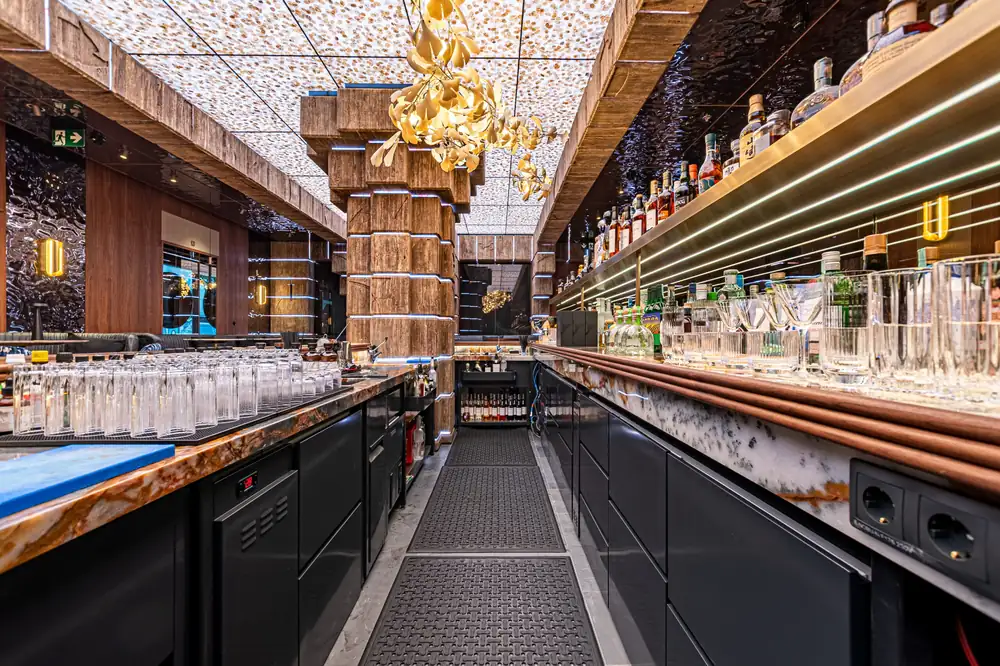
This is clearly demonstrated by the 2026 renovation of ÉS Bisztró, where the guest area, bar and show kitchen were “reset” along a unified concept. Professional equipment, custom-made stainless steel elements and carefully organized work processes have created an environment that simultaneously serves professional efficiency and the visual impression of guests.
Modern kitchen technology is now about much more than just the placement of machines and equipment. Optimizing energy use, food safety considerations, sustainable operation and an ergonomic working environment for employees are essential parts of the design process.
The latest launch of the 15-year-old NOBU Budapest
Of the recently completed developments, the renovation of NOBU Budapest has undoubtedly received the most attention. And it is no coincidence: we are talking about a restaurant that, as part of the international NOBU network, has been a defining player in the Budapest gastronomic scene for many years.
During the transformation, in addition to the guest area, the entire kitchen technology background was also rethought. The preparation and cooking kitchen, the dessert kitchen, the pastry finishing department, the related storage areas were renovated, and the sushi bar, the grill counter and the bar technology system were also given a fresh look. Among them was a Josper Robatagrill, the use of which was introduced for the first time in the life of the restaurant chain at the Budapest location.
The A.MeCoD team balanced global brand expectations with local operational specifics. In the case of NOBU, every detail had to be aligned with an internationally defined quality standard, while the Budapest unit's own needs also emerged prominently during the design and construction. Interestingly, the sushi refrigerator requires special technology (a new manufacturing partner had to be found for this), as these are very sensitive products, for which special attention must be paid to the humidity and temperature settings. It is also exciting that the tuna has to be stored in a much cooler environment, at minus sixty degrees Celsius, otherwise the fish fibers would be destroyed.
All of this would hardly be possible without their many years of experience and the coordination between the disciplines. Pinpoint precision and attention were required both at the design table and on site, which was further complicated by the extremely short timeframe for the renovation.
The next chapter will be written in Balatonfüred
In gastronomy, chefs, new dishes or interiors are often in the spotlight, while a significant part of the most significant developments take place in the background. Ideally, a well-designed kitchen remains unnoticed by the outside observer (unless an open or semi-open kitchen is the goal): it makes work more dynamic, operations safer and more efficient, service more predictable, while giving room for creativity so that new ideas can take root in the refreshed space.
The Kempinski Hotel Corvinus Budapest project therefore goes beyond a traditional renovation: it is about how to prepare the kitchens of a versatile hotel for the challenges of the coming decades in a way that guests hardly notice, except that everything works more consistently, faster and to a higher standard.
For A.MeCoD, this is another important milestone in the series of hotel projects. And the story continues: the next chapter is being written by the Birgés Hotel Lifestyle & View**** Superior in Balatonfüred, where the team is also responsible for the kitchen technology design, construction and professional support of the opening.