Peruvian street food meets Alpine luxury in St. Moritz
The restaurant takes its name from the serpent figure of Inca mythology, and its interior evokes this rich world of imagination.
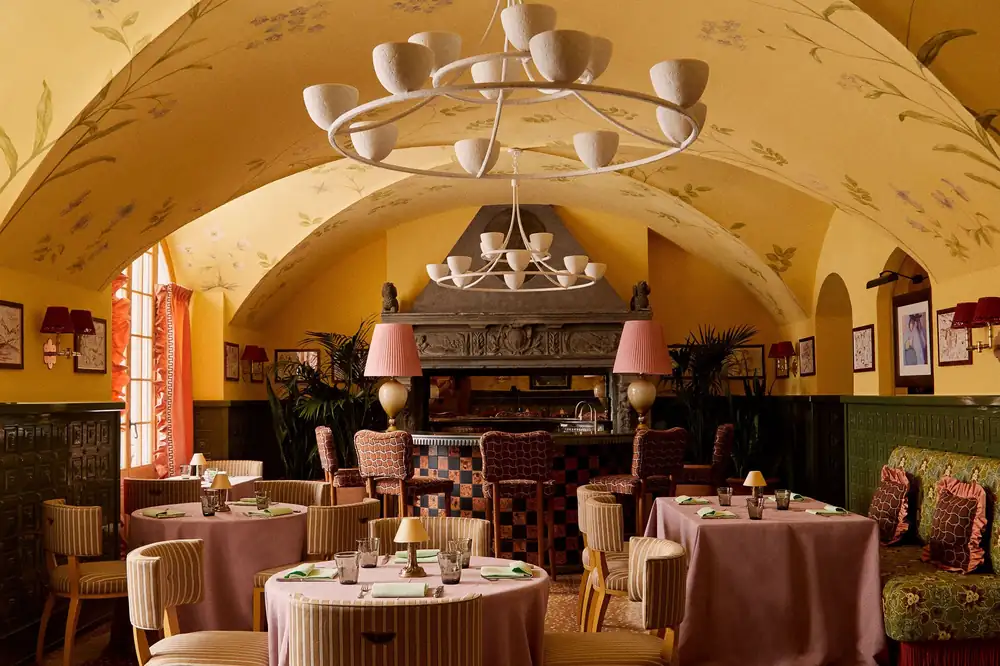
Luke Edward Hall’s signature color palette of green, pink, and sunny yellow lends the space a romantic, almost surreal feel, further enhanced by London-based artist Timba Woollard’s monumental ceiling mural, which evokes Engadin wildflowers in an oversized form.
The olive-green lacquered wood paneling echoes the world of Spanish Baroque doors, while adding an almost tactile depth to the space. The mushroom-shaped lamps, powder pink tablecloths, and hand-woven antelope-patterned rugs all emphasize the meticulous detail that characterizes Hall's work in general.
Paintings by Peruvian artist Ernesto Gutierrez and Hall's sketches of floral and Peruvian landscapes also play an important role in the storytelling, and they also appear on the canvas bags given to guests upon arrival.
But Amaru's interior is not just a spectacular setting, it's an integral part of the dining experience. According to Luke Edward Hall, truly exciting restaurants have the ability to create a sense of another world - places that feel almost like fantasy, yet are connected to something real.
This approach is closely intertwined with Claudia Canessa's cuisine. Drawing on her Peruvian-Italian roots, the chef creates street food-inspired dishes that are both bold and refined: the emphasis is on simple, yet precisely prepared ingredients.
Canessa's name has become increasingly familiar in St. Moritz's gastronomic scene in recent years, and Amaruval has finally got its own full-fledged stage at the Kulm Hotel. However, his cuisine is far from sticking to classic Peruvian recipes: Thai and Japanese influences also appear on the menu, which naturally blend into the South American basics.
Empanadas, for example, are made with shrimp, ginger, lemongrass and spring onions, and come with a sweet & sour sauce made with tamarind and Peruvian rocoto chili. One of the centerpieces of Amaru is the ceviche bar, where the classic Don Ceviche is made with sea bass, tiger prawns, red onion, coriander and sweet potato.
Canessa’s ceviches are intense in their spiciness, but they don’t overwhelm the delicate texture of the fish, instead adding a firmness and energy to the dish. One of the chef’s most exciting dishes is a soup called La Resacosa, which means hangover in Peruvian slang. Made with coconut milk, Peruvian chili, ginger, lemongrass, galangal and kaffir lime, the dish evokes South America and Southeast Asia at the same time.
At Amaru, the world of Peruvian street food is not interpreted as an authentic reproduction, but as a freely reimagined experience, integrated into a luxury hotel.
Gastronomy, design and storytelling merge almost completely here – and perhaps this is what makes Amaru one of the most exciting new examples of contemporary luxury hospitality.