Anthony Bourdain-inspired dishes combined with a film screening – Dávid Pallag talks about their “Routine” movie night
The evening on September 10th will be dedicated to Anthony Bourdain's story: Tony - The Birth of a Chef depicts the period when the nineteen-year-old Bourdain first gets close to the world of a restaurant kitchen.
What stuck with me the most was his honesty: Anthony Bourdain doesn't romanticize the profession, but shows the toughness of the kitchen, its hierarchy, its madness, and the camaraderie that can develop while working. Many of the situations were familiar to me, because in the kitchen you quickly find out how you behave under pressure. Nowadays, we do a lot of things differently, but I'm also familiar with the feeling when this world suddenly sucks you in...
Anthony Bourdain's The Most Determinative Summer of His Life Will Be Released in August
On September 10th, in collaboration with ETELE Cinema, we would like to show you this. First, we will have dinner together, and then, before the premiere, we will watch the film Tony – The Birth of a Chef in the Premium Room. The evening will have two start times (from 18:30 and 20:00), and the ticket includes the full dinner, the film screening, unlimited buffet consumption, drink pairing and four hours of free parking.
The host will be András Jókuti, a gastronomic journalist, which means a lot to me, because few people in Hungary know the restaurant world and Anthony Bourdain's legacy better than him. During the dinner, his stories and thoughts will also enrich the program. And the drinks will be provided by Zoltán Nagy, the owner of Boutiq'Bar, who makes the cocktails from his own vermouth (Moena Wermut was created together with bartender Balázs Molnár - ed.), so the glasses will also have something quite unique to accompany the dishes.
The film is about how someone becomes a chef and what happens behind the scenes. When you got the invitation, how important was it for you to create not “just” a dinner for a movie, but to somehow connect the food to the mood of the movie or Anthony Bourdain’s thinking? What do you think a plate can tell you about a chef that a movie or an interview can’t necessarily?
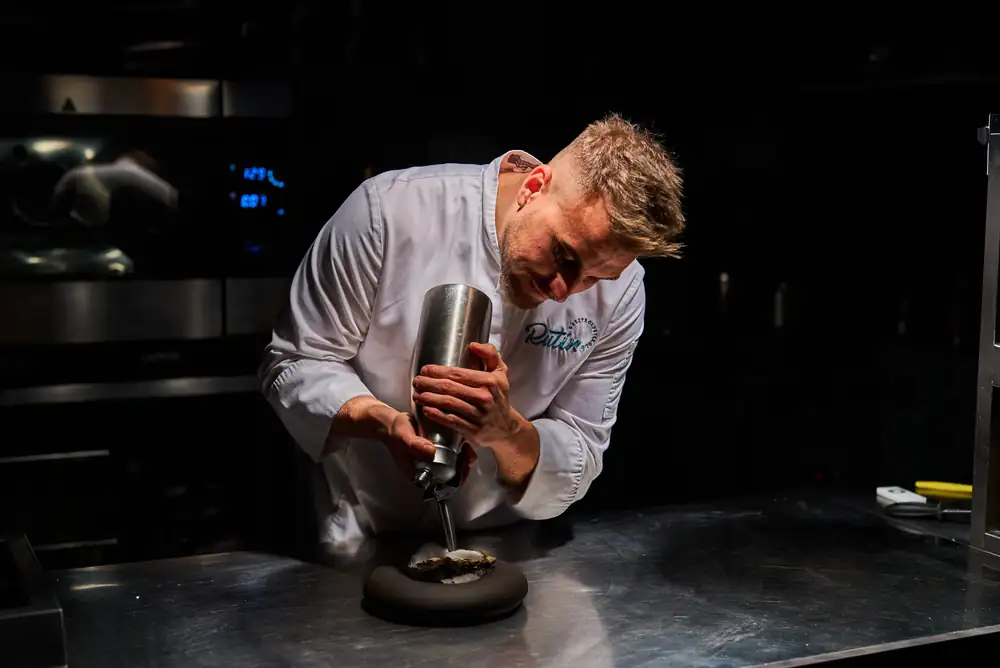
It's important to me that the food has something to do with Bourdain's character, and not just cook something for the show. He approached different cultures very freely, full of curiosity and without prejudice, while always looking for honest, tasty food that speaks for itself. I think a plate says a lot about a chef: it can reveal where he came from, what interests him, how much he dares to take risks, and what he considers to be truly important.
This is not the first time you have cooked for ETELE Cinema Premium guests, you have worked together several times before. What have you learned from the previous occasions, and how is cooking for a cinema audience different from cooking for Rutin guests? Are there any aspects that need to be approached completely differently in such a venue?
This is an ongoing collaboration with ETELE Cinema Premium, and we learn something every time. At Rutin, we control almost all the circumstances, but here we have to adapt to the film, the location and many more guests at the same time. For this reason, timing, heat retention and serving are particularly important: the dishes have to be planned in such a way that they provide the same experience even in larger quantities.
The current menu excitingly combines various cultural and gastronomic references in several places. Where did the idea for this menu come from, and how did this rather freely associative, yet consciously structured menu finally come together?
The menu was inspired by Bourdain's thirst for knowledge, the way he could move from one culture to another with complete naturalness. That's why oysters Rockefeller, New England chowder, a Hungarian reinterpretation of lobster and Vietnamese iced coffee were placed side by side. The sequence of dishes may seem instinctive or improvisational at first, but the same thing holds them together throughout, we try to show familiar, strong flavors through our own stories and the thinking of Rutin.
Could you tell us some behind-the-scenes secrets that your guests probably won't notice at the table? For example, why you cook the lamb mangalica sausage in a foil-lined pan, what the homemade sauerkraut adds to the chowder, or how the bisque and fried sour cream made "Rácz-style" are structured?
The veil fat protects the lamb-mangalica sausage during baking, keeping it juicy and forming a thin, browned layer on it. The acidity of the sauerkraut cuts through the creaminess of the chowder, making it a bit of a soup. In the dish prepared “Rácz style”, the saffron bisque cooked from lobster shells meets the Hungarian flavors of paprika, tomato, sour cream and bacon. Perhaps the biggest challenge was the balance of this, so that none of the flavors overwhelms the other. The taste of the fried sour cream is the best element of any dish on a tray. I remember when I could grab the browned part on the edge of the tray, it was always the best bite. We want to give everyone what I think is the best (smiles).
The Vietnamese iced coffee with condensed milk ice cream that comes as dessert takes the evening in a completely different direction, while the entire menu is a play with different culinary cultures, classics and your own ideas. Which dish is closest to you and why? Is there a dish, technique or ingredient that has been particularly interesting to you lately, and which could be continued at Rutin?
I feel like the lobster croquette is the closest to me, mostly because of the “Rácz method” sauce that goes with it. I’m really intrigued by how a classic French lobster bisque can be combined with the flavors of paprika, tomato, sour cream, and bacon that are familiar from the carp in a way that doesn’t overwhelm the other. I’ve been finding myself thinking this way a lot lately – to reinterpret Hungarian flavors with ingredients and techniques from other cuisines – and we’ll definitely continue this at Rutin.