“I’ve learned more in the last six months than in the previous six years” – Lukas Wieser on the launch of 99 Sushi Bar & Restaurant in Budapest
Wieser talked about how such an international concept works in practice in Budapest and what consistent quality means for them, but he also touched on the initial reactions of the Budapest audience and how the image of luxury is changing today.
After more than six years at The Ritz-Carlton Vienna, you left to become the executive chef at The St. Regis Budapest. What convinced you that the move would be a good one?
At The Ritz-Carlton Vienna, I got to experience the luxury environment and rose to the position of executive sous chef. During this time, I had the opportunity to participate in several special openings and international projects: I worked on the opening of The Ritz-Carlton Yacht Collection’s Luminara, the opening of The Ritz-Carlton Masai Mara in Kenya, and spent a winter in Berlin as a task force executive chef.
Yet I had been looking for the right moment to move from Vienna to an executive chef position for a while – and Budapest came at the right time. I took the train, came here, met Ausra, the general manager, and we toured the building. It was really exciting that you can build it all from scratch and put your own stamp on everything – I remember every plate, cutlery or glass we chose. It makes it very personal: this is my kitchen, my hotel, my team.
How different was the experience of building the culinary operations of a completely new hotel compared to taking over an already operating unit?
I am sure that I have learned more in the last six months than in the previous six years. It is a very special experience, which also brings the management team together very much. Sometimes I still think back to when I first walked into the office and there were only five people sitting there – it creates a very strong bond. It is a fantastic experience.
As executive chef, what exactly is your role in the daily operations of 99 Sushi Bar & Restaurant?
If someone asks me what I do, I say: I make sure my chefs have everything they need to cook. That's my job. Of course, I also oversee the purchasing, quality and financial side to make sure we run a successful business. But I also make sure my chefs enjoy coming to work - for me, that's even more important than the financial side.
At the same time, I feel like I've hit the jackpot here: I don't go to work every day, but to a hotel, and I want to pass this feeling on. But for this to happen, you need a clean, properly equipped kitchen, where everything is available for good work. Creating this is one of my most important tasks.
The daily operation is led by chef de cuisine Gergely Dávid, who is a very talented, young Hungarian chef. He is joined by a sous chef and a junior sous chef, who focus specifically on sushi. I am not a sushi specialist, there are chefs who are much more specialized than me.
99 Sushi Bar & Restaurant is an international brand. How strictly defined is the system that you operate under? For example, do I mean that the same dish has to be the same in Budapest as in the Moroccan restaurant?
The system is very strict. I work closely with Thinus, [Thinus van der Westhuizen – International Culinary Director for Ninety Nine SB Investment, leading gastronomic development for 99 Sushi Bar & Restaurant - ed.] the international culinary director of 99 Sushi Bar & Restaurant, and we are in daily contact about quality and standards. There is a food tasting every day: we taste a part of the menu every day, take pictures of the dishes and then share them with the team. This way we can ensure that wherever you go in the world, you get the same quality consistently. The hard part is not to make something well once. That’s easy. The hard part is to make it equally good every single day.
However, there are some ingredients that we cannot obtain in Hungary in the expected quality or with sufficient consistency. In such cases, we do not put them on the menu. For example, sea urchin: it may arrive in perfect quality three times, but the fourth time we do not receive it, or it is not suitable. If I cannot guarantee consistent quality, I prefer not to put it on the menu.
How much freedom does the local chef have in this system?
At 99 Sushi Bar & Restaurant, we stick to the standards. However, in the hotel, we have plenty of other opportunities to be creative and create something special, so the chefs have plenty of room to create.
In Vienna, it was important for you to have direct contact with local producers. How can you continue this in a Japanese restaurant in Hungary, where many of the key ingredients come from other parts of the world?
Our primary task at the moment is to make sure that we set the standards and that we can offer the same quality to our guests every single day. Incorporating local products is the next step, but it is our absolute goal. For example, if we find a partner who can source our salad locally, of course we want to do that. And it’s not just about something being local: it has to have a story. I want to be able to tell you why we use that particular chocolate, ham or cheese, where it comes from and why we think it’s special.
But I'm not the kind of chef who pushes things until everything falls apart. It has to happen naturally. But one of my most important tasks is to localize the offer as much as possible.
You mentioned the importance of local stories. Can this be given a prominent role in a luxury hotel?
Yes, because the very concept of luxury is changing. You can now buy caviar anywhere in the world. If you have enough money, you can get it in the desert and Antarctica. It is not a luxury in itself. But you can only taste a local Mangalica ham here. I think that is what the international traveler is increasingly looking for, rather than a product that can be obtained in the same quality anywhere in the world.
In Vienna, the steakhouse had such a level of traceability that I could tell you the address of the farm where the animal was raised. We knew exactly where it came from, we knew the farmers personally and we could tell you a lot about the ingredients. And this also affects the chefs and the servers: you offer a product much more confidently if you know that it is truly the best possible.
99 Sushi Bar & Restaurant goes beyond classic Japanese sushi in several ways: truffles, caviar, wagyu, and even gold appear in the dishes. Is this primarily about the flavors, or is it also part of the brand's international, luxury character?
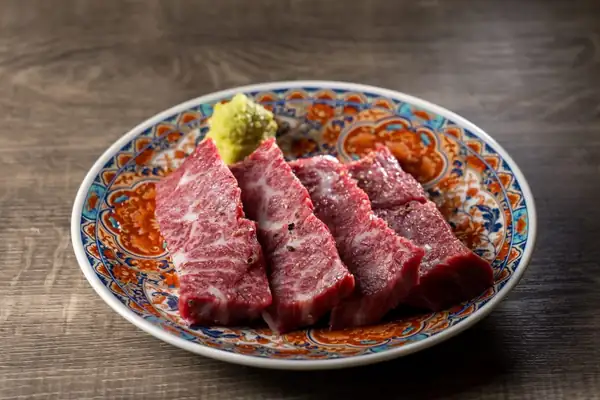
This is basically due to the international nature of the brand. Take for example one of our meat dishes, in which we use Spanish Rubia Gallega beef. 99 Sushi Bar & Restaurant was founded in Spain, has its roots there, and later expanded to the Middle East. I myself lived in Spain for a long time, and I think it is one of the best beefs to work with in Europe.
Connecting this with Japanese cuisine makes perfect sense to me. 99 Sushi Bar & Restaurant is very ingredient-centric: if we have a fantastic product, why not use it? The same goes for truffles and other ingredients that are not necessarily traditionally part of Japanese cuisine.
You also have a 14-course omakase menu. How did it come together?
Very simply: we have put together our favorite dishes. These are the dishes that we consider to be the best. If someone only visits 99 Sushi Bar & Restaurant once, we think these are worth trying.
And what do you think is the absolute best dish in the restaurant?
My favorite is the flambéed sea bass nigiri with truffles.
What background did the Budapest sushi team come from?
Our team is roughly 50/50 local and 50/50 Asian. As a Japanese restaurant, it is important for us to have Asian colleagues on the team, all of whom have a solid sushi background.
Before the opening, a team from Abu Dhabi also came to you. What was their task?
We work very closely with the central team of 99 Sushi Bar & Restaurant, which includes continuous knowledge sharing. Initially, a task force helped us to ensure that the Budapest team reached the expected level, learned and followed the standards properly.
But it works mutually: if there is a shortage of workers in one of the restaurants, we are there to help. Part of the joint work is that there are also quarterly personal visits. It is important that we operate as one 99 Sushi Bar & Restaurant.
The restaurant has been open for a few months. How has the Budapest public received 99 Sushi Bar & Restaurant?
We are getting very good feedback. I think we opened at the right time: we had a quieter summer period, during which we built up the team properly and reached the expected level. We want to offer the best possible service to every guest, and this period has been a great opportunity to practice for this. Now we are ready for what we hope will be a very busy winter, and next year we would like to introduce the terrace, which will make the restaurant bigger.
What would you like to see different in a year, either in the restaurant or on the menu?
My wish would be that nothing changes, in the sense that the same team would work with me in the kitchen. That would be the best case scenario. I am really happy with where we are now. However, it is always important to look ahead: every day there is something to improve, there is always something to work on. So in a year we will definitely not be the same as we are now – we will be much better.