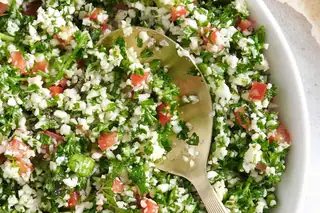
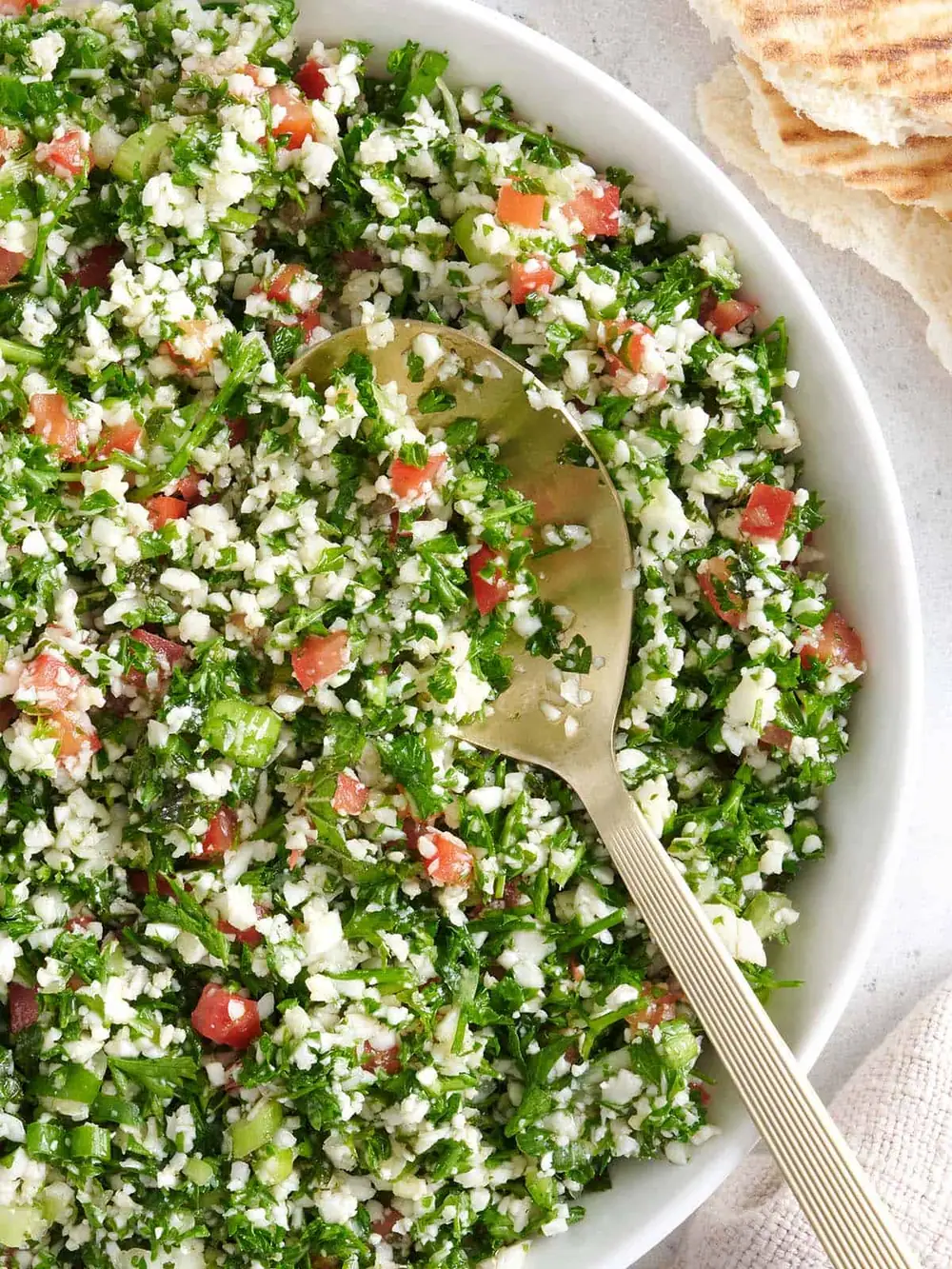
Una versión brillante y cítrica del tabbouleh, elaborada con coliflor
Este tabulé de coliflor es una versión fresca, sabrosa y llena de verduras del tabulé tradicional, hecho con arroz de coliflor en lugar de bulgur para una guarnición completamente sin gluten, sin cereales y apta para la dieta cetogénica.
- 1 cabeza de coliflor (rallada, tamaño pequeño, 260 g sin hojas) $2.96)
- 3 cebolletas (picadas, $0.48)
- 3 tomates Roma (sin semillas y cortados en cubos, $0.69)
- 1 manojo de perejil rizado fresco (picado, $1.07*)
- 1 paquete de menta fresca (picada, (aproximadamente ¼ de taza) $1.78)
- ½ cucharadita de sal (0,01 $)
- ¼ cucharadita de pimienta negra (recién molida, $0.05)
- 1 limón (jugo, (2 cucharadas) $0.68)
- ⅓ taza de aceite de oliva ($0.97)
- Reúna los ingredientes.
- Prepara los ingredientes: retira los tallos gruesos de la menta, corta el limón por la mitad, quita las semillas y corta en dados los tomates Roma, y pica finamente la parte verde de las cebolletas (¡reserva la parte blanca!).
- Retire las partes verdes de la coliflor y sepárelas en ramilletes. Añádalas a la procesadora de alimentos junto con la parte blanca de las cebolletas.
- Procesar la coliflor y las cebollas hasta que tengan el tamaño de granos de arroz. Reservar.
- Retire los tallos más gruesos del perejil rizado.
- Con un cuchillo afilado, pica finamente el perejil y las hojas de menta. (No uso el procesador de alimentos para este paso porque creo que oxida las hierbas frescas y las deja marrones).
- Añade tomates picados, hierbas picadas y cebolletas a la coliflor rallada.
- Sazona con sal y pimienta. Mezcla bien para que todas las verduras y hierbas se distribuyan uniformemente.
- Añade zumo de limón.
- Añade aceite de oliva y mezcla bien. ¡Que aproveche!
This Cauliflower Tabbouleh is a fresh, flavorful, and veggie-packed twist on traditional tabbouleh—made with cauliflower rice instead of bulgur for a completely gluten-free, grain-free, and keto-friendly side dish. I actually used to serve a version of this at my former restaurant when we first opened, and it was such a hit that we could barely keep up with demand! People loved how bright, herby, and lemony it was, and honestly, I do too. Now it’s one of my favorite no-cook recipes to make at home because it’s so easy and perfect for meal prep!
Fresh Cauliflower Tabbouleh Recipe
Tabbouleh is a really fresh, herby salad originating from the Middle East. Traditionally, it’s made with lots (and lots) of parsley, mint, tomatoes, lemon, and bulgur wheat. These days, you’ll see plenty of versions that swap the grain depending on dietary needs and what’s in the pantry (we actually have a quinoa tabbouleh on the site already!). This recipe I’m sharing here keeps everything fresh with ingredients you’d expect to see in a tabbouleh, but uses riced cauliflower instead of bulgur, so it’s completely no-cook and super light. I like to rice my own cauliflower in the food processor, but pre-riced cauliflower works too if you’re short on time!
Recipe Success Tips
Fresh herbs only. Fresh curly parsley and mint are the whole point here, so dried herbs are a hard no! Grab herbs that look bright and smell fresh. If they’re a little droopy, dunk them in an ice bath for 5-10 minutes to revive them, then dry them really well before chopping.
Remove the seeds from the tomatoes. I remove the seeds from my tomatoes to stop my cauliflower tabbouleh from getting too watery once it’s all mixed together. It also helps it hold up better for meal prepping.
Room temp citrus yields more juice. If your lemon is cold, let it sit out for a bit before juicing to get the most out of it!
Using ready-made cauliflower rice? If needed, you can give it a quick pulse in the food processor with the white parts of the green onions to create a finer texture. Avoid frozen cauliflower rice as it releases too much water. One small head of cauliflower (about 9.3 oz once trimmed) makes roughly 3 to 3¼ cups when riced. If you’re starting with pre-riced, use 3 cups and add a little more if your cauliflower tabbouleh looks light after mixing. However, making your own cauliflower rice works out much cheaper!
flat and curly parsley work in this cauliflower tabbouleh, but curly parsley adds extra volume.
how to make Cauliflower Tabbouleh step-by-step photos
Prep the produce: Remove the thick stems from 1 clamshell of mint, slice 1 lemon in half, seed and dice 3 Roma tomatoes, and thinly slice the green parts of 3 green onions. Be sure to save the white parts of the green onions!
Break down the cauliflower: Remove the outer greens from 1 small head of cauliflower and cut the head into florets. Add the florets to the food processor along with the white parts of the green onions.
Rice the cauliflower: Pulse until the mixture resembles grains of rice, then transfer to a large bowl and set aside.
Prep the herbs: Trim off any thick stems from 1 bunch of curly parsley.
Assemble: Add the diced tomatoes, minced herbs, and green onions to the bowl of riced cauliflower.
Add ½ tsp salt and ¼ tsp black pepper, then gently toss until everything is evenly combined.
Squeeze in the fresh lemon juice from 1 lemon (about 2 Tbsp total).
Drizzle with ⅓ cup olive oil and stir to combine.
Finish: Now your cauliflower rice tabbouleh is ready! Serve and enjoy.
I like this flavorful gluten-free tabbouleh best served on top of my white bean hummus or packed into a wrap with homemade falafel. Try chilling it for about 30 minutes before serving so the flavors can meld, and it tastes extra refreshing. It also fits perfectly as part of a budget-friendly mezze spread with pita and baba ganoush, or served with chicken shawarma if you’re not keeping things veggie!
Storage Instructions
Store leftover cauliflower tabbouleh salad in an airtight container in the fridge for up to 3 days. It’s best within the first day or two while the herbs are at their brightest. If you notice a little liquid at the bottom (totally normal as it sits), give it a quick stir before serving, or drain off a spoonful. Everything will soften the longer it’s stored.