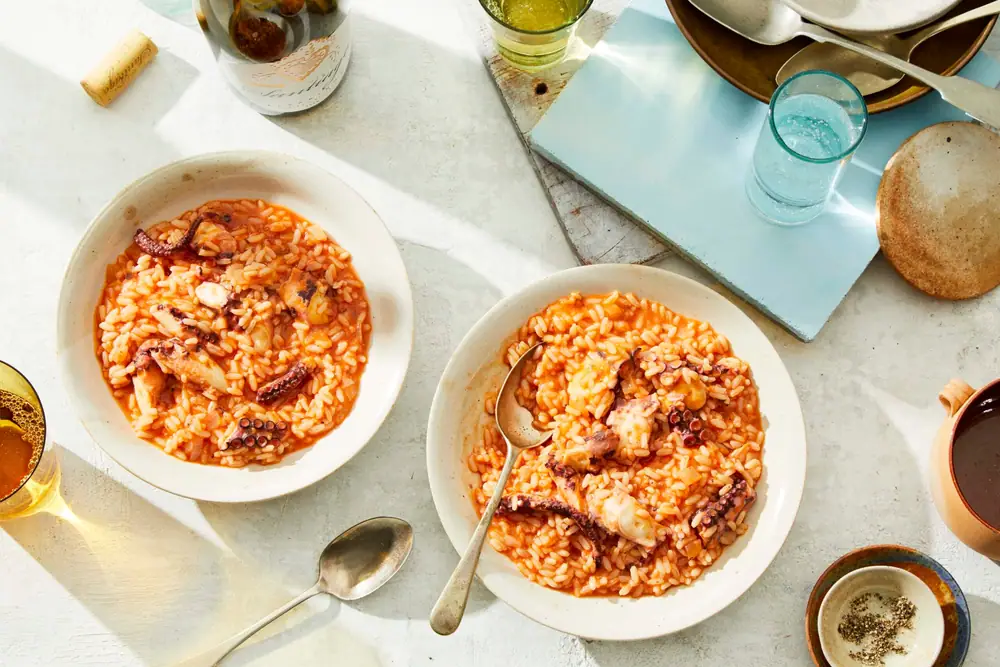
Tomato and Octopus Rice
Octopus is a popular protein source throughout Portugal, and the element is often incorporated into a whole category of comforting, tomato-laced rice dishes—though other types of seafood, including salt cod and shellfish, may as well be swapped in or added without compromising the spirit of this dish.
“In Portugal’s Vinho Verde, Wine Is Green in More Ways Than One”
To a second medium bowl, add black gram and enough cool water to cover by 2 inches. To a third medium bowl, add the poha and enough cool water to cover by 2 inches. Meanwhile, make the podi: To a small skillet set over medium heat, add the sesame seeds and cook, stirring frequently, until golden brown, 3–4 minutes.
Transfer the seeds to a small bowl and return the skillet to medium heat. Add the chana dal and cook, stirring frequently, until just beginning to brown, about 2 minutes; transfer the dal to the bowl with the sesame seeds and return the skillet to medium heat.
Add the black gram and cook, stirring frequently, until toasty and just beginning to brown, 3–4 minutes; transfer to the bowl and return the skillet to medium heat. Add the curry leaves, cumin, and black peppercorns, and toast, stirring frequently until very fragrant, 2–3 minutes; transfer to the bowl and return the skillet to medium heat.
Finally, add the chiles, sesame oil, and asafoetida, and cook, stirring frequently, until the chiles begin to crackle and the mixture is very fragrant, 3–4 minutes. Transfer to the bowl, then add the roasted garlic (if using).
Set the mixture aside to cool to room temperature, then transfer to a blender and process to a coarse powder. Drain the idli rice, tapioca, and poha, then add them to the blender and process, adding a couple of tablespoons at a time of cool water, to achieve a medium-coarse paste (about ½ cup total). (If the mixture or the blender starts to get very warm, set aside to cool for a few minutes before continuing to blend.) Transfer the paste to a large bowl.
Drain the black gram, transfer it to the blender and process until smooth, adding a couple of tablespoons at a time of cool water, a couple tablespoons of water at a time to the blender to get a smooth paste (about ¾ cup total). Using a silicone spatula, fold the black gram paste into the rice mixture to make a loose batter, similar in consistency to pancake batter (thin with more water if necessary). Cover with a clean kitchen towel, and set aside in a warm place to ferment until the batter is bubbly and smells sour, 8–12 hours.
Gently and taking care not to deflate the batter, fold in the salt. Fill an idli steamer pot with 2 inches of water, and set over medium heat.
Grease the plates generously with vegetable oil, then fill each of them ⅔ of the way with the batter. (If your steamer has less than 6 plates, set the remaining batter aside for a second batch.). Carefully stack the plates in their rack, then place the rack in the steamer pot, cover, and steam until the idlis have risen and are cooked through, 8–10 minutes.
Remove the rack of plates from the pot and set aside until cool enough to handle. Remove the plates from their rack, then run an offset spatula along the edge of each idli to loosen.
Invert each plate to unmold the cakes, then transfer to a platter and keep warm while you steam the remaining batter.
- Who: Linda Pugliese · Food Styling