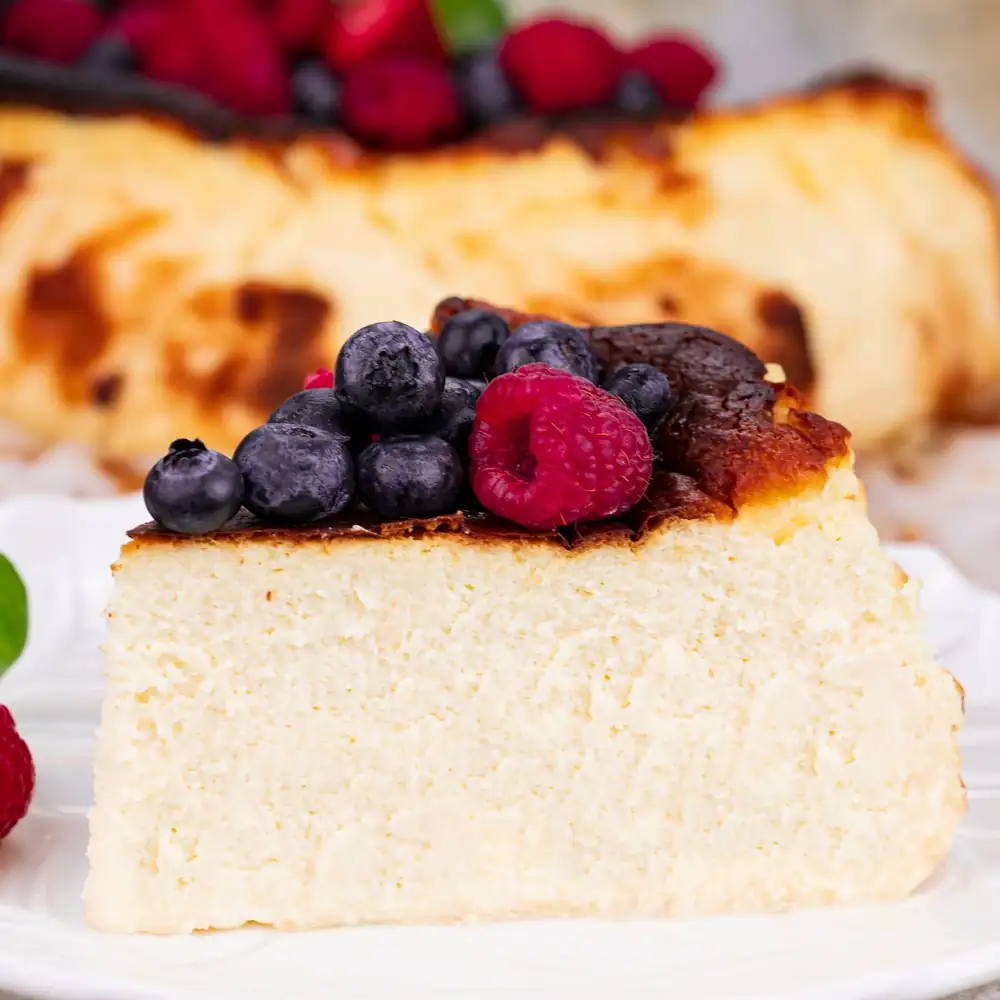
Basque cheesecake
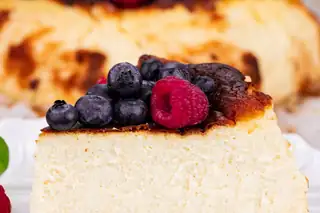
Basque cheesecake is a unique cheesecake baked without a base. This recipe is very interesting because it's baked for a relatively short time, but at a high temperature. Furthermore, it's flourless.
- Preparation time: 20 minutes
- Baking time: 45 minutes Minimum cooling time: 6 hours
- Number of servings: 24 cm cake tin - approximately 1880 g In 100 g of cheesecake:
- Energy value 324 kcal
- Carbohydrates 16 g
- Including sugars 16 g
- Protein 6 g
- Fat 26 g
- Diet: gluten-free, low-carbohydrate, vegetarian.
- about 1 kg of cream cheese, e.g. Philadelphia - my cheese mix is in the description
- 500 ml of heavy cream 36% - a whole carton
- 6 large or 8 small eggs - about 400 g after breaking
- 1 cup of fine sugar - about 250 g (you can use less sugar)
- 1 sachet of vanilla sugar - 16 g
- 1 flat teaspoon of salt - about 4 g
Basque cheesecake
My glass holds 250 ml. To bake the cheesecake, I used a 24 cm springform pan with a high rim. A 25-26 cm springform pan will also work perfectly. Remove the eggs, cream cheese, and cream from the refrigerator in advance to allow them to reach room temperature.
NOTE: The ingredients include approximately 1 kg of cream cheese. Basque cheesecake should be baked entirely with Philadelphia cream cheese. However, it is quite expensive, and in my experience, Basque cheesecake is most delicious when you mix several types of cheese. My best, most tried-and-true combination is: - 2 packages of Philadelphia cream cheese, 125 grams each. - 1 package of mascarpone cheese, 250 grams each. - 4 "buckets" of Almette cream cheese, 150 grams each.
Before you start making the cheesecake, I recommend reading the entire recipe first to prepare yourself well in advance for the next steps.
Place approximately 1000-1100 grams of cream cheese in the bowl of a stand mixer. I make the most delicious Basque cheesecake with the following cheeses: - 2 packages of Philadelphia cheese, 125 grams each. - 1 package of mascarpone cheese, 250 grams each. - 4 "buckets" of Almette cream cheese, 150 grams each. The cheeses can be slightly salty, and this is perfectly acceptable, as we add salt to the cheesecake anyway. You don't have to use exactly the same combination. You can use, for example, 500 grams of mascarpone and 500 grams of fluffy cheese (yogurt or cream cheese) like Almette, Turek, or similar. You can use just the Philadelphia cheese or combine it with the fluffy cheeses. From my experience, it is worth combining very creamy cheese, such as mascarpone and Philadelphia, with fluffy cheeses such as ground cottage cheese (but not the cheesecake cottage cheese from a bucket, only the fluffy sandwich ones).
Add 250 grams of caster sugar (powdered sugar will work too), a small sachet (16 grams) of vanilla sugar, and a level teaspoon of salt (or less if you don't like the salty flavor of salted caramel or salted caramel ice cream). Blend everything with a mixer (on high speed) until smooth. The sugar should melt into the cheese mixture. This took me about 2 minutes. Next, start adding the eggs. Continue mixing at high speed, adding the eggs every 15-20 seconds.
Tip: You can replace the vanilla sugar with homemade vanilla sugar, or add a few drops of vanilla extract or half a teaspoon of vanilla paste. If you prefer less sweet cheesecakes, you can reduce the sugar amount to 150 grams.
Finally, add another 500 ml of 36% whipping cream. This will be a whole, larger carton of thin (sweet) cream. Blend for another 10-15 seconds, but now at a lower speed. You'll have a thin consistency.
Tip: You can probably use cream with a 12% fat content. However, I always use the super-fat 36% cream.
Prepare a baking pan. I used a 24 cm springform pan with a raised rim. Line the bottom and sides of the pan with baking paper/parchment paper and secure the rim. This time, I used two larger sheets of baking paper. I dented them to make them more pliable. First, I placed one, then the other, so that the longer piece of parchment would stick out everywhere. This will ensure that even a very risen cheesecake won't escape the pan. You can also cut strips of parchment out of the pan instead of denting them. To ensure the paper holds well, grease the inside of the sides with soft butter. Place higher strips of parchment paper (you'll need to cut them yourself from a sheet of parchment paper) on the greased sides. Pour the entire Basque cheesecake mixture into the pan. In my case, the mixture filled the pan almost completely (almost to the top of the rim).
This cheesecake is not baked with a steam function. A water bath is also not used. The cheesecake bakes for a relatively short time, but at a high temperature. Place the cheesecake pan in an oven preheated to 230 degrees Celsius (450 degrees Fahrenheit). Baking option: top/bottom. Choose a rack one level lower than the middle (ideally, even the first or second rack from the bottom). Bake the cheesecake for about 45-50 minutes. It will likely rise significantly and begin to brown on top, even burning slightly towards the end. This is normal. After turning off the oven, keep the oven door closed for at least 30 minutes. After this time, open the oven and remove the cheesecake. At some point, the cheesecake will sink back to its original position. The Basque cheesecake will have a custard-like texture after baking. This means that if you gently shake the pan from side to side, the cheesecake will act like jelly (in the middle). Once removed from the oven, do not remove the cheesecake from the pan, as it will be very delicate and needs to cool before serving and slicing. Once cooled, place it in the refrigerator (in the pan) for at least six hours, preferably overnight.
Tip: If you're baking the cheesecake in a 26cm pan, baking time can be 40-45 minutes. I recommend keeping an eye on the cheesecake in the oven halfway through baking, as each oven heats differently and yours may brown too quickly, or even burn too early. In this case, lower the heat by 10 degrees. Cheesecake also browns more quickly if it's too close to the top element.
Serve Basque cheesecake only after it has cooled completely. It slices perfectly, yet is delicate and creamy. Refrigerated, it will stay fresh for at least six days. Before serving, I recommend garnishing it with fresh fruit. You can also sprinkle the top with sugar, which should be immediately toasted with a blowtorch. This will create a caramel-like, sugary layer.
You can also drizzle salted caramel over the cheesecake. To make it, you'll need 80 grams of sugar, 35 grams of butter, 50 ml of 36% whipping cream, and a generous pinch of salt. Keep the butter and cream at room temperature. Pour all the sugar into a heavy-bottomed pot or pan. Turn the heat to low and wait for the sugar to dissolve. You can slowly stir the sugar with a spatula. Only when the sugar is completely dissolved and has a beautiful honey-amber color should you add the butter. Stir immediately, and when the butter is combined with the melted sugar, add the cream and salt. Stir briefly. When the salted caramel begins to boil, turn off the heat. Continue stirring the caramel until smooth. Drizzle the slightly cooled caramel over the cheesecake. You can also top the caramel with popcorn or roasted peanuts. Enjoy.