Terra Madre Salone del Gusto 2026: a global call for biodiversity, justice and peace
A political declaration for agroecology and food sovereignty that decisively rejects exclusion and nationalism.
“Carlo showed us that food means culture, joy, identity, justice, and care for the Earth,” said Edward Mukiibi. “It cannot be separated from the ecological, social, and political conditions under which it is produced, distributed, and consumed. There is no food justice without peace, and no lasting peace without justice,” he added. “As a global movement, we reject individualism, exclusion, and nationalism, and instead embrace diversity, solidarity, and cooperation.”
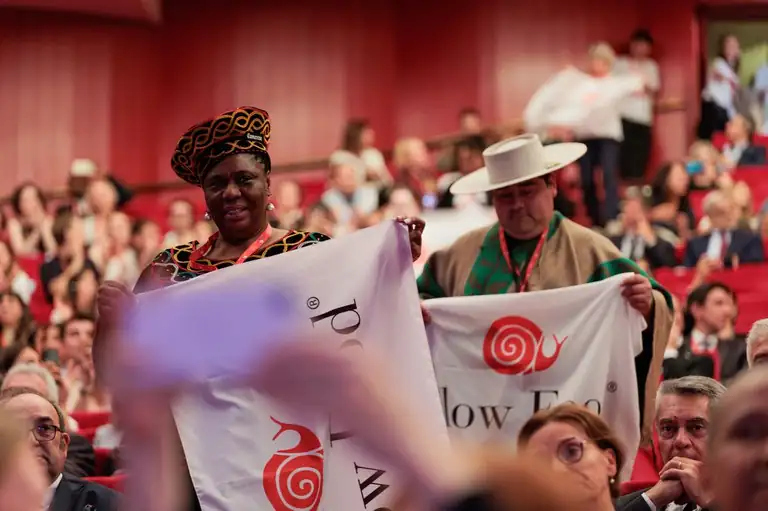
During the closing event of the Slow Food Participants' Assembly (Congress), delegates from the global network reaffirmed a shared political vision for the next four years and underscored Slow Food's role as a global movement for food justice, biodiversity, and social change. The decisions made in Turin reinforce Slow Food's commitment to acting simultaneously at the local and global levels: supporting communities in transforming their local food systems and connecting their knowledge, experiences, and demands with a worldwide movement.
“Together we can create food systems that value the dignity and knowledge of the people who produce our food. In a world increasingly characterized by division and polarization, the message of our meeting is clear: building connections is not an abstract hope, but a political act and crucial for real change,” Mukiibi concluded.
Renewed international leadership
The Slow Food Board confirmed President Edward Mukiibi (Uganda), Marta Messa, who served as Secretary General in the previous term, Dali Nolasco Cruz (Mexico), activist for the rights of indigenous peoples and head of the Slow Food Indigenous Communities Network, and Francesco Sottile (Italy), professor and internationally recognized expert on agrobiodiversity. Ramon Uy Jr. (Philippines), organic farmer, social entrepreneur, and dedicated advocate for agroecology, sustainable gastronomy, and biodiversity conservation in Southeast Asia, was newly appointed to the Board. The international Board reflects the diversity, expertise, and global reach of Slow Food.
Carrying on Carlo Petrini's vision
This was the first assembly since the death of Slow Food founder Carlo Petrini. Delegates came together to pay tribute to his extraordinary legacy and, at the same time, to take responsibility for carrying it forward collectively. The assembly reaffirmed that the future of Slow Food does not depend on any single individual. Its strength lies in the relationships, knowledge, and actions of thousands of communities connected across cultures, regions, and generations.
Real connections for real change
The focus of the assembly was the adoption of Real Connections for Real Change, a new political declaration in which Slow Food sets out its response to a world marked by interconnected crises: climate change, armed conflicts, growing inequalities, the decline of democratic rights and the increasing concentration of power in global food systems.
The declaration calls for decisive action to protect biodiversity, recognize food as a fundamental human right, promote agroecology and food sovereignty, and defend the rights of indigenous peoples and local communities, whose knowledge and commitment are essential for the future of food systems. At the same time, the document warns against technological solutions that exacerbate inequalities or deprive communities of control over their resources and knowledge. Innovation, it states, must serve the common good, strengthen transparency and democracy, and support, rather than replace, human relationships and traditional knowledge.
Four commitments for the next four years
The assembly translated this shared political vision into four strategic commitments:
- To build stronger and more inclusive food communities worldwide by connecting local initiatives with the knowledge, solidarity and political power of the global movement;
- to expand the network of farms that promote agroecology and biodiversity, and to support food producers who maintain ecosystems, regenerate soils and ensure the diversity on which the future of our food depends;
- to reach one million people through nutrition education and awareness-raising so that people of all ages can understand the impact of their dietary choices and actively shape food systems;
- to strengthen Slow Food's role as a global political force by bringing the voices, experiences and demands of communities to where decisions are made about food, agriculture, climate and biodiversity.
Together, these commitments reaffirm the core of Slow Food's mission: to build communities that can translate shared values into collective action.
They also recognize that the movement is particularly relevant politically again today. Amidst ecological, social, and democratic crises, diversity and solidarity are not just ideals, but sources of strength, resilience, resistance, and hope – and concrete ways to meet challenges that no single community can overcome alone.
These commitments are not abstract goals, but are rooted in daily practice: in agricultural operations that use agroecological methods, in communities that protect seeds and food traditions, in fishermen who defend aquatic ecosystems, in educational work with young people, and in indigenous peoples who preserve territories and knowledge.
The strength of the mandate adopted in Turin will therefore be measured not only by the international visibility of the movement, but also by its ability to strengthen this work, to connect people and communities, and to create a common force for systemic change from thousands of local activities.
Looking ahead
As the delegates leave Turin, the assembly ends – but the work continues with renewed urgency.
The message from Turin is both urgent and hopeful: Real change begins with real connections. By bringing people together across cultures, generations, and continents, Slow Food demonstrates that a different food system is possible—and it must be built collectively. The future of food will not be determined solely by declarations, but by the daily actions of the millions of people worldwide who grow, fish, prepare, share, and defend food. The next chapter of Slow Food begins with them.
The alliances and commitments strengthened in Turin will continue to thrive in local projects, campaigns, educational work, political engagement, and community activities. They will gain further momentum at upcoming international Terra Madre meetings.
Terra Madre 2026 ends with a clear mission: to transform connection into action, to translate solidarity into political power, and to transform the daily work of communities into lasting change.